THE CLASSIC COLLECTION✦An outlaw’s diary: the CommuneCLASSIC FREE BOOKS
An outlaw’s diary: the Commune
Cécile Tormay
THE CLASSIC COLLECTION · 1910
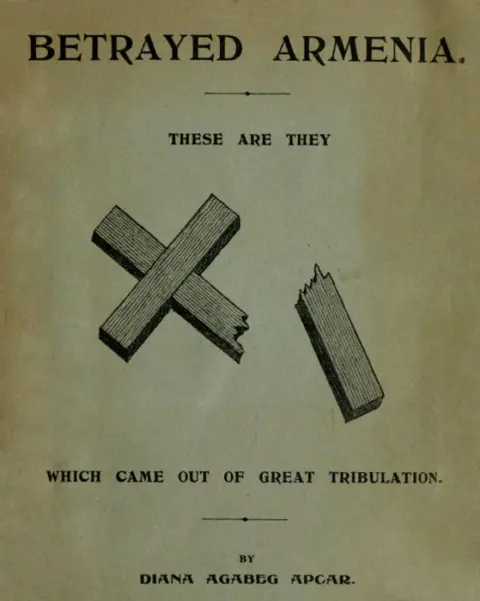
"Betrayed Armenia" by Diana Agabeg Apcar is a historical account written in the early 20th century. The book delves into the massacres of Armenians, particularly during the events leading up to and following the Armenian Massacres of April 1909 in Cilicia, shedding light on the suffering of Armenians under Ottoman rule. It aims to raise awareness about the historical and systemic oppression faced by the Armenian people and their quest for survival and autonomy." "The opening of "Betrayed Armenia" presents a harrowing overview of the Armenian Massacres, asserting that these atrocities were orchestrated by the Young Turks, challenging the earlier belief that Abdul Hamid was solely responsible. Apcar reflects on the characteristics of the Armenian people—intelligent and industrious— and describes their deep love for nationality, positioning it against the historical backdrop of oppression. The narrative is imbued with a sense of urgency, prompting a call to action for intervention from Christian nations to prevent further massacres, as Apcar laments the helplessness of the Armenian population against such brutality and questions the role of European powers in allowing this suffering to perpetuate."
Introduction adapted from the source catalogue; source summaries may be automatically generated.
Free to read · English · 31,344 words · No account needed
MAKE TIME FOR A GOOD BOOK
On by default. Untick to stop anonymous reading totals. Each page counts after 10 seconds in view. How this works.
Anonymous counting is on unless you have switched it off.
The author of “La Crise de L’Orient” continues in this strain. Are we then to suppose that the British Consuls, men whose truthfulness has never been impeached, whose reports on the unsupportable sufferings of the subject christian races and the oppressions and hideous atrocities of the Turks, have filled volumes: and likewise the American Missionaries, men who have deservedly gained the honor and respect of the world, whose statements have corroborated the British Consular reports; have been according to Ahmed Riza Bey the mischief-makers in the Turkish Empire? since it is from them alone the world has gained the widest and most correct knowledge of the daily miseries and oppressions under which the subject Christian races have groaned. Are we also to suppose that men like Mr. James Bryce and Dr. Dillon have by mendacious writings upheld them, British Consul and American Missionary, liars, and mischief makers? Or rather are we not to suppose that if thinking men and women in the world have come to cry out with Chateaubriand “L’espèce humaine ne peut que gagner à la destruction de l’Empire Ottoman” it is because the Turks have earned the world’s condemnation through their own diabolical acts, and on account of the woe and desolation which Turkish rule has worked over the fairest provinces under the sun. If the Turk will turn from the evil of his ways unto good, the stigma of “the unspeakable Turk” which now attaches itself to him, will cease to be a veritable truth. The bringing about of the transformation rests with himself.
Further in answer to Ahmed Riza Bey’s account of the Armenian “prétendus patriotards” in connection with the Ottoman Bank; I cannot do better than quote from Mr. Bryce’s version of the story, and the massacre that followed: “In the following June serious trouble arose at Van, where some sort of insurrection is said to have been planned, though in the discrepancy of the accounts it is hard to arrive at the truth. Masses of Kurds came down threatening to massacre the Christians, and a conflict in which many innocent persons perished, was with difficulty brought to an end by the intervention of the British Consul. A little later the Armenian revolutionary party, emboldened by the rising in Crete, where the Christians, being well armed and outnumbering the Muslims, held their ground successfully, issued appeals to the Embassies and to the Turkish Government to introduce reforms, threatening disturbances if the policy of repression and massacre was persisted in. These threats were repeated in August, and ultimately, on August 26, a band of about twenty Armenians, belonging the revolutionary party, made a sudden attack on the Imperial Ottoman Bank in Constantinople, declaring they were prepared to hold it and blow it up should the Sultan refuse their demand. They captured the building by a coup de main, but were persuaded by the Russian dragoman to withdraw upon a promise of safety. Meanwhile the Government, who through their spies knew of the project, had organised and armed a large mob of Kurds and Lazes--many of whom had recently been brought to the city--together with the lowest Turkish class. Using the occasion, they launched this mob upon the peaceful Armenian population. The onslaught began in various parts of the city so soon after the attack on the Bank that it had obviously been prearranged, and the precaution had been taken to employ the Turkish ruffians in different quarters from those in which they dwelt; so that they might less easily be recognised. Carts had moreover been prepared in which to carry off the dead. For two days an indiscriminate slaughter went on, in which not only Armenian merchants and traders of the cultivated class, not only the industrious and peaceable Armenians of the humbler class, clerks, domestic servants, porters employed on the quays and in the warehouses, but also women and children were butchered in the streets and hunted down all through the suburbs. On the afternoon of the 27th the British Chargé d’Affaires (whose action throughout won general approval) told the Sultan he would land British sailors, and the Ambassadors telegraphed to the Sultan. Then the general massacre was stopped, though sporadic slaughter went on round the city during the next few days. The Ambassadors, who did not hesitate to declare that the massacre had been organised by the Government, estimated the number of killed at from 6000 to 7000; the official report made to the Sultan is said to have put it at 8750.[1] During the whole time the army and the police had perfect control of the city--the police, and a certain number of the military officers and some high civil officials, joining in the slaughter. Of all the frightful scenes which Constantinople, a city of carnage, has seen since the great insurrection of A.D. 527 when 30,000 people perished in the hippodrome there has been none more horrible than this. For this was not the suppression of an insurrection in which contending factions fought. It was not the natural sequel to a capture by storm, as when the city was taken and sacked by the Crusaders in A.D. 1204, and by the Turks in A.D. 1453. It was slaughter in cold blood, when innocent men and women, going about their usual avocations in a time of apparent peace, were suddenly beaten to death with clubs, or hacked to pieces with knives, by ruffians who fell upon them in the streets before they could fly to any place of refuge.”[2]
Your reading position is saved on this browser. Take it to another device with a library code. Reading pages adapt to text, rather than matching a printed edition.
BEHIND THE BOOK
This eBook is for the use of anyone anywhere in the United States and most other parts of the world at no cost and with almost no restrictions whatsoever. You may copy it, give it away or re-use it under the terms of the Project Gutenberg License included with this eBook or online at www.gutenberg.org. If you are not located in the United States, you will have to check the laws of the country where you are located before using this eBook. Read the source licence.
The original source file, including credits and licence, is retained by this library. Request an original-format copy at no charge. Please include the book title and Project Gutenberg identifier #53170.
KEEP YOUR CURIOSITY GOING
Cécile Tormay

Moritz Busch
John L. Ransom
Frances Wright
Cécile Tormay

Mabel Potter Daggett