THE CLASSIC COLLECTION✦The man in the street: Papers on American topicsCLASSIC FREE BOOKS
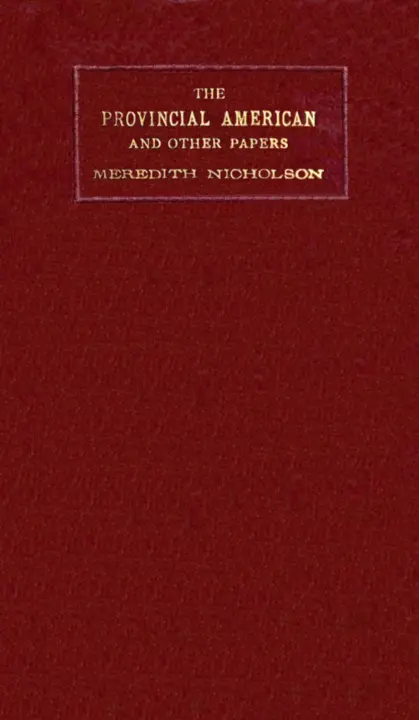
The man in the street: Papers on American topics
Meredith Nicholson
THE CLASSIC COLLECTION · 1919
"Best Laid Schemes" by Meredith Nicholson is a novel written in the early 20th century. The story begins with Susan Parker, a twenty-six-year-old librarian, who feels that nothing significant has occurred in her life, particularly in regard to romantic encounters. Susan, grappling with her identity and the societal expectations placed upon her, yearns for adventure and a break from her monotonous routine. At the start of the narrative, the focus is on Susan's mundane existence as she reflects on her past interactions with various men, none of which led to meaningful relationships. The plot takes a turn when she receives an unexpected dinner invitation from her neighbor, Webster G. Burgess, who is desperate to impress an esteemed guest, Brown Pendleton. This encounter catalyzes a transformation in Susan, allowing her to shed the constraints of her former self and embrace her more vivacious persona as "Susie." The unfolding events suggest a mix of comedy and romance as Susan's dinner with the socially prominent figures leads to unexpected revelations and connections, setting the stage for further developments in her life.
Introduction adapted from the source catalogue; source summaries may be automatically generated.
Free to read · English · 62,088 words · No account needed
MAKE TIME FOR A GOOD BOOK
On by default. Untick to stop anonymous reading totals. Each page counts after 10 seconds in view. How this works.
Anonymous counting is on unless you have switched it off.
The pencil continued to move over the paper; and from time to time Tate turned the pad and scrutinized his work critically. The men immediately about him watched his hand, wide-eyed, fascinated. There was something uncanny and unreal in the situation: it was like watching a wild animal approaching a trap and wholly unmindful of its danger. The square box which formed the base of the device was traced clearly; the arcs which were its familiar embellishment were carefully added. The governor, having exhausted Cleveland, went back to Jackson, and Tate finished a second drawing, absorbed in his work and rarely lifting his eyes.
Seeing that Tate had tired of this pastime, the governor brought his lecture to an end, exclaiming:
“Great Scott, Burgess! Why haven’t you stopped me! I’ve said enough here to ruin me with my party, and you hadn’t the grace to shut me off.”
“I’m glad for one,” said Tate, pushing back the pad, “that I got in in time to hear you; I’ve never known before that any Democrat could be so broad-minded!”
“The governor loosens up a good deal between campaigns,” said Burgess, rising. “And now, let’s go into the library where the chairs are easier.”
The governor rose with the others, but remained by his chair, talking to Tate, until the room cleared, and then resumed his seat.
“This is perfectly comfortable; let’s stay here, Mr. Tate. Burgess, close the door, will you.”
Tate hesitated, looked at his watch, and glanced at Burgess, who sat down as though wishing to humor the governor, and lighted a cigar.
“Mr. Tate,” said the governor unhurriedly, “if I’m not mistaken, you are George Avery’s brother-in-law.”
Tate turned quickly, and his eyes widened in surprise.
“Yes,” he answered in slow, even tones; “Avery married my sister.”
“Mr. Tate, I have in my pocket a pardon all ready to sign, giving Avery his liberty. His case has troubled me a good deal; I don’t want to sign this pardon unless I’m reasonably sure of Avery’s innocence. If you were in my place, Mr. Tate, would you sign it?”
The color went out of the man’s face and his jaw fell; but he recovered
himself quickly.
“Of course, governor, it would be a relief to me, to my sister, all of us, if you could see your way to pardoning George. As you know, I’ve been doing what I could to bring pressure to bear on the Board of Pardons: everything that seemed proper. Of course,” he went on ingratiatingly, “we’ve all felt the disgrace of the thing.”
Your reading position is saved on this browser. Take it to another device with a library code. Reading pages adapt to text, rather than matching a printed edition.
Meredith Nicholson
Meredith Nicholson
Meredith Nicholson
Meredith Nicholson
BEHIND THE BOOK
This eBook is for the use of anyone anywhere in the United States and most other parts of the world at no cost and with almost no restrictions whatsoever. You may copy it, give it away or re-use it under the terms of the Project Gutenberg License included with this eBook or online at www.gutenberg.org. If you are not located in the United States, you will have to check the laws of the country where you are located before using this eBook. Read the source licence.
The original source file, including credits and licence, is retained by this library. Request an original-format copy at no charge. Please include the book title and Project Gutenberg identifier #68334.
KEEP YOUR CURIOSITY GOING
Coulson Kernahan

Maurice Baring
Frances Wright
Cécile Tormay

Frederic Jesup Stimson

W. H. P. (William Henry Pope) Jarvis