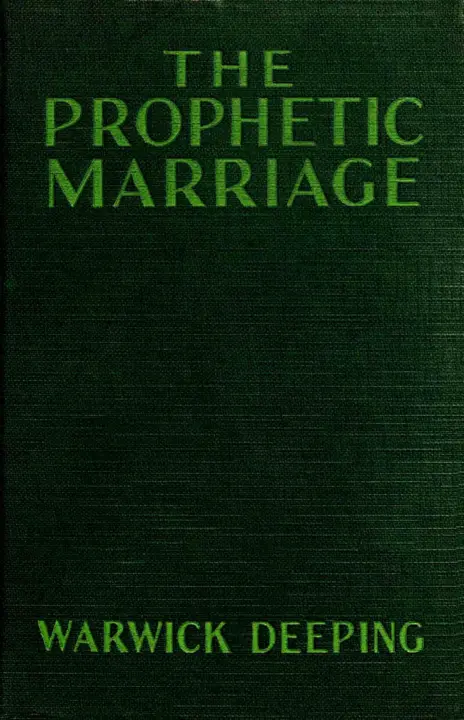
The prophetic marriage
Warwick Deeping
THE CLASSIC COLLECTION · 1908
"Bertrand of Brittany" by Warwick Deeping is a historical novel written in the early 20th century. The story centers on the life of Bertrand du Guesclin, a young man grappling with the unkindness of his mother, Dame Jeanne, as well as with his own identity and self-worth in a society that prizes appearance and gentility. In an era of noble conflicts and personal struggles, the story promises an exploration of themes such as honor, family loyalty, and the journey towards self-acceptance. The opening of the novel establishes a vivid portrayal of the du Guesclin family dynamic, particularly the friction between Bertrand and his mother, who is embarrassed by her firstborn's looks and rough demeanor. As Bertrand grows up amidst harsh treatment and neglect, he perseveres through bitterness and a sense of injustice, seeking a place in his family's world. The interactions between family members set the stage for Bertrand’s challenges, with his mother favoring his more attractive brother, Olivier, while he yearns for recognition and love. The tone is both melancholic and reflective as Bertrand’s plight is revealed, hinting at the inner strength that will ultimately drive his narrative forward.
Introduction adapted from the source catalogue; source summaries may be automatically generated.
Free to read · English · 101,297 words · No account needed
MAKE TIME FOR A GOOD BOOK
On by default. Untick to stop anonymous reading totals. Each page counts after 10 seconds in view. How this works.
Anonymous counting is on unless you have switched it off.
“Would my lord eat and drink?”
Bertrand accepted the suggestion. He felt it embarrassing, this setting-up of him like an idol to be stared at unwinkingly by so many pairs of eyes. If the god ate, they would at least see that he was half-human like themselves.
“My good-fellow, honest men are always thirsty.”
And had it been possible they would have emptied a hogshead of Bordeaux down Bertrand’s throat by way of testifying their devotion.
Even the cook, gardeners, and dairy-women crowded “the screens” to catch a glimpse of Bertrand as he sat at the high table. They watched him eat and drink as though he were an ogre, whispering together, peeping over one another’s shoulders. Bertrand, who had none of the spirit of the mock hero, chafed under this flattering publicity, being in no humor to be gaped at like a black bear in a cage.
“My good-fellow, do people ever eat here?”
Girard flourished a napkin and looked puzzled.
“Ah, messire—”
“These friends of yours seem to grudge me my hunger by the way they push
and stare.”
Girard took the hint and closed the doors on the array of inquisitive faces. He returned and made his bow.
“Messire du Guesclin must pardon the people. Messire du Guesclin is a great soldier and a hero.”
“Nonsense, sir,” and Bertrand laughed half foolishly at Girard’s
magniloquent respect.
“Messire, you have a modest heart.”
“Modest heart!—to the devil with you!”
“And a courage that will not be flattered.”
Bertrand picked up his wine-cup and held it towards Girard.
“Enough, friend,” he said; “I am clumsy at catching compliments. Drink to all good Bretons. That will please me better.”
And Girard drank, his eyes looking at Bertrand over the rim of the cup.
It was then that the door leading to the stairway behind the dais opened, showing Tiphaïne in a green gown, a red girdle about her waist.
“Bertrand.”
He saw at once that she had been weeping, though her eyes shone like a
clear sky after rain.
“Come.”
Bertrand followed her without a word. She climbed the stairs and halted on the threshold of the solar, her hand on the latch of the closed door.
“My father has asked for you.”
The man before her appeared far more distrustful of himself than if he had been called to lead the forlornest of forlorn hopes.
“You will find him changed.”
“Am I to go alone?”
“If you wish it.”
Bertrand’s face betrayed his unwillingness.
“I would rather—”
“I came with you?”
And she took his hand.
Your reading position is saved on this browser. Take it to another device with a library code. Reading pages adapt to text, rather than matching a printed edition.
Warwick Deeping
Warwick Deeping
Warwick Deeping
Warwick Deeping
BEHIND THE BOOK
This eBook is for the use of anyone anywhere in the United States and most other parts of the world at no cost and with almost no restrictions whatsoever. You may copy it, give it away or re-use it under the terms of the Project Gutenberg License included with this eBook or online at www.gutenberg.org. If you are not located in the United States, you will have to check the laws of the country where you are located before using this eBook. Read the source licence.
The original source file, including credits and licence, is retained by this library. Request an original-format copy at no charge. Please include the book title and Project Gutenberg identifier #56707.
KEEP YOUR CURIOSITY GOING
Cécile Tormay

Moritz Busch
Coulson Kernahan
John L. Ransom

Maurice Baring
Frances Wright