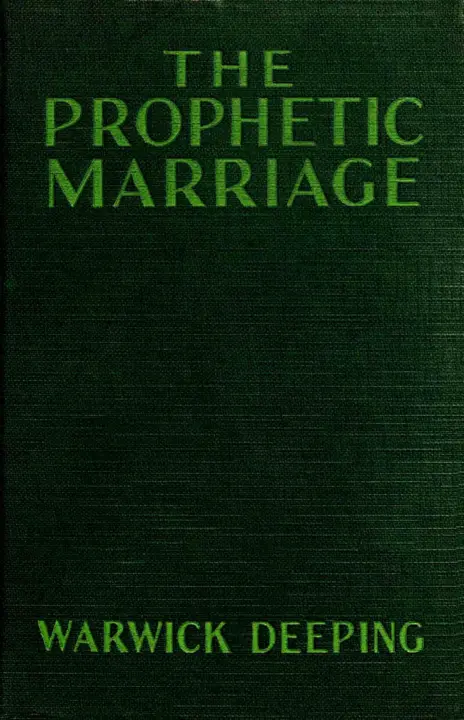
The prophetic marriage
Warwick Deeping
THE CLASSIC COLLECTION · 1908
"Bertrand of Brittany" by Warwick Deeping is a historical novel written in the early 20th century. The story centers on the life of Bertrand du Guesclin, a young man grappling with the unkindness of his mother, Dame Jeanne, as well as with his own identity and self-worth in a society that prizes appearance and gentility. In an era of noble conflicts and personal struggles, the story promises an exploration of themes such as honor, family loyalty, and the journey towards self-acceptance. The opening of the novel establishes a vivid portrayal of the du Guesclin family dynamic, particularly the friction between Bertrand and his mother, who is embarrassed by her firstborn's looks and rough demeanor. As Bertrand grows up amidst harsh treatment and neglect, he perseveres through bitterness and a sense of injustice, seeking a place in his family's world. The interactions between family members set the stage for Bertrand’s challenges, with his mother favoring his more attractive brother, Olivier, while he yearns for recognition and love. The tone is both melancholic and reflective as Bertrand’s plight is revealed, hinting at the inner strength that will ultimately drive his narrative forward.
Introduction adapted from the source catalogue; source summaries may be automatically generated.
Free to read · English · 101,297 words · No account needed
MAKE TIME FOR A GOOD BOOK
On by default. Untick to stop anonymous reading totals. Each page counts after 10 seconds in view. How this works.
Anonymous counting is on unless you have switched it off.
“I accuse no one, messire.”
“Nine-and-twenty of us fought at Mivoie, and Guillaume de Montauban took
the vacant place.”
“You are well-informed, sir; you say I was not there. Why ask me all
these questions?”
“Because,” and De Bodegat hugged his knee, “you cannot answer me, messire, and you show these gentlemen how to escape a lie.”
Bertrand angrily tightened one wrist against the other, so that the straining thongs twisted and bruised the sinews.
“Then, Messire Bertrand du Guesclin, we can color our own conclusions?”
“Well?”
“That you took bribes from Bamborough and the English not to fight at
Mivoie.”
Bertrand looked at the apple-boughs, and answered:
“That is a lie.”
The merest child could have seen that he was suffering, yet for De Bodegat there was an ungenerous gratification of the ego in prolonging the humiliation of a man who once worsted him in a duel.
“And yet, sir, you were with Croquart at Pontivy?”
“I have already answered that.”
“And you had battered the bearings from your shield.”
“Well, you have seen it.”
“So we may say that you loved the Fleming because of the blood-money that had been offered for his head.”
A few short, sharp laughs, like the yapping of dogs, betrayed the temper of those to whom Carro de Bodegat appealed. Bertrand looked round him with a defiant lifting of the head. His eyes gleamed out at these countrymen of his who seemed so ready to condemn and to disgrace.
“Messires, I tell no lies, neither do I ask for mercy. If I am a traitor—and God himself cannot prove that true—give me my quittance and make an end.”
Carro de Bodegat turned to Dubois, and made some pretence of deferring to his brother’s judgment, feeling perfectly assured that justice would meet with no obstruction in that quarter. It was sufficient for Messire Geoffroi Dubois that his authority had been consulted. A straightforward and rather savage soldier, he had no manner of doubt as to Bertrand’s guilt, and elected to have him hanged on the nearest tree.
Carro de Bodegat called one of his esquires forward.
“Gretry, where is this gentleman’s sword?”
A man-at-arms had taken charge of it, and delivered the sword to Gretry, who brought it to his master. Carro de Bodegat unsheathed the weapon, and held it before him, balanced by the blade across his palm.
“Here, gentlemen, you see the sword of a traitor—a sword that was to be bought and sold, and used for the winning of blood-money in these wars. Such swords must be broken with those who handle them. Come, Messire Bertrand du Guesclin, have you anything to say?”
“Nothing, messire.”
Your reading position is saved on this browser. Take it to another device with a library code. Reading pages adapt to text, rather than matching a printed edition.
Warwick Deeping
Warwick Deeping
Warwick Deeping
Warwick Deeping
BEHIND THE BOOK
This eBook is for the use of anyone anywhere in the United States and most other parts of the world at no cost and with almost no restrictions whatsoever. You may copy it, give it away or re-use it under the terms of the Project Gutenberg License included with this eBook or online at www.gutenberg.org. If you are not located in the United States, you will have to check the laws of the country where you are located before using this eBook. Read the source licence.
The original source file, including credits and licence, is retained by this library. Request an original-format copy at no charge. Please include the book title and Project Gutenberg identifier #56707.
KEEP YOUR CURIOSITY GOING
Cécile Tormay

Moritz Busch
Coulson Kernahan
John L. Ransom

Maurice Baring
Frances Wright