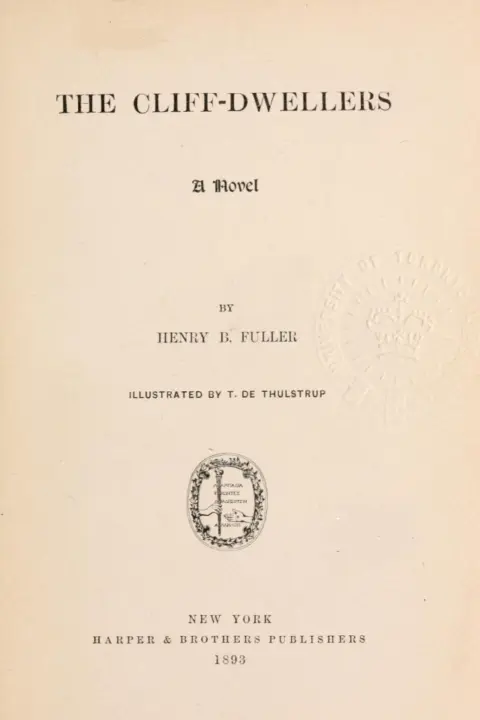
The Cliff-Dwellers: A Novel
Henry Blake Fuller
THE CLASSIC COLLECTION · 1919
"Bertram Cope's Year" by Henry Blake Fuller is a novel published in 1919, sometimes called the first American homosexual novel. Set at a Midwestern university, it follows an attractive young English instructor navigating the attentions of wealthy patrons—both male and female—while completing his thesis. Fuller's understated, ironic approach depicts what one critic called "normative homosexuality" with delicate restraint, allowing his characters to move through their world with surprising ease. The novel's subtle treatment of taboo themes initially baffled reviewers and readers, leaving its deeper meanings hidden to those without the key.
Introduction adapted from the source catalogue; source summaries may be automatically generated.
Free to read · English · 71,715 words · No account needed
MAKE TIME FOR A GOOD BOOK
On by default. Untick to stop anonymous reading totals. Each page counts after 10 seconds in view. How this works.
Anonymous counting is on unless you have switched it off.
Cope sat down again and began to run his eye uncomfortably about the room, as if dredging the air for an idea. Behind one corner of a mirror was a large bunch of drying leaves. They had been brought in from the sand dunes as a decorative souvenir of the autumn, and had kept their place through mere inertia: an oak bough, once crimson and russet; a convoluted length of bittersweet, to which a few split berries still clung; and a branch of sassafras, with its intriguing variety of leaves--a branch selected, in fact, because it gave, within narrow compass, the plant's entire scope and repertoire as to foliage.
Cope caught at the sassafras as a falling balloonist catches at his
parachute.
"Well," he said, still reluctant and fumbling, "perhaps I can devise a legend: the Legend, let us say, of the Sassafras Bush."
"Good!" cried Medora heartily.
Pearson, whispering to Amy Leffingwell, gave little heed to Cope and his strained endeavor to please Mrs. Phillips. Foster, quite passive, listened with curiosity for what might come.
"Or perhaps you would prefer folk-lore," Cope went on. "Why the Sassafras has Three Kinds of Leaves, or something like that."
"Better yet!" exclaimed Medora. "Listen, everybody. Why the Sassafras has Three Kinds of Leaves."
Pearson stopped his buzzings, and Cope began. "The Wood-nymphs," he said slowly, "were a nice enough lot of girls, but they labored under one great disadvantage: they had no thumbs."
Hortense pricked up her ears. Did he mean to be personal? If so, he should find that one of the nymphs had a whole hand as surely as he himself had a cheek.
Cope paused. "Of course you've got to postulate something," he
submitted apologetically.
"Of course," Medora agreed.
"So when they bought their gloves, or mittens, or whatever their handgear might be called, they usually patronized the hickory or the beech or some other tree with leaves that were----"
"Ovate!" cried Medora delightedly.
"Ovate, yes; or whatever just the right word may be. But a good many of them traded at the Sign of the Sassafras, where they found leaves that were similar, but rather more delicate."
"I believe he's going to do it," thought Foster.
"Yet the nymphs knew that they lacked thumbs and kept on wanting them. So, during the long, dull winter, they put their minds to it, and finally thumbs came."
"Will-power!" said Medora.
"And early in April they went to the Sassafras and said: 'We have thumbs! We have thumbs! So we need a different sort of mitten.'
"The Sassafras was only half awake. 'Thumbs?' he repeated. 'How many?'
"'Two!' cried the nymphs. 'Two!'
Your reading position is saved on this browser. Take it to another device with a library code. Reading pages adapt to text, rather than matching a printed edition.
Henry Blake Fuller
Henry Blake Fuller
Henry Blake Fuller
Henry Blake Fuller
BEHIND THE BOOK
This eBook is for the use of anyone anywhere in the United States and most other parts of the world at no cost and with almost no restrictions whatsoever. You may copy it, give it away or re-use it under the terms of the Project Gutenberg License included with this eBook or online at www.gutenberg.org. If you are not located in the United States, you will have to check the laws of the country where you are located before using this eBook. Read the source licence.
The original source file, including credits and licence, is retained by this library. Request an original-format copy at no charge. Please include the book title and Project Gutenberg identifier #8101.
KEEP YOUR CURIOSITY GOING
Coulson Kernahan

Maurice Baring
Frances Wright
Cécile Tormay

Frederic Jesup Stimson

W. H. P. (William Henry Pope) Jarvis