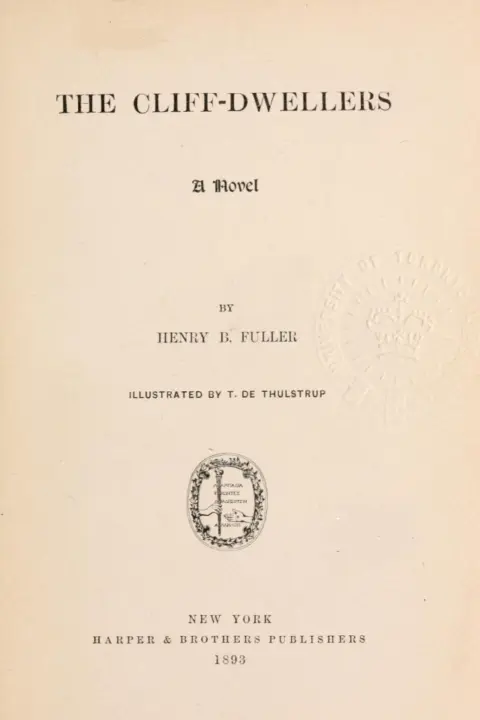
The Cliff-Dwellers: A Novel
Henry Blake Fuller
THE CLASSIC COLLECTION · 1919
"Bertram Cope's Year" by Henry Blake Fuller is a novel published in 1919, sometimes called the first American homosexual novel. Set at a Midwestern university, it follows an attractive young English instructor navigating the attentions of wealthy patrons—both male and female—while completing his thesis. Fuller's understated, ironic approach depicts what one critic called "normative homosexuality" with delicate restraint, allowing his characters to move through their world with surprising ease. The novel's subtle treatment of taboo themes initially baffled reviewers and readers, leaving its deeper meanings hidden to those without the key.
Introduction adapted from the source catalogue; source summaries may be automatically generated.
Free to read · English · 71,715 words · No account needed
MAKE TIME FOR A GOOD BOOK
On by default. Untick to stop anonymous reading totals. Each page counts after 10 seconds in view. How this works.
Anonymous counting is on unless you have switched it off.
"What! must it all be done in a drive?" she asked.
"By no means. Watch me relax. Is that my chair? See me drop into complete physical and mental passivity--the kef of the Arabs."
He mounted the model-throne, sank into the wide chair, and placed his hands luxuriously on its arms. His general pose mattered little: she had not gone beyond his head and shoulders.
Hortense stared. Would he push her on the moment into the right mood? Would he have her call into instant readiness her colors and brushes? Why, even a modest amateur must be allowed her minutes of preparation and approach.
"Passivity?" she repeated, beginning to get under way. "Shall I find you very entertaining in that condition?"
"Entertaining? Me, the sitter? Why, I've always heard it was an important part of a portrait-painter's work to keep the subject interested and amused."
He smiled in his cold, distant way. The north light cut across the forehead, nose and chin which made his priceless profile. The canvas itself, done on theory in a lesser light, looked dull and lifeless.
Hortense felt this herself. She did not see how she was going to key it up in a single hour. As she considered among her brushes and tubes, she began to feel nervous, and her temper stirred.
"You have a great capacity for being interested and amused," she said. "Most men are like you. Especially young ones. They are amused, diverted, entertained--and there it ends."
Cope felt the prick. "Well, we are bidden," he said; "and we come. Too many of us have little to offer in return, except appreciation and goodwill. How better appreciate such kindness as Mrs. Phillips' than by gratefully accepting more of it?" (Stilted copy-book talk; and he knew it.)
"You haven't been accepting much of it lately," she returned, feeling the point of a new brush. She spoke with the consciousness of empty evenings that might have been full.
"Hardly," he replied. And he felt that this one word sufficed.
"Well, the coast will be clear after the twentieth of April."
"That is the date, then, is it?" The more he thought of the impending ceremony, the more grateful he was for his escape. Thankfulness had salved the earlier wound; no pain now came from his touching it.
"Yes; on that day the house will see the last of them."
"The wedding, then, will----?"
"Yes. Aunt Medora says, 'Why go to Iowa?--you're at home here.' Why, indeed, drag George away out to Fort Lodge? Let her own people, who are not many, come to us. Aunt will do everything, and do it handsomely."
Your reading position is saved on this browser. Take it to another device with a library code. Reading pages adapt to text, rather than matching a printed edition.
Henry Blake Fuller
Henry Blake Fuller
Henry Blake Fuller
Henry Blake Fuller
BEHIND THE BOOK
This eBook is for the use of anyone anywhere in the United States and most other parts of the world at no cost and with almost no restrictions whatsoever. You may copy it, give it away or re-use it under the terms of the Project Gutenberg License included with this eBook or online at www.gutenberg.org. If you are not located in the United States, you will have to check the laws of the country where you are located before using this eBook. Read the source licence.
The original source file, including credits and licence, is retained by this library. Request an original-format copy at no charge. Please include the book title and Project Gutenberg identifier #8101.
KEEP YOUR CURIOSITY GOING
Coulson Kernahan

Maurice Baring
Frances Wright
Cécile Tormay

Frederic Jesup Stimson

W. H. P. (William Henry Pope) Jarvis