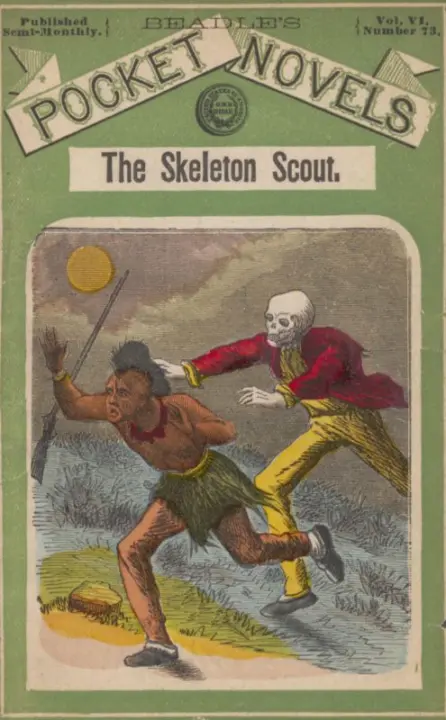
The skeleton scout; or, The border block
Albert W. Aiken
THE CLASSIC COLLECTION · 1875
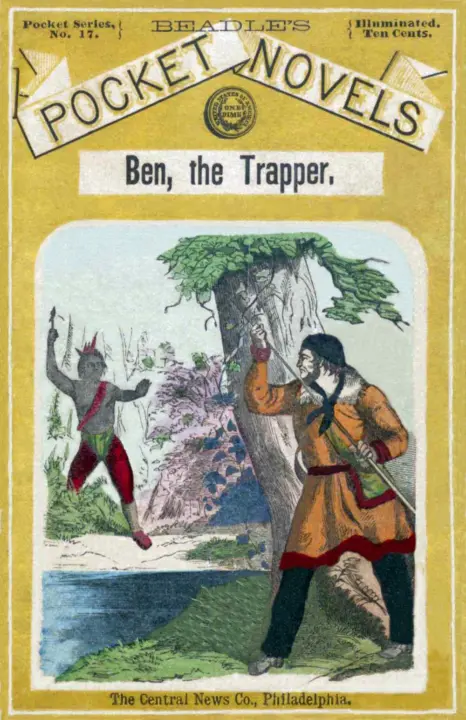
"Ben, the Trapper; Or, The Mountain Demon: A Tale of the Black Hills" by Major Lewis W. Carson is a novel written in the late 19th century. The story focuses on the rugged life of trappers in the Black Hills during a time of conflict between territorial powers and Native American tribes. The main character, Ben Miffin, is a skilled trapper and hunter who, along with his companions—Jules, a Frenchman, and Jan, a Dutchman—navigates the dangers of the wild and confronts hostile forces, including a mysterious beast referred to as the "Mountain Devil." The opening of the tale introduces us to Ben Miffin and his companions as they establish a camp in the Black Hills. Their banter reveals their distinct personalities, setting the stage for their adventures. As they settle in, they discuss the harsh realities of their lives as trappers and face the immediate danger of a grizzly bear, showcasing Ben’s bravery and experience. The narrative hints at underlying tensions in the region, as well as future confrontations with both wildlife and Native American tribes. The dynamic between the characters and their humorous interactions provide a lively and engaging entry into the novel’s broader themes of survival, camaraderie, and the brutal realities of life on the frontier.
Introduction adapted from the source catalogue; source summaries may be automatically generated.
Free to read · English · 35,637 words · No account needed
MAKE TIME FOR A GOOD BOOK
On by default. Untick to stop anonymous reading totals. Each page counts after 10 seconds in view. How this works.
Anonymous counting is on unless you have switched it off.
They hurried on to the assistance of the trapper, and found him standing in the mouth of the pass, rifle in hand, disputing the further advance of the party of Indians, who had by this time crossed the stream, and were parleying with him.
“My brother will let his red friends come. They wish to smoke a pipe with him,” said the leading Indian.
“I am not in a smoking mood to-day,” said Ben. “You clear out. I’ve made a camp hyar, an’ hyar I mean to stay.”
“My brother is welcome to the home of the Blackfeet. But, why has he come among us, and stolen our prisoners?”
“None of your puisiness,” roared Jan, taking a position by the side of Ben so suddenly, that even the iron-nerved trapper started. “Vat you vant here?”
“Ah-ha! Ar’ you thar, old Bologna?” laughed the trapper. “I’m teachin’ ye how to do it, then. Ha, Jule, you here too? Whar is the little ’un? Whar is she?”
“Here,” said Millicent, in her clear, sweet voice, stepping to the front. “I could not keep away, while you were all in danger. And I brought Bentley his rifle. He needs a weapon.”
Something in her manner as she gave the weapon into the owner’s hand, told Jules that this indeed was her lover. He turned pallid as a corpse, and ground his teeth fiercely, but said not a word. That was useless now. He hoped that his day of triumph was not far off.
“Now, sons of the Blackfeet,” said Ben, raising his voice, “ye kin see what kind of a chaince ye’ve got ag’in’ us, with them bows, arrers and spears. I reckon ye mout ez well give it up.”
The Indians drew together and held a conference. This over, they turned their horses’ heads and galloped away to the east. One by one the horses splashed through the river, and they were gone across the broad prairie, toward their camp.
“Penn,” said Jan Schneider, extending his hand, “I’m glad you shumps dat rifer. I pees afrait you gone dere.”
“So was I, Jan, when I see how wide it was. Let’s go an’ measure it. I’m proud of that jump.”
They went back to the stream and measured the distance, and found it to be just twenty-three feet. And the river was nearly as deep.
“Swanzey-dree feet!” roared Jan. “Dere! Some of you peat dat!”
“I can’t,” said Bentley. “What did that Indian say when you jumped? I heard him roar something after you.”
Your reading position is saved on this browser. Take it to another device with a library code. Reading pages adapt to text, rather than matching a printed edition.
Albert W. Aiken
Albert W. Aiken
Albert W. Aiken
Albert W. Aiken
BEHIND THE BOOK
This eBook is for the use of anyone anywhere in the United States and most other parts of the world at no cost and with almost no restrictions whatsoever. You may copy it, give it away or re-use it under the terms of the Project Gutenberg License included with this eBook or online at www.gutenberg.org. If you are not located in the United States, you will have to check the laws of the country where you are located before using this eBook. Read the source licence.
The original source file, including credits and licence, is retained by this library. Request an original-format copy at no charge. Please include the book title and Project Gutenberg identifier #65087.
KEEP YOUR CURIOSITY GOING
Coulson Kernahan

Maurice Baring
Frances Wright
Cécile Tormay

Frederic Jesup Stimson

W. H. P. (William Henry Pope) Jarvis