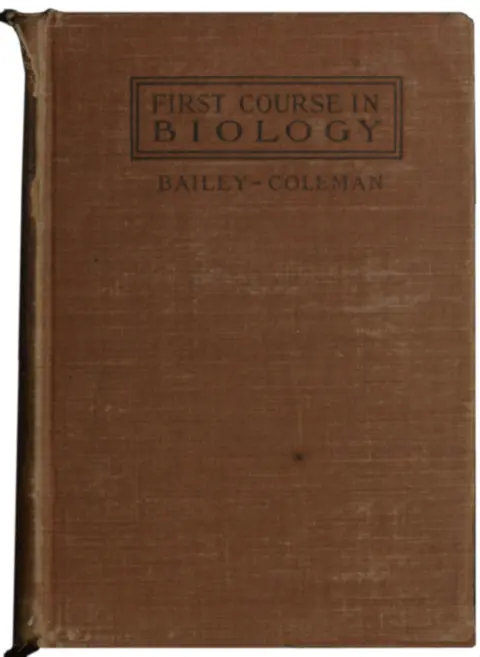
First course in biology
L. H. (Liberty Hyde) Bailey & Walter Moore Coleman

THE CLASSIC COLLECTION · 1921
"Beginners' Botany" by L.H. Bailey is a scientific publication written in the early 20th century. The book serves as an introductory guide to the study of botany, focusing on the fundamental observations and principles that govern plant life. It emphasizes hands-on learning and direct observation of plants in their natural environment as essential for beginners to grasp key concepts. The opening of "Beginners' Botany" sets the stage for a practical approach to learning about plants. L.H. Bailey argues that understanding the living plants should take precedence over mere definitions and technical jargon. He outlines the need for the beginner to observe and compare various plants to appreciate the concept of variation—highlighting that no two plants are alike in every detail. The text encourages personal engagement with nature, urging readers to observe plants not just as subjects of study but as vibrant parts of their ecosystem. By focusing on the broad adaptations and struggles of plants for survival, Bailey lays a strong foundation for readers to appreciate the complexities of botany.
Introduction adapted from the source catalogue; source summaries may be automatically generated.
Free to read · English · 56,263 words · No account needed
MAKE TIME FOR A GOOD BOOK
On by default. Untick to stop anonymous reading totals. Each page counts after 10 seconds in view. How this works.
Anonymous counting is on unless you have switched it off.
SUGGESTIONS.—Few subjects connected with the study of plant-life are so useful in schoolroom demonstrations as germination. The pupil should prepare the soil, plant the seeds, water them, and care for the plants. =10.= Plant seeds in pots or shallow boxes. The box should not be very wide or long, and not over four inches deep. Holes may be bored in the bottom so it will not hold water. Plant a number of squash, bean, corn, pine, or other seeds about an inch deep in damp sand or pine sawdust in this box. The depth of planting should be two to four times the diameter of the seeds. Keep the sand or sawdust moist but not wet. If the class is large, use several boxes, that the supply of specimens may be ample. Cigar boxes and chalk boxes are excellent for individual pupils. It is well to begin the planting of seeds at least ten days in advance of the lesson, and to make four or five different plantings at intervals. A day or two before the study is taken up, put seeds to soak in moss or cloth. The pupil then has a series from swollen seeds to complete germination, and all the steps can be made out. Dry seeds should be had for comparison. If there is no special room for laboratory, nor duplicate apparatus for every pupil, each experiment may be assigned to a committee of two pupils to watch in the schoolroom. =11.= Good seeds for study are those detailed in the lesson, and buckwheat, pumpkin, cotton, morning glory, radish, four o’clock, oats, wheat. It is best to use familiar seeds of farm and garden. Make drawings and notes of all the events in the germination. Note the effects of unusual conditions, as planting too deep and too shallow and different sides up. For hypogeal germination, use the garden pea, scarlet runner, or Dutch case-knife bean, acorn, horse-chestnut. Squash seeds are excellent for germination studies, because the cotyledons become green and leafy and germination is rapid. Onion is excellent, except that it germinates too slowly. In order to study the root development of germinating plantlets, it is well to provide a deeper box with a glass side against which the seeds are planted. =12.= Observe the germination of any common seed about the house premises. When elms, oaks, pines, or maples are abundant, the germination of their seeds may be studied in lawns and along fences. =13.= When studying germination the pupil should note the differences in shape and size between cotyledons and plumule leaves, and between plumule leaves and the normal leaves (Fig. 30). Make drawings. =14=. Make the tests described in the introductory experiments with bean, corn, the castor bean, and other seed for starch and proteids. Test flour, oatmeal, rice, sunflower, four o’clock, various nuts, and any other seeds obtainable. Record your results by arranging the seeds in three classes, 1. Much starch (colour blackish or purple), 2. Little starch (pale blue or greenish), 3. No starch (brown or yellow). =15.= Rate of growth of seedlings as affected by differences in temperature. Pack soft wet paper to the depth of an inch in the bottom of four glass bottles or tumblers. Put ten soaked peas or beans into each. Cover each securely and set them in places having different temperatures that vary little. (A furnace room, a room with a stove, a room without stove but reached by sunshine, an unheated room not reached by the sun). Take the temperatures occasionally with the thermometer to find difference in temperature. The tumblers in warm places should be covered very tightly to prevent the germination from being retarded by drying out. Record the number of seeds which sprout in each tumbler within 1 day, 2 days, 3 days, 4 days, etc. =16.= Is air necessary for the germination and growth of seedlings? Place damp blotting paper in the bottom of a bottle and fill it three-fourths full of soaked seeds, and close it tightly with a rubber stopper or oiled cork. Prepare a “check experiment” by having another bottle with all conditions the same except that it is covered loosely that air may have access to it, and set the bottles side by side (why keep the bottles together?). Record results as in the preceding experiment. =17.= What is the nature of the gas given off by germinating seeds? Fill a tin box or large-necked bottle with dry beans or peas, then add water; note how much they swell. Secure two fruit jars. Fill one of them a third full of beans and keep them moist. Allow the other to remain empty. In a day or two insert a lighted splinter or taper into each. In the empty jar the taper burns: it contains oxygen. In the seed jar the taper goes out: the air has been replaced by carbon dioxide. The air in the bottle may be tested for carbon dioxide by removing some of it with a rubber bulb attached to a glass tube (or a fountain-pen filler) and bubbling it through lime water. =18.= Temperature. Usually there is a perceptible rise in temperature in a mass of germinating seeds. This rise may be tested with a thermometer. =19.= Interior of seeds. Soak seeds for twenty-four hours and remove the coat. Distinguish the embryo from the endosperm. Test with iodine. =20.= Of what utility is the food in seeds? Soak some grains of corn overnight and remove the endosperm, being careful not to injure the fleshy cotyledon. Plant the incomplete and also some complete grains in moist sawdust and measure their growth at intervals. (Boiling the sawdust will destroy moulds and bacteria which might interfere with the experiment.) Peas or beans may be sprouted on damp blotting paper; the cotyledons of one may be removed, and this with a normal seed equally advanced in germination may be placed on a perforated cork floating in water in a jar so that the roots extend into the water. Their growth may be observed for several weeks. =21.= Effect of darkness on seeds and seedlings. A box may be placed mouth downward over a smaller box in which seedlings are growing. The empty box should rest on half-inch blocks to allow air to reach the seedlings. Note any effects on the seedlings of this cutting off of the light. Another box of seedlings not so covered may be used as a check. Lay a plank on green grass and after a week note the change that takes place beneath it. =22.= Seedling of pine. Plant pine seeds. Notice how they emerge. Do the cotyledons stay in the ground? How many cotyledons have they? When do the cotyledons get free from the seed-coat? What is the last part of the cotyledon to become free? Where is the growing point or plumule? How many leaves appear at once? Does the new pine cone grow on old wood or on wood formed the same spring with the cone? Can you always find partly grown cones on pine trees in winter? Are pine cones when mature on two-year-old wood? How long do cones stay on a tree after the seeds have fallen out? What is the advantage of the seeds falling before the cones? =23.= Home experiments. If desired, nearly all of the fore-going experiments may be tried at home. The pupil can thus make the drawings for the notebook at home. A daily record of measurements of the change in size of the various parts of the seedling should also be made. =24.= Seed-testing.—It is important that one know before planting whether seeds are good, or able to grow. A simple seed-tester may be made of two plates, one inverted over the other (Fig. 31). The lower plate is nearly filled with clean sand, which is covered with cheese cloth or blotting paper on which the seeds are placed. Canton flannel is sometimes used in place of sand and blotting paper. The seeds are then covered with another blotter or piece of cloth, and water is applied until the sand and papers are saturated. Cover with the second plate. Set the plates where they will have about the temperature that the given seeds would require out of doors, or perhaps a slightly higher temperature. Place 100 or more grains of clover, corn, wheat, oats, rye, rice, buckwheat, or other seeds in the tester, and keep record of the number that sprout. The result will give a percentage measure of the ability of the seeds to grow. Note whether all the seeds sprout with equal vigour and rapidity. Most seeds will sprout in a week or less. Usually such a tester must have fresh sand and paper after each test, for mould fungi are likely to breed in it. If canton flannel is used, it may be boiled. If possible, the seeds should not touch one another.
Your reading position is saved on this browser. Take it to another device with a library code. Reading pages adapt to text, rather than matching a printed edition.
L. H. (Liberty Hyde) Bailey & Walter Moore Coleman
L. H. (Liberty Hyde) Bailey

L. H. (Liberty Hyde) Bailey
L. H. (Liberty Hyde) Bailey
BEHIND THE BOOK
This eBook is for the use of anyone anywhere in the United States and most other parts of the world at no cost and with almost no restrictions whatsoever. You may copy it, give it away or re-use it under the terms of the Project Gutenberg License included with this eBook or online at www.gutenberg.org. If you are not located in the United States, you will have to check the laws of the country where you are located before using this eBook. Read the source licence.
The original source file, including credits and licence, is retained by this library. Request an original-format copy at no charge. Please include the book title and Project Gutenberg identifier #73531.
KEEP YOUR CURIOSITY GOING

John Muir

Asa Gray
Asa Gray

Florence Nightingale
Elizabeth Robins Pennell
Denison Olmsted