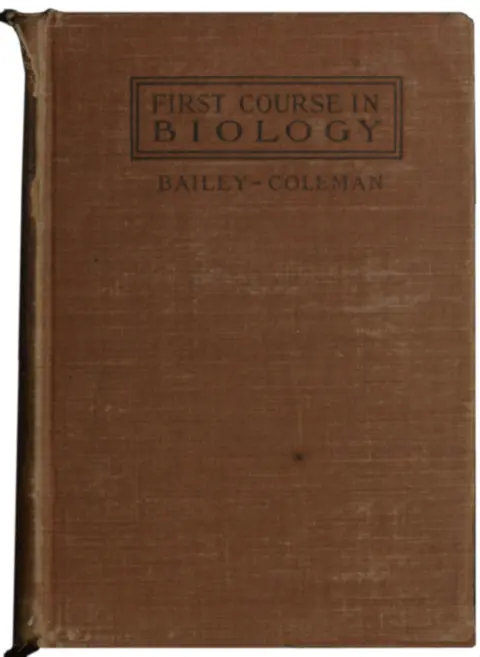
First course in biology
L. H. (Liberty Hyde) Bailey & Walter Moore Coleman

THE CLASSIC COLLECTION · 1921
"Beginners' Botany" by L.H. Bailey is a scientific publication written in the early 20th century. The book serves as an introductory guide to the study of botany, focusing on the fundamental observations and principles that govern plant life. It emphasizes hands-on learning and direct observation of plants in their natural environment as essential for beginners to grasp key concepts. The opening of "Beginners' Botany" sets the stage for a practical approach to learning about plants. L.H. Bailey argues that understanding the living plants should take precedence over mere definitions and technical jargon. He outlines the need for the beginner to observe and compare various plants to appreciate the concept of variation—highlighting that no two plants are alike in every detail. The text encourages personal engagement with nature, urging readers to observe plants not just as subjects of study but as vibrant parts of their ecosystem. By focusing on the broad adaptations and struggles of plants for survival, Bailey lays a strong foundation for readers to appreciate the complexities of botany.
Introduction adapted from the source catalogue; source summaries may be automatically generated.
Free to read · English · 56,263 words · No account needed
MAKE TIME FOR A GOOD BOOK
On by default. Untick to stop anonymous reading totals. Each page counts after 10 seconds in view. How this works.
Anonymous counting is on unless you have switched it off.
pome. An apple-like or pear-like or quince-like fruit, with a five-carpeled or en-carpeled “core.”
proterandrous. Said of a flower when the anthers mature in advance of the pistils in the same flower.
proterogynous. Said of a flower when its pistils mature before
its anthers.
prothallus (“first thallus”). The minute leaf-like body or organ produced by the germination of a spore, in ferns and allied plants. It bears the sex organs.
protoplasm. The living matter in plants. It is the living part of the cells, usually in a semi-fluid, translucent state.
pseud-annual. A plant that is apparently annual, but which is
carried over winter by a bulb, tuber, or similar body; as potato,
onion.
pyxis. A dry fruit or capsule in which the top comes off, like a
cover to a jar.
raceme. A simple (unbranched) cluster in which the flowers are on short pedicels and open from the base upwards.
raphe. A ridge or elevation on some seeds caused by the seed-stalk and seed-coats growing together.
ray. The elongated corolla-limb of some members of the Compositæ
family.
receptive. Said of a stigma when it is “ripe” or ready to receive
the pollen.
regular flowers are those in which all the members of each series (as all the sepals, or all the petals, or all the stamens) are like each other in shape, size, and colour.
reinforced. See accessory fruits.
respiration. Breathing; manifest by oxygen taken in and carbon
dioxide given off.
rhizome. A rootstock; an underground root-like stem. It has
joints, usually scales representing leaves, and is often thick and
fleshy.
samara. A key fruit, being an indehiscent (not opening) fruit
provided with a wing or wings.
saprophyte. A plant that lives on dead or decaying material. See
parasite.
scape. A flower-stem rising directly from the crown of the plant at the surface of the ground or near it. A scape may have bracts.
self-fertilization or close-fertilization is fertilization by means of pollen produced in the same flower.
sepal. One of the parts or leaves of the calyx.
septicidal. A form of dehiscence or opening along the natural
partitions of the capsule.
sessile. Sitting; without a stem, as a leaf without petiole, or a flower without pedicel or peduncle.
shrub. A low woody plant that does not have a distinct trunk. When a plant normally has a trunk, it is a tree.
silicle. A short, more or less circular, capsule of the mustard
family.
silique. A long capsule of the mustard family.
society. An aggregation or company of plants, comprising a more
or less distinct group.
sorus (plural sori). See fruit-dot.
Your reading position is saved on this browser. Take it to another device with a library code. Reading pages adapt to text, rather than matching a printed edition.
L. H. (Liberty Hyde) Bailey & Walter Moore Coleman
L. H. (Liberty Hyde) Bailey

L. H. (Liberty Hyde) Bailey
L. H. (Liberty Hyde) Bailey
BEHIND THE BOOK
This eBook is for the use of anyone anywhere in the United States and most other parts of the world at no cost and with almost no restrictions whatsoever. You may copy it, give it away or re-use it under the terms of the Project Gutenberg License included with this eBook or online at www.gutenberg.org. If you are not located in the United States, you will have to check the laws of the country where you are located before using this eBook. Read the source licence.
The original source file, including credits and licence, is retained by this library. Request an original-format copy at no charge. Please include the book title and Project Gutenberg identifier #73531.
KEEP YOUR CURIOSITY GOING

John Muir

Asa Gray
Asa Gray

Florence Nightingale
Elizabeth Robins Pennell
Denison Olmsted