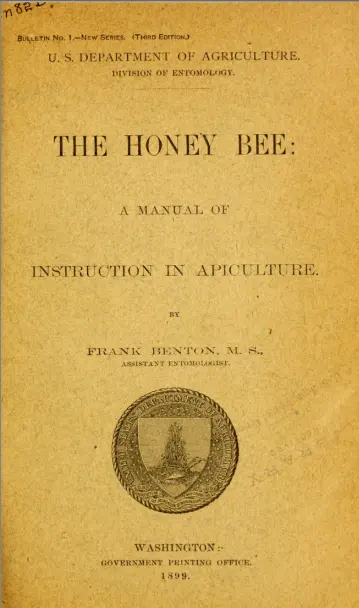
The honey bee: a manual of instruction in apiculture
Frank Benton
THE CLASSIC COLLECTION · 1897
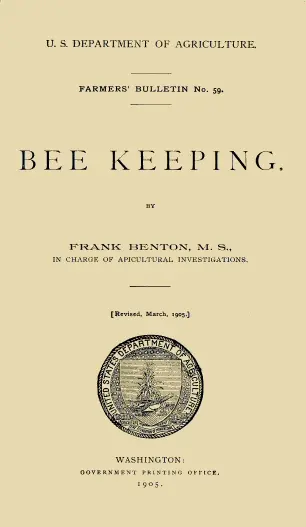
"Bee Keeping" by Frank Benton is a scientific publication written in the early 20th century. The work serves as a comprehensive guide to apiculture, detailing the practices necessary for successful bee keeping, including the different races of bees, hive management, and honey production techniques. The book is directed towards both beginners interested in starting their own apiary and experienced apiarists seeking to optimize their yields. The opening of the book introduces the context for the guide, explaining that the U.S. Department of Agriculture compiled it in response to numerous inquiries regarding successful bee management. Benton highlights the suitability of various locations for keeping bees, emphasizing that even unpromising environments can yield productive colonies if proper flora is present. He encourages readers by stating that nearly anyone can learn to manage bees with some patience and attention, setting the stage for the practical advice and detailed methodologies that will follow throughout the publication.
Introduction adapted from the source catalogue; source summaries may be automatically generated.
Free to read · English · 19,642 words · No account needed
MAKE TIME FOR A GOOD BOOK
On by default. Untick to stop anonymous reading totals. Each page counts after 10 seconds in view. How this works.
Anonymous counting is on unless you have switched it off.
=Sulla, or sulla clover=, a perennial plant, closely related to esparcet or sainfoin, succeeds, like the latter, best upon limestone soil or when fertilized with lime. It yields a splendid quality of honey from beautiful pink blossoms, which continue during May and June. The plant is an excellent soil fertilizer and of great value in connection with the feeding of stock, particularly dairy animals. It is, however, much less hardy than esparcet, and success with it can therefore hardly be looked for above the latitude of North Carolina and Arkansas. When the qualities and requirements of this plant were brought by the writer to the notice of a prominent scientific agriculturist of the South, this gentleman suggested as very probable that the black belt of Alabama, Mississippi, Louisiana, and Texas would be well adapted to it, the lands of this region being exceedingly strong in lime. In portions of southern Europe sulla clover is a most important forage crop for farm stock as well as for honey bees.
=Serradella= is an annual leguminous plant which will grow on sandy land, and which yields, besides good forage, clear honey of good quality in June and July.
=Chestnut=, valuable for timber, ornament, shade, and nuts, yields honey and pollen in June or July.
=Linden=, =sourwood=, and =catalpa=, fine shade,
ornamental, and timber trees, yield great quantities of first quality
honey in June and July.
=Cotton.=--In the South cotton blossoms, appearing as they do in succession during the whole summer, often yield considerable honey. It would appear, however, that when the plants are very rank in growth the blossoms--being correspondingly large--are too deep for the bees to reach the nectar.
=Chicory=, raised for salad and for its roots, is, whenever permitted to blossom, eagerly visited for honey in July and August.
=Sweet, medicinal, and pot herbs=, such as marjoram, savory, lavender, catnip, balm, sage, thyme, etc., when allowed to blossom, nearly all yield honey in June, July, or August. Where fields of them are grown for the seed the honey yield may be considerable from this source.
=Alfalfa= furnishes in the West a large amount of very fine honey during June and July. Its importance there as a forage crop is well known, but how far eastward its cultivation may be profitably extended is still a question, and even should it prove of value in the East as a forage plant, its honey-producing qualities there would be still uncertain.
=Parsnips=, when left for seed, blossom freely from June to August, inclusive, and are much frequented by honey bees.
Your reading position is saved on this browser. Take it to another device with a library code. Reading pages adapt to text, rather than matching a printed edition.
BEHIND THE BOOK
This eBook is for the use of anyone anywhere in the United States and most other parts of the world at no cost and with almost no restrictions whatsoever. You may copy it, give it away or re-use it under the terms of the Project Gutenberg License included with this eBook or online at www.gutenberg.org. If you are not located in the United States, you will have to check the laws of the country where you are located before using this eBook. Read the source licence.
The original source file, including credits and licence, is retained by this library. Request an original-format copy at no charge. Please include the book title and Project Gutenberg identifier #48546.
KEEP YOUR CURIOSITY GOING
John Muir
Asa Gray
Asa Gray
Florence Nightingale
Elizabeth Robins Pennell
Denison Olmsted