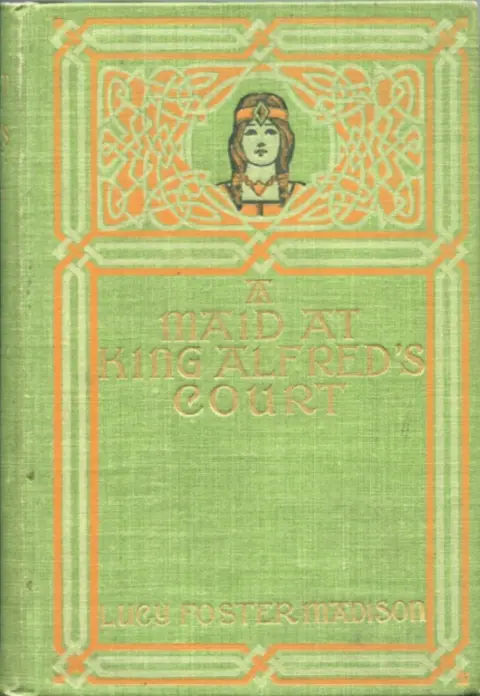
A Maid at King Alfred’s Court: A Story for Girls
Lucy Foster Madison
THE CLASSIC COLLECTION · 1913
"Bee and Butterfly: A Tale of Two Cousins" by Lucy Foster Madison is a fictional work written in the early 20th century. The story centers on Beatrice Raymond, a girl who has grown up without her father, who has been abroad for ten years collecting butterfly specimens. The narrative begins with Beatrice's anticipation and excitement as her father is set to return, alongside her struggle with feelings of inadequacy compared to her cousin, Adele, who is considered beautiful and charming. At the start of the book, the reader is introduced to Beatrice's world and the dynamic between her and her cousin Adele. Beatrice is depicted as an intelligent, nature-loving girl who feels overshadowed by Adele's beauty, igniting her insecurities, especially in light of her father's imminent return. As she wrestles with her identity and the judgments imposed by society, she attempts drastic measures, like altering her appearance to gain her father's affection. This opening portion sets the stage for themes of self-acceptance, the complexities of familial love, and the societal pressures concerning beauty and worth.
Introduction adapted from the source catalogue; source summaries may be automatically generated.
Free to read · English · 56,613 words · No account needed
MAKE TIME FOR A GOOD BOOK
On by default. Untick to stop anonymous reading totals. Each page counts after 10 seconds in view. How this works.
Anonymous counting is on unless you have switched it off.
"Bravo!" exclaimed a voice, and she looked around in some confusion to discover a boy gazing at her with admiring eyes. "I think that's pretty good for a girl."
"Oh! indeed!" cried Bee heatedly. "Could you have done any better yourself, even though you are a boy?"
"I don't know," replied the lad coolly. "I never wanted a butterfly bad
enough to try it."
"I don't believe that you ever even chased one in your life," said the girl, staring at him scornfully. "You look a namby-pamby sort."
The boy's face flushed. He was all of thirteen years old, but despite the fact was garbed in black velvet knickerbockers, a ruffled white blouse, long black stockings with low, ribbon-tied shoes, and had a silken sash knotted about his waist. Worst of all, to the girl's mind, he wore his hair in curls which fell far down upon his shoulders.
"If you were a boy I'd fight you for that," cried the urchin angrily,
clenching his fists.
"Pooh!" sniffed Bee, turning up her nose. "I would not be afraid of such a baby if I were six times a boy. Where's your mother?"
"She's home, asleep. What's yours thinking about that she lets you go wild like this? My mother said, when she saw you running through the fields one day, that she wondered what kind of a woman she could be to let you go like that. Where is she?"
"She is dead," answered the girl in a low voice. "I think your mother is
horrid."
"She isn't. She's lovely. Everybody says so. I am sorry that yours is dead. You can't help being rude, of course, if you have no mother. Who looks after you?"
"Why, father, of course," answered Bee. "And I am not rude."
"What makes you run after butterflies and things, then?" demanded he sternly. "I saw you one day, and you had a worm--a great, ugly worm--in your hand."
Beatrice gave way to a burst of laughter.
"A worm?" cried she mirthfully. "Oh, you poor little thing! You don't know anything, do you? That was not a worm. It was a caterpillar."
"Well; what's the difference?"
"A true worm never turns into an insect," she informed him. "It goes creeping around through life, a worm and nothing more; while a caterpillar changes at last into a beautiful butterfly, or moth. This was a caterpillar once," she ended, raising the net with her captured prize for his inspection.
"You are a strange girl," observed the boy. "I never knew one before who cared about such things. Where did you learn it?"
Your reading position is saved on this browser. Take it to another device with a library code. Reading pages adapt to text, rather than matching a printed edition.
Lucy Foster Madison
Lucy Foster Madison
Lucy Foster Madison
BEHIND THE BOOK
This eBook is for the use of anyone anywhere in the United States and most other parts of the world at no cost and with almost no restrictions whatsoever. You may copy it, give it away or re-use it under the terms of the Project Gutenberg License included with this eBook or online at www.gutenberg.org. If you are not located in the United States, you will have to check the laws of the country where you are located before using this eBook. Read the source licence.
The original source file, including credits and licence, is retained by this library. Request an original-format copy at no charge. Please include the book title and Project Gutenberg identifier #33407.
KEEP YOUR CURIOSITY GOING
Coulson Kernahan

Maurice Baring
Frances Wright
Cécile Tormay

Frederic Jesup Stimson

W. H. P. (William Henry Pope) Jarvis