THE CLASSIC COLLECTION✦A journey to Central AfricaCLASSIC FREE BOOKS
A journey to Central Africa
Bayard Taylor
THE CLASSIC COLLECTION · 1872
"Beauty and the Beast" by Bayard Taylor is a novel that intertwines fact and fancy, presenting a narrative set in mid-19th century Russia. The story engages with themes of love, power dynamics, and societal customs, focused on the characters of Prince Alexis, his wife Princess Martha, and their son Prince Boris. It explores the complexities of their lives within the context of Russian nobility and serfdom, revealing the interpersonal struggles and emotions that shape their world. The opening portion introduces us to Kinesma, a town on the Volga, where Prince Alexis finds himself in turmoil over a postponed dinner. His comedic insistence on avoiding a festival for his son leads to a series of events involving a drunken bear and a harried court-poet, setting the stage for the whimsical yet dark environment of the castle. As the narrative unfolds, we witness the egocentric behaviors of Alexis, the meekness of Princess Martha, and the cowardly nature of Boris, all richly painted against the backdrop of Russian culture and humor. The tone oscillates between severe brutality and lighthearted farce, foreshadowing the transformations that will occur as their lives progress.
Introduction adapted from the source catalogue; source summaries may be automatically generated.
Free to read · English · 85,672 words · No account needed
MAKE TIME FOR A GOOD BOOK
On by default. Untick to stop anonymous reading totals. Each page counts after 10 seconds in view. How this works.
Anonymous counting is on unless you have switched it off.
It was growing dusk when they reached the house. In the dim candle-light Asenath's paleness was not remarked; and Richard's silence was attributed to fatigue.
The next morning the whole family attended meeting at the neighboring Quaker meeting-house, in the preparation for which, and the various special occupations of their “First-day” mornings, the unsuspecting parents overlooked that inevitable change in the faces of the lovers which they must otherwise have observed. After dinner, as Eli was taking a quiet walk in the garden, Richard Hilton approached him.
“Friend Mitchenor,” said he, “I should like to have some talk with
thee.”
“What is it, Richard?” asked the old man, breaking off some pods from a seedling radish, and rubbing them in the palm of his hand.
“I hope, Friend Mitchenor,” said the young man, scarcely knowing how to approach so important a crisis in his life, “I hope thee has been satisfied with my conduct since I came to live with thee, and has no fault to find with me as a man.”
“Well,” exclaimed Eli, turning around and looking up, sharply, “does thee want a testimony from me? I've nothing, that I know of, to say against thee.”
“If I were sincerely attached to thy daughter, Friend Mitchenor, and she returned the attachment, could thee trust her happiness in my hands?”
“What!” cried Eli, straightening himself and glaring upon the speaker, with a face too amazed to express any other feeling.
“Can you confide Asenath's happiness to my care? I love her with my whole heart and soul, and the fortune of my life depends on your answer.”
The straight lines in the old man's face seemed to grow deeper and more rigid, and his eyes shone with the chill glitter of steel. Richard, not daring to say a word more, awaited his reply in intense agitation.
“So!” he exclaimed at last, “this is the way thee's repaid me! I didn't expect THIS from thee! Has thee spoken to her?”
“I have.”
“Thee has, has thee? And I suppose thee's persuaded her to think as thee does. Thee'd better never have come here. When I want to lose my daughter, and can't find anybody else for her, I'll let thee know.”
“What have you against me, Friend Mitchenor?” Richard sadly asked, forgetting, in his excitement, the Quaker speech he had learned.
“Thee needn't use compliments now! Asenath shall be a Friend while I live; thy fine clothes and merry-makings and vanities are not for her. Thee belongs to the world, and thee may choose one of the world's women.”
“Never!” protested Richard; but Friend Mitchenor was already ascending the garden-steps on his way to the house.
Your reading position is saved on this browser. Take it to another device with a library code. Reading pages adapt to text, rather than matching a printed edition.
Bayard Taylor
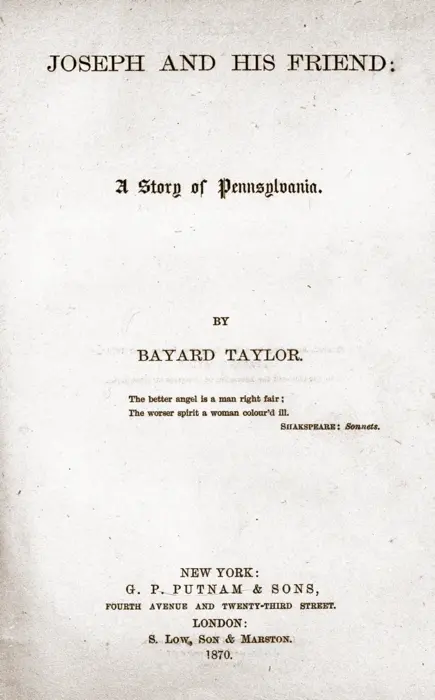
Bayard Taylor
Bayard Taylor
Bayard Taylor
BEHIND THE BOOK
This eBook is for the use of anyone anywhere in the United States and most other parts of the world at no cost and with almost no restrictions whatsoever. You may copy it, give it away or re-use it under the terms of the Project Gutenberg License included with this eBook or online at www.gutenberg.org. If you are not located in the United States, you will have to check the laws of the country where you are located before using this eBook. Read the source licence.
The original source file, including credits and licence, is retained by this library. Request an original-format copy at no charge. Please include the book title and Project Gutenberg identifier #292.
KEEP YOUR CURIOSITY GOING
Coulson Kernahan

Maurice Baring
Frances Wright
Cécile Tormay

Frederic Jesup Stimson

W. H. P. (William Henry Pope) Jarvis