THE CLASSIC COLLECTION✦A journey to Central AfricaCLASSIC FREE BOOKS
A journey to Central Africa
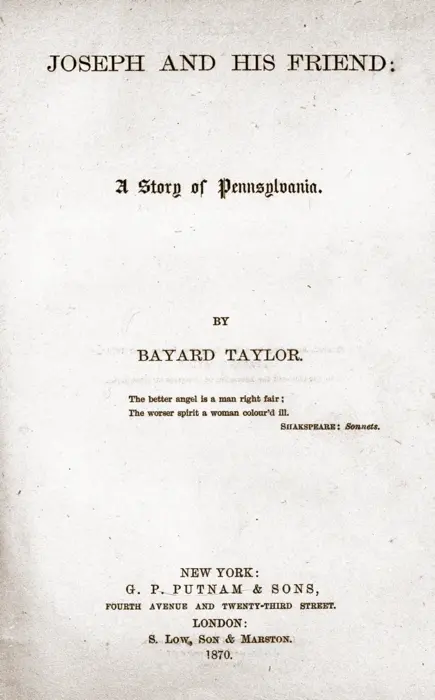
Bayard Taylor
THE CLASSIC COLLECTION · 1872
"Beauty and the Beast" by Bayard Taylor is a novel that intertwines fact and fancy, presenting a narrative set in mid-19th century Russia. The story engages with themes of love, power dynamics, and societal customs, focused on the characters of Prince Alexis, his wife Princess Martha, and their son Prince Boris. It explores the complexities of their lives within the context of Russian nobility and serfdom, revealing the interpersonal struggles and emotions that shape their world. The opening portion introduces us to Kinesma, a town on the Volga, where Prince Alexis finds himself in turmoil over a postponed dinner. His comedic insistence on avoiding a festival for his son leads to a series of events involving a drunken bear and a harried court-poet, setting the stage for the whimsical yet dark environment of the castle. As the narrative unfolds, we witness the egocentric behaviors of Alexis, the meekness of Princess Martha, and the cowardly nature of Boris, all richly painted against the backdrop of Russian culture and humor. The tone oscillates between severe brutality and lighthearted farce, foreshadowing the transformations that will occur as their lives progress.
Introduction adapted from the source catalogue; source summaries may be automatically generated.
Free to read · English · 85,672 words · No account needed
MAKE TIME FOR A GOOD BOOK
On by default. Untick to stop anonymous reading totals. Each page counts after 10 seconds in view. How this works.
Anonymous counting is on unless you have switched it off.
One afternoon, as he was idly sitting on the stone wall which separated the garden from the lane, Asenath, attired in a new gown of chocolate-colored calico, with a double-handled willow work-basket on her arm, issued from the house. As she approached him, she paused and said--
“The time seems to hang heavy on thy hands, Richard. If thee's strong enough to walk to the village and back, it might do thee more good than sitting still.”
Richard Hilton at once jumped down from the wall.
“Certainly I am able to go,” said he, “if you will allow it.”
“Haven't I asked thee?” was her quiet reply.
“Let me carry your basket,” he said, suddenly, after they had walked, side by side, some distance down the lane.
“Indeed, I shall not let thee do that. I'm only going for the mail, and some little things at the store, that make no weight at all. Thee mustn't think I'm like the young women in the city, who, I'm told, if they buy a spool of Cotton, must have it sent home to them. Besides, thee mustn't over-exert thy strength.”
Richard Hilton laughed merrily at the gravity with which she uttered the
last sentence.
“Why, Miss--Asenath, I mean--what am I good for; if I have not strength enough to carry a basket?”
“Thee's a man, I know, and I think a man would almost as lief be thought wicked as weak. Thee can't help being weakly-inclined, and it's only right that thee should be careful of thyself. There's surely nothing in that that thee need be ashamed of.”
While thus speaking, Asenath moderated her walk, in order, unconsciously to her companion, to restrain his steps.
“Oh, there are the dog's-tooth violets in blossom?” she exclaimed, pointing to a shady spot beside the brook; “does thee know them?”
Richard immediately gathered and brought to her a handful of the nodding yellow bells, trembling above their large, cool, spotted leaves.
“How beautiful they are!” said he; “but I should never have taken them
for violets.”
“They are misnamed,” she answered. “The flower is an Erythronium; but I am accustomed to the common name, and like it. Did thee ever study botany?”
“Not at all. I can tell a geranium, when I see it, and I know a heliotrope by the smell. I could never mistake a red cabbage for a rose, and I can recognize a hollyhock or a sunflower at a considerable distance. The wild flowers are all strangers to me; I wish I knew something about them.”
Your reading position is saved on this browser. Take it to another device with a library code. Reading pages adapt to text, rather than matching a printed edition.
Bayard Taylor
Bayard Taylor
Bayard Taylor
Bayard Taylor
BEHIND THE BOOK
This eBook is for the use of anyone anywhere in the United States and most other parts of the world at no cost and with almost no restrictions whatsoever. You may copy it, give it away or re-use it under the terms of the Project Gutenberg License included with this eBook or online at www.gutenberg.org. If you are not located in the United States, you will have to check the laws of the country where you are located before using this eBook. Read the source licence.
The original source file, including credits and licence, is retained by this library. Request an original-format copy at no charge. Please include the book title and Project Gutenberg identifier #292.
KEEP YOUR CURIOSITY GOING
Coulson Kernahan

Maurice Baring
Frances Wright
Cécile Tormay

Frederic Jesup Stimson

W. H. P. (William Henry Pope) Jarvis