THE CLASSIC COLLECTION✦A journey to Central AfricaCLASSIC FREE BOOKS
A journey to Central Africa
Bayard Taylor
THE CLASSIC COLLECTION · 1872
"Beauty and the Beast" by Bayard Taylor is a novel that intertwines fact and fancy, presenting a narrative set in mid-19th century Russia. The story engages with themes of love, power dynamics, and societal customs, focused on the characters of Prince Alexis, his wife Princess Martha, and their son Prince Boris. It explores the complexities of their lives within the context of Russian nobility and serfdom, revealing the interpersonal struggles and emotions that shape their world. The opening portion introduces us to Kinesma, a town on the Volga, where Prince Alexis finds himself in turmoil over a postponed dinner. His comedic insistence on avoiding a festival for his son leads to a series of events involving a drunken bear and a harried court-poet, setting the stage for the whimsical yet dark environment of the castle. As the narrative unfolds, we witness the egocentric behaviors of Alexis, the meekness of Princess Martha, and the cowardly nature of Boris, all richly painted against the backdrop of Russian culture and humor. The tone oscillates between severe brutality and lighthearted farce, foreshadowing the transformations that will occur as their lives progress.
Introduction adapted from the source catalogue; source summaries may be automatically generated.
Free to read · English · 85,672 words · No account needed
MAKE TIME FOR A GOOD BOOK
On by default. Untick to stop anonymous reading totals. Each page counts after 10 seconds in view. How this works.
Anonymous counting is on unless you have switched it off.
“I read aloud, and the sound of my own voice gave me confidence; many passages suggested discussions, in which I took a part; and you may judge, Ned, how fast I got on, from the fact that I ventured to tell Eunice of my fish-bakes with Perkins, and invite her to join them. After that, she also often disappeared from sight for an hour or two in the afternoon.”
----“Oh, Mr. Johnson,” interrupted Mrs. Billings, “it wasn't for the
fish!”
“Of course not,” said her husband; “it was for my sake.”
“No, you need not think it was for you. Enos,” she added, perceiving the feminine dilemma into which she had been led, “all this is not necessary to the story.”
“Stop!” he answered. “The A. C. has been revived for this night only. Do you remember our platform, or rather no-platform? I must follow my impulses, and say whatever comes uppermost.”
“Right, Enos,” said Mr. Johnson; “I, as temporary Arcadian, take the same ground. My instinct tells me that you, Mrs. Billings, must permit the confession.”
She submitted with a good grace, and her husband continued:
“I said that our lazy life during the hot weather had become a little monotonous. The Arcadian plan had worked tolerably well, on the whole, for there was very little for any one to do--Mrs. Shelldrake and Perkins Brown excepted. Our conversation, however, lacked spirit and variety. We were, perhaps unconsciously, a little tired of hearing and assenting to the same sentiments. But one evening, about this time, Hollins struck upon a variation, the consequences of which he little foresaw. We had been reading one of Bulwer's works (the weather was too hot for Psychology), and came upon this paragraph, or something like it:
“'Ah, Behind the Veil! We see the summer smile of the Earth--enamelled meadow and limpid stream,--but what hides she in her sunless heart? Caverns of serpents, or grottoes of priceless gems? Youth, whose soul sits on thy countenance, thyself wearing no mask, strive not to lift the masks of others! Be content with what thou seest; and wait until Time and Experience shall teach thee to find jealousy behind the sweet smile, and hatred under the honeyed word!'
“This seemed to us a dark and bitter reflection; but one or another of us recalled some illustration of human hypocrisy, and the evidences, by the simple fact of repetition, gradually led to a division of opinion--Hollins, Shelldrake, and Miss Ringtop on the dark side, and the rest of us on the bright. The last, however, contented herself with quoting from her favorite poet, Gamaliel J. Gawthrop:
Your reading position is saved on this browser. Take it to another device with a library code. Reading pages adapt to text, rather than matching a printed edition.
Bayard Taylor
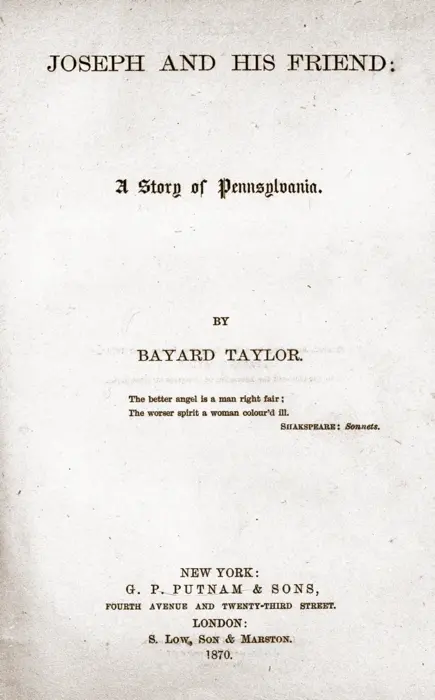
Bayard Taylor
Bayard Taylor
Bayard Taylor
BEHIND THE BOOK
This eBook is for the use of anyone anywhere in the United States and most other parts of the world at no cost and with almost no restrictions whatsoever. You may copy it, give it away or re-use it under the terms of the Project Gutenberg License included with this eBook or online at www.gutenberg.org. If you are not located in the United States, you will have to check the laws of the country where you are located before using this eBook. Read the source licence.
The original source file, including credits and licence, is retained by this library. Request an original-format copy at no charge. Please include the book title and Project Gutenberg identifier #292.
KEEP YOUR CURIOSITY GOING
Coulson Kernahan

Maurice Baring
Frances Wright
Cécile Tormay

Frederic Jesup Stimson

W. H. P. (William Henry Pope) Jarvis