THE CLASSIC COLLECTION✦A journey to Central AfricaCLASSIC FREE BOOKS
A journey to Central Africa
Bayard Taylor
THE CLASSIC COLLECTION · 1872
"Beauty and the Beast" by Bayard Taylor is a novel that intertwines fact and fancy, presenting a narrative set in mid-19th century Russia. The story engages with themes of love, power dynamics, and societal customs, focused on the characters of Prince Alexis, his wife Princess Martha, and their son Prince Boris. It explores the complexities of their lives within the context of Russian nobility and serfdom, revealing the interpersonal struggles and emotions that shape their world. The opening portion introduces us to Kinesma, a town on the Volga, where Prince Alexis finds himself in turmoil over a postponed dinner. His comedic insistence on avoiding a festival for his son leads to a series of events involving a drunken bear and a harried court-poet, setting the stage for the whimsical yet dark environment of the castle. As the narrative unfolds, we witness the egocentric behaviors of Alexis, the meekness of Princess Martha, and the cowardly nature of Boris, all richly painted against the backdrop of Russian culture and humor. The tone oscillates between severe brutality and lighthearted farce, foreshadowing the transformations that will occur as their lives progress.
Introduction adapted from the source catalogue; source summaries may be automatically generated.
Free to read · English · 85,672 words · No account needed
MAKE TIME FOR A GOOD BOOK
On by default. Untick to stop anonymous reading totals. Each page counts after 10 seconds in view. How this works.
Anonymous counting is on unless you have switched it off.
As for J. Edward Johnson, it is enough to say that he was a tall, thin gentleman of forty-five, with an aquiline nose, narrow face, and military whiskers, which swooped upwards and met under his nose in a glossy black mustache. His complexion was dark, from the bronzing of fifteen summers in New Orleans. He was a member of a wholesale hardware firm in that city, and had now revisited his native North for the first time since his departure. A year before, some letters relating to invoices of metal buttons signed, “Foster, Kirkup, & Co., per Enos Billings,” had accidentally revealed to him the whereabouts of the old friend of his youth, with whom we now find him domiciled. The first thing he did, after attending to some necessary business matters in New York, was to take the train for Waterbury.
“Enos,” said he, as he stretched out his hand for the third cup of tea (which he had taken only for the purpose of prolonging the pleasant table-chat), “I wonder which of us is most changed.”
“You, of course,” said Mr. Billings, “with your brown face and big mustache. Your own brother wouldn't have known you if he had seen you last, as I did, with smooth cheeks and hair of unmerciful length. Why, not even your voice is the same!”
“That is easily accounted for,” replied Mr. Johnson. “But in your case, Enos, I am puzzled to find where the difference lies. Your features seem to be but little changed, now that I can examine them at leisure; yet it is not the same face. But, really, I never looked at you for so long a time, in those days. I beg pardon; you used to be so--so remarkably shy.”
Mr. Billings blushed slightly, and seemed at a loss what to answer.
His wife, however, burst into a merry laugh, exclaiming--
“Oh, that was before the days of the A. C!”
He, catching the infection, laughed also; in fact Mr. Johnson laughed,
but without knowing why.
“The 'A. C.'!” said Mr. Billings. “Bless me, Eunice! how long it is since we have talked of that summer! I had almost forgotten that there ever was an A. C.”
“Enos, COULD you ever forget Abel Mallory and the beer?--or that scene between Hollins and Shelldrake?--or” (here SHE blushed the least bit) “your own fit of candor?” And she laughed again, more heartily than ever.
“What a precious lot of fools, to be sure!” exclaimed her husband.
Mr. Johnson, meanwhile, though enjoying the cheerful humor of his hosts, was not a little puzzled with regard to its cause.
“What is the A. C.?” he ventured to ask.
Your reading position is saved on this browser. Take it to another device with a library code. Reading pages adapt to text, rather than matching a printed edition.
Bayard Taylor
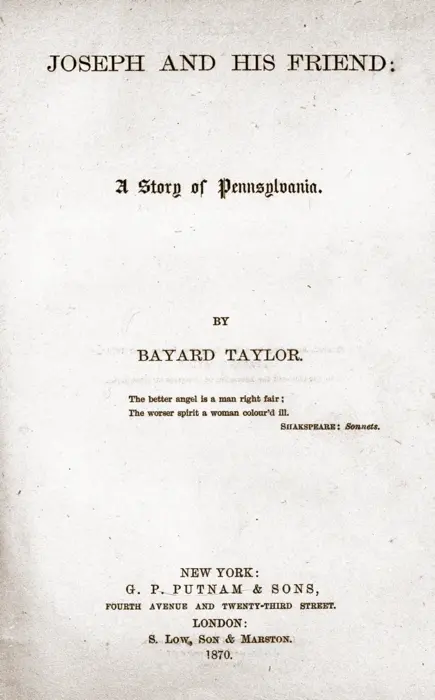
Bayard Taylor
Bayard Taylor
Bayard Taylor
BEHIND THE BOOK
This eBook is for the use of anyone anywhere in the United States and most other parts of the world at no cost and with almost no restrictions whatsoever. You may copy it, give it away or re-use it under the terms of the Project Gutenberg License included with this eBook or online at www.gutenberg.org. If you are not located in the United States, you will have to check the laws of the country where you are located before using this eBook. Read the source licence.
The original source file, including credits and licence, is retained by this library. Request an original-format copy at no charge. Please include the book title and Project Gutenberg identifier #292.
KEEP YOUR CURIOSITY GOING
Coulson Kernahan

Maurice Baring
Frances Wright
Cécile Tormay

Frederic Jesup Stimson

W. H. P. (William Henry Pope) Jarvis