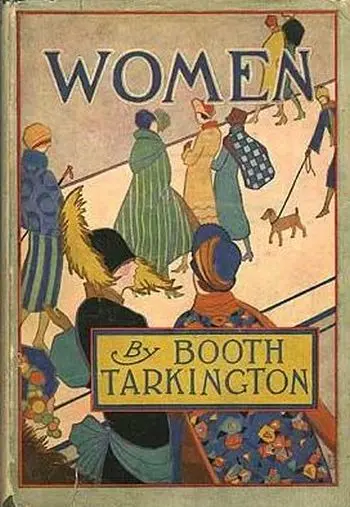
Women
Booth Tarkington
THE CLASSIC COLLECTION · 1909
"Beasley's Christmas Party" by Booth Tarkington is a fictional narrative likely written in the early 20th century. The story introduces the protagonist, who has recently moved to Wainwright, where he becomes intrigued by the enigmatic figure of Mr. David Beasley, a local political figure. As the protagonist navigates his new life, he finds himself drawn to the peculiar occurrences surrounding Beasley’s residence, leading to an exploration of themes such as loneliness, community, and the nature of friendship. The opening of the story sets up a tranquil October morning as the narrator returns from his first shift at the local newspaper. He reflects on a particular house that he admires, which belongs to Mr. Beasley, while experiencing intrigue at the strange occurrences he senses coming from within. During a chance encounter with Miss Apperthwaite, the daughter of his boarding house owner, he learns about Beasley's character and his solitary living arrangement. The initial chapters paint a picture of Beasley as a quirky yet kind-hearted man, deeply connected to a sickly child named Hamilton Swift, who uses an imaginary world to cope with his difficult life. This leads to humorous and poignant exchanges that hint at deeper emotional currents, creating an engaging setup for their eventual Christmas gathering. The tone of the narrative combines lighthearted observations with an underlying sense of longing and mystery, prompting the reader to further explore Beasley’s character and the relationships around him.
Introduction adapted from the source catalogue; source summaries may be automatically generated.
Free to read · English · 16,436 words · No account needed
MAKE TIME FOR A GOOD BOOK
On by default. Untick to stop anonymous reading totals. Each page counts after 10 seconds in view. How this works.
Anonymous counting is on unless you have switched it off.
“Yes,” she returned, thoughtfully. “He rather did; it's true. At least, I see how you got that impression.” She seemed to muse upon this, letting her eyes fall; then, raising them, allowed her far-away gaze to rest upon the house beyond the fence, and said, “It IS an interesting old place.”
“And Mr. Beasley himself--” I began.
“Oh,” she said, “HE isn't interesting. That's his trouble!”
“You mean his trouble not to--”
She interrupted me, speaking with sudden, surprising energy, “I mean he's a man of no imagination.”
“No imagination!” I exclaimed.
“None in the world! Not one ounce of imagination! Not one grain!”
“Then who,” I cried--“or what--is Simpledoria?”
“Simple--what?” she said, plainly mystified.
“Simpledoria.”
“Simpledoria?” she repeated, and laughed. “What in the world is that?”
“You never heard of it before?”
“Never in my life.”
“You've lived next door to Mr. Beasley a long time, haven't you?”
“All my life.”
“And I suppose you must know him pretty well.”
“What next?” she said, smiling.
“You said he lived there all alone,” I went on, tentatively.
“Except for an old colored couple, his servants.”
“Can you tell me--” I hesitated. “Has he ever been thought--well,
'queer'?”
“Never!” she answered, emphatically. “Never anything so exciting! Merely deadly and hopelessly commonplace.” She picked up the saucer, now exceedingly empty, and set it upon a shelf by the lattice door. “What was it about--what was that name?--'Simpledoria'?”
“I will tell you,” I said. And I related in detail the singular performance of which I had been a witness in the late moonlight before that morning's dawn. As I talked, we half unconsciously moved across the lawn together, finally seating ourselves upon a bench beyond the rose-beds and near the high fence. The interest my companion exhibited in the narration might have surprised me had my nocturnal experience itself been less surprising. She interrupted me now and then with little, half-checked ejaculations of acute wonder, but sat for the most part with her elbow on her knee and her chin in her hand, her face turned eagerly to mine and her lips parted in half-breathless attention. There was nothing “far away” about her eyes now; they were widely and intently alert.
When I finished, she shook her head slowly, as if quite dumfounded, and altered her position, leaning against the back of the bench and gazing straight before her without speaking. It was plain that her neighbor's extraordinary behavior had revealed a phase of his character novel enough to be startling.
Your reading position is saved on this browser. Take it to another device with a library code. Reading pages adapt to text, rather than matching a printed edition.
Booth Tarkington
Booth Tarkington
Booth Tarkington
Booth Tarkington
BEHIND THE BOOK
This eBook is for the use of anyone anywhere in the United States and most other parts of the world at no cost and with almost no restrictions whatsoever. You may copy it, give it away or re-use it under the terms of the Project Gutenberg License included with this eBook or online at www.gutenberg.org. If you are not located in the United States, you will have to check the laws of the country where you are located before using this eBook. Read the source licence.
The original source file, including credits and licence, is retained by this library. Request an original-format copy at no charge. Please include the book title and Project Gutenberg identifier #5949.
KEEP YOUR CURIOSITY GOING
Coulson Kernahan

Maurice Baring
Frances Wright
Cécile Tormay

Frederic Jesup Stimson

W. H. P. (William Henry Pope) Jarvis