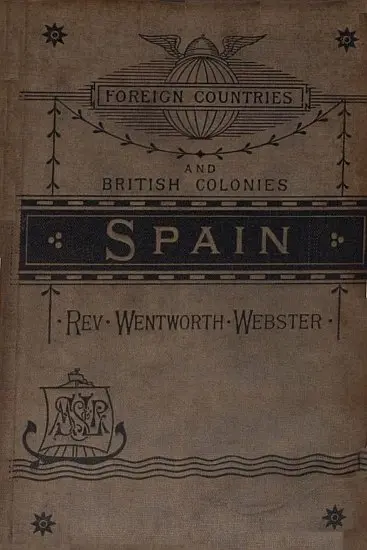
Spain
Wentworth Webster
THE CLASSIC COLLECTION · 1877
"Basque Legends; With an Essay on the Basque Language" by Wentworth Webster is a collection of traditional tales and folklore from the Basque region, written in the late 19th century. The book explores the unique mythology and cultural narratives of the Basques, including legendary creatures such as the Tartaro and the Heren-Suge, as well as various animal fables. It offers an intriguing look into the Basque societal values and linguistic elements, making it a valuable resource for anthropology and folklore enthusiasts. At the start of the work, the introduction emphasizes the significance of studying comparative mythology and highlights the Basque people’s distinct cultural heritage, characterized by their unwritten language and rich oral traditions. The opening portion sets the stage for the stories to come, revealing how these legends—believed to represent ancient truths—are recounted by Basque peasants during communal activities. The narratives intertwine historical influences and local beliefs, depicting characters like the one-eyed Tartaro and heroic figures enmeshed in quests and adventures, illustrating themes of cleverness, survival, and the interplay of the familiar with the supernatural.
Introduction adapted from the source catalogue; source summaries may be automatically generated.
Free to read · English · 96,186 words · No account needed
MAKE TIME FOR A GOOD BOOK
On by default. Untick to stop anonymous reading totals. Each page counts after 10 seconds in view. How this works.
Anonymous counting is on unless you have switched it off.
[101] i.e., the piece of "braise," or glowing ember from the wood fire, which is always nearly on a level with the floor in a Basque house.
[102] Through the whole of the South of Europe, in Greece, Italy, Spain, Portugal, etc., the firing of guns, pistols, crackers, is universal at all kinds of "fêtes," especially religious ones; the half-deafened foreigner often longs for some such law as that infringed by "Mahistruba;" but cf. "Juan de Kalais," p. 151.
[103] Cf. supra, p. 38, "The Serpent in the Wood."
[104] This tale is somewhat like Campbell's "Three Soldiers," with the variations, Vol. I., p. 176. It is said to be very widely spread.
[105] This is an interpolation by the narrator.
[106] At Bayonne one part of the town is called "Les Cinq Cantons."
[107] For like involuntary sleep, where the lady cannot awaken her lover, cf. Campbell, "The Widow's Son," Vol. II., p. 296.
[108] For the incident of the eagle, cf. Campbell, "The King of Lochlin's Three Daughters," Vol. I., pp. 238-9:--"When they were at the mouth of the hole, the stots were expended, and she was going to turn back; but he took a steak out of his own thigh, and he gave this to the eagle, and with one spring she was on the surface of the earth."
[109] Cf. the horse in Naaké's "Slavonic Fairy Tales," "Ivan Kruchina" (from the Russian), p. 117, and "the dun shaggy filly," in Campbell's "The Young King of Easaidh Ruadh," Vol. I., p. 5, and elsewhere; also the horse in the "Uso-Andre," and "The Unknown Animal," below. Campbell, Vol. I., p. 63, remarks that the horses in Gaelic stories are always feminine; but they are red as well as grey.
[110] In this, and the following tale, Ezkabi's golden hair is evidently like "Diarmaid's" beauty spot. "He used to keep his cap always down on the beauty-spot; for any woman that might chance to see it, she would be in love with him."--Campbell's "Diarmaid and Grainne," Vol. III., p. 39, notes and variations.
[111] Compare the following legend, and "Old Deccan Days" ("Truth's
Triumph"), pp. 62, 63.
[112] Cf. above, "The Grateful Tartaro and the Heren-Suge," p. 22.
[113] Cf. note, supra, p. 113, and Grainne seeing Diarmaid as he lifts his cap or helmet. These beauty-spots seem to be the counterpart of Aphrodite's cestus.
[114] Cf. the two golden pears in the Spanish "Juanillo el Loco," Patrañas, p. 38, given in exchange for the same water.
[115] Cf. below, "The Singing Tree," etc., p. 176.
[116] Cf. "Old Deccan Days," p. 139; and Cox, "Aryan Mythology,"
Vol. I., p. 160, seq.
[117] Cf. below, p. 156.
Your reading position is saved on this browser. Take it to another device with a library code. Reading pages adapt to text, rather than matching a printed edition.
Wentworth Webster
BEHIND THE BOOK
This eBook is for the use of anyone anywhere in the United States and most other parts of the world at no cost and with almost no restrictions whatsoever. You may copy it, give it away or re-use it under the terms of the Project Gutenberg License included with this eBook or online at www.gutenberg.org. If you are not located in the United States, you will have to check the laws of the country where you are located before using this eBook. Read the source licence.
The original source file, including credits and licence, is retained by this library. Request an original-format copy at no charge. Please include the book title and Project Gutenberg identifier #34902.
KEEP YOUR CURIOSITY GOING

Maurice Baring
Francis Greenleaf Allinson & Anne C. E. (Anne Crosby Emery) Allinson
Stuart Dodgson Collingwood
Percy Keese Fitzhugh
Mary Macleod & Edmund Spenser

Cooke Don-Carlos