
A Son of Ishmael: A Novel
L. T. Meade
THE CLASSIC COLLECTION · 1892
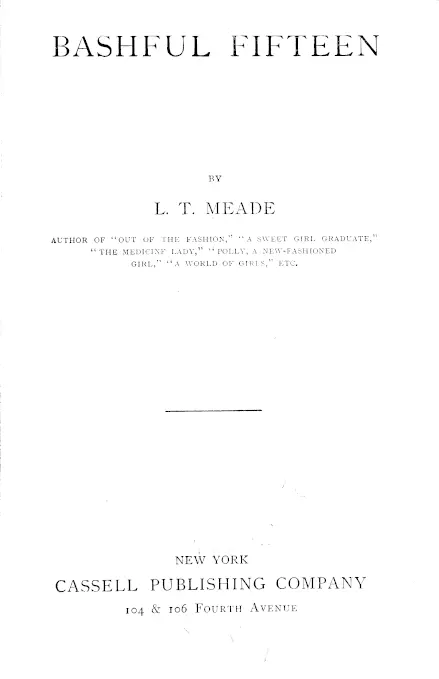
"Bashful Fifteen" by L. T. Meade is a novel written in the late 19th century. The story is set in a girls' school called Mulberry Court, where a new student named Bridget O'Hara arrives, stirring interest and curiosity among her classmates. The narrative explores themes of friendship, individuality, and the challenges of fitting into a new environment, as Bridget stands out due to her spirited personality and carefree nature. At the start of the book, the anticipation for the arrival of Bridget O'Hara creates a buzz among the fifty girls at Mulberry Court. The opening chapter introduces their curious chatter regarding the new girl, who arrives mid-term under unusual circumstances. As the girls watch her carriage approach, their speculation is palpable. Upon her entrance, Bridget's vibrant character is quickly established; she is lively and charming, albeit somewhat oblivious to the rules and expectations of the school. Her first interactions highlight her magnetic but troublesome nature as she prattles on about her past adventures in Ireland, capturing the attention of the younger girls while causing mixed reactions among the older ones, particularly regarding her potential to disrupt the school’s established order.
Introduction adapted from the source catalogue; source summaries may be automatically generated.
Free to read · English · 88,044 words · No account needed
MAKE TIME FOR A GOOD BOOK
On by default. Untick to stop anonymous reading totals. Each page counts after 10 seconds in view. How this works.
Anonymous counting is on unless you have switched it off.
After a long period of silence a remark dropped from her lips.
"I have made up my mind," she said, turning round and addressing all
the children.
"O Janey, what have you thought of now?" asked Alice, raising her pretty flushed face, and pushing aside her painting.
"Take care of messing that fan, dear; you are painting in that red
poppy very nicely," answered Janet. "Well, girls, I have made up my
mind."
"Yes, Janey, yes; what about?" they all answered.
"Our stall is to be far and away the most beautiful at the Fancy Fair."
"Three cheers!" exclaimed the children, but then Alice said in a
wistful tone:
"I don't see how it can be, Janet, for we are none of us rich. I heard Dolly say this morning that Evelyn's stall would certainly be far and away the best, for she was the only one of us who had money."
"Evelyn may not have a stall at all," said Janet, "but, in any case, if you six little girls will back me, and if Olive--I can answer for Olive that she will do her best--if Olive will help also, our stall will be the richest and the most lovely at the fair. Will you trust me to manage this, children?"
"Of course, Janet!" replied Nora, her eyes sparkling.
"Now I tell you what," said Janet, "I know pretty well what the other girls are doing. Frances Murray's girls are going in for the sober and useful; Dorothy Collingwood's are working with a will on the same dull lines. Poor old Ruth--oh, I'm not disparaging her--can't rise above her patchwork quilts, whereas we, we alone, have embraced ART. Girls, the combination of art and money will produce the most lovely stall at the fair. Now I have spoken! You stick to me, girls, and keep your secret to yourselves. Say nothing, but determine, every one of you, to do her utmost, not only for little Tim, but for the glory of the 'Janet May Stall.'"
"We will, we will!" said the children.
They were quite impressed by Janet's enthusiasm, and looked upon their own humble little efforts in the great field of art with some awe.
"It shall be done!" said Janet. "You have my word for it; I can, I will manage it. I shall take immediate steps. Olive, will you look after the girls during the remainder of this afternoon? I must do something at once to secure our ends."
Janet walked quickly back to the house. She was so lost in thought that she never saw a girl who was running full tilt against her.
Your reading position is saved on this browser. Take it to another device with a library code. Reading pages adapt to text, rather than matching a printed edition.
BEHIND THE BOOK
This eBook is for the use of anyone anywhere in the United States and most other parts of the world at no cost and with almost no restrictions whatsoever. You may copy it, give it away or re-use it under the terms of the Project Gutenberg License included with this eBook or online at www.gutenberg.org. If you are not located in the United States, you will have to check the laws of the country where you are located before using this eBook. Read the source licence.
The original source file, including credits and licence, is retained by this library. Request an original-format copy at no charge. Please include the book title and Project Gutenberg identifier #61857.
KEEP YOUR CURIOSITY GOING
Coulson Kernahan

Maurice Baring
Frances Wright
Cécile Tormay

Frederic Jesup Stimson

W. H. P. (William Henry Pope) Jarvis


