
A Son of Ishmael: A Novel
L. T. Meade
THE CLASSIC COLLECTION · 1892
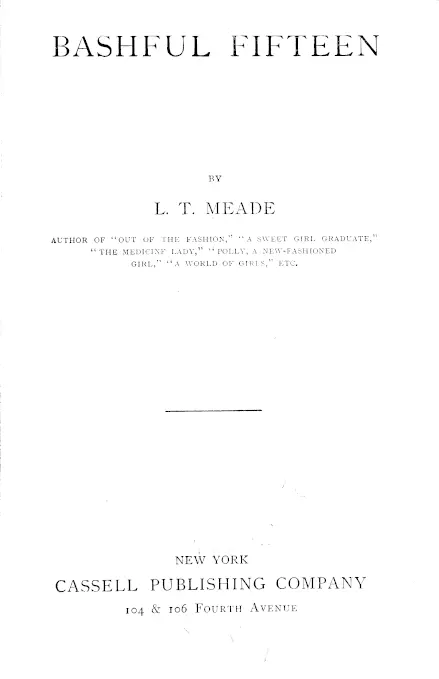
"Bashful Fifteen" by L. T. Meade is a novel written in the late 19th century. The story is set in a girls' school called Mulberry Court, where a new student named Bridget O'Hara arrives, stirring interest and curiosity among her classmates. The narrative explores themes of friendship, individuality, and the challenges of fitting into a new environment, as Bridget stands out due to her spirited personality and carefree nature. At the start of the book, the anticipation for the arrival of Bridget O'Hara creates a buzz among the fifty girls at Mulberry Court. The opening chapter introduces their curious chatter regarding the new girl, who arrives mid-term under unusual circumstances. As the girls watch her carriage approach, their speculation is palpable. Upon her entrance, Bridget's vibrant character is quickly established; she is lively and charming, albeit somewhat oblivious to the rules and expectations of the school. Her first interactions highlight her magnetic but troublesome nature as she prattles on about her past adventures in Ireland, capturing the attention of the younger girls while causing mixed reactions among the older ones, particularly regarding her potential to disrupt the school’s established order.
Introduction adapted from the source catalogue; source summaries may be automatically generated.
Free to read · English · 88,044 words · No account needed
MAKE TIME FOR A GOOD BOOK
On by default. Untick to stop anonymous reading totals. Each page counts after 10 seconds in view. How this works.
Anonymous counting is on unless you have switched it off.
"I'm sick of the new girl," said Janet; "if you are going to talk about her I shall go into the house; I want to look over my French preparation. M. le Comte is coming to-morrow morning, and he is so frightfully over-particular that I own I'm a little afraid of him."
"Nonsense, Janet, you know you're one of the best French scholars in the school. You won't get out of answering my question by that flimsy excuse. Don't you hate Miss O'Hara?"
"Hate her?" said Janet; "there must be a certain strength about a girl to make you hate her. I've a contempt for Bridget, but I don't rouse myself to the exertion of hating."
"Oh, well; it's all the same," said Olive. "You won't admit the feeling that animates your breast, but I know that it is there, chérie. Now I have got something to confess on my own account--I don't like her either."
"You have too good taste to like her, Olive, but do let us talk about something more interesting. How are you getting on with that table cover for the fair?"
"Oh, I'll come to that by and by; now about Miss O'Hara. Janet, I deny
that she's weak."
"You deny that she's weak," repeated Janet. "I wonder what your idea of
strength is, Olive."
"She's not learned, I admit," replied Olive, "but weak! no, she's not weak; no weak character could be so audacious, so fearless, so indifferent to her own ignorance."
"If she had any strength, she'd be ashamed of her ignorance," retorted
Janet.
"I don't agree with you," answered Olive. "Strength shows itself in many forms. Miss O'Hara is pretty."
"Pretty," interrupted Janet, scorn curling her lip.
"Yes, Janet, she's pretty and she's rich, and she's destitute of fear. She is quite certain to have her own party in the school. I repeat," continued Olive, "that there is no weakness in Bridget. I grant that she is about the most irritating creature I know, but weak she is not."
"Well, well," interrupted Janet impatiently, "have your own way, Olive. Make that tiresome, disagreeable girl a female Hercules if you fancy, only cease to talk about her. That is all I have to beg."
"I must say one thing," replied Olive, "and then I will turn to a more congenial theme. I hope Evelyn Percival won't take Miss O'Hara's part. You know, Janet, what strong prejudices Evelyn has."
"Oh, don't I!" said Janet, stamping her small foot.
"And if she happens to fancy Bridget she won't mind a word we say
against her. She never does mind what anyone says. You know that,
Janet."
Your reading position is saved on this browser. Take it to another device with a library code. Reading pages adapt to text, rather than matching a printed edition.
BEHIND THE BOOK
This eBook is for the use of anyone anywhere in the United States and most other parts of the world at no cost and with almost no restrictions whatsoever. You may copy it, give it away or re-use it under the terms of the Project Gutenberg License included with this eBook or online at www.gutenberg.org. If you are not located in the United States, you will have to check the laws of the country where you are located before using this eBook. Read the source licence.
The original source file, including credits and licence, is retained by this library. Request an original-format copy at no charge. Please include the book title and Project Gutenberg identifier #61857.
KEEP YOUR CURIOSITY GOING
Coulson Kernahan

Maurice Baring
Frances Wright
Cécile Tormay

Frederic Jesup Stimson

W. H. P. (William Henry Pope) Jarvis


