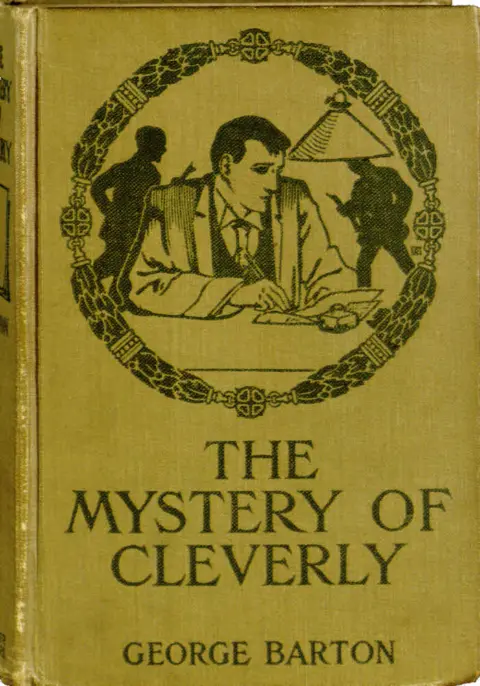
The Mystery of Cleverly: A Story for Boys
George Barton
THE CLASSIC COLLECTION · 1912
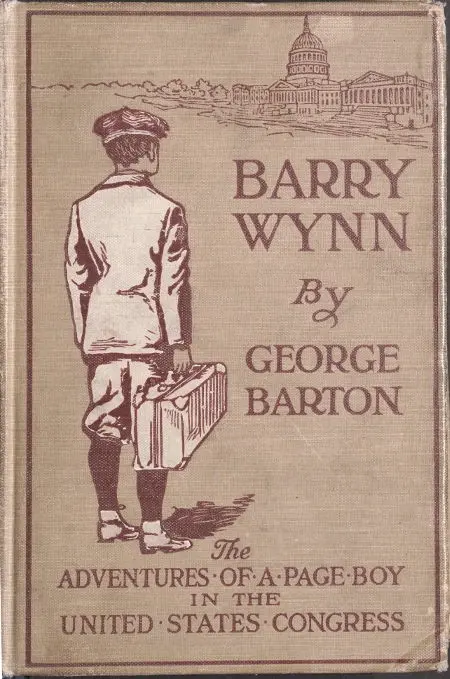
"Barry Wynn; Or, The Adventures of a Page Boy in the United States Congress" by George Barton is a novel written in the early 20th century. The story revolves around a young boy named Barry Wynn, who has just been appointed as a page in the U.S. House of Representatives and is brimming with excitement and ambition as he steps into the world of politics and governance. The book explores Barry's experiences in Washington, including his interactions with political figures and the challenges he faces as he learns the workings of congress. The opening of the novel introduces Barry as he embarks on his journey to Washington, filled with anticipation and naivety. He receives an important package to deliver to Congressman Carlton and begins to understand the significance of his new role. Upon arriving in the Capitol, Barry is struck by the grandeur of the building and its history, but he also faces the realities of being a page boy, including moments of embarrassment and the need to navigate a new environment. His initial encounters with other pages and Congressman Carlton set the foundation for his development and the adventures that lie ahead in the bustling political landscape.
Introduction adapted from the source catalogue; source summaries may be automatically generated.
Free to read · English · 56,288 words · No account needed
MAKE TIME FOR A GOOD BOOK
On by default. Untick to stop anonymous reading totals. Each page counts after 10 seconds in view. How this works.
Anonymous counting is on unless you have switched it off.
Conway made it his business to see that a copy of his paper was placed on the desk of every member. When Carlton entered the House he was surrounded by a group of members who shook hands with him, heartily congratulating him on the forceful interview they had read in the morning paper.
"It was right to the point," said one enthusiastic Westerner, "it was
what we call 'hot stuff.'"
Carlton smiled at the recollection of his talk with Conway.
"I only deserve part of the praise," he said; "most of it belongs to our friend Felix. He's the brightest reporter in Washington."
Hudson, on his entrance, found that he was looked upon with coldness. He realized before long that his latest move against Carlton had been a mistake. He was furious over the counter attack which had been made against him by Felix Conway, but he was helpless to resist it. Moreover, such members as did not openly condemn his own charge against Barry Wynn, slyly ridiculed him. He could not stand that. Few public men can stand up against ridicule. So, at the first opportunity, Hudson slipped out of the House and disappeared from view.
During a lull in the proceedings Mr. Carlton left his desk and started for the office of the Sergeant-at-Arms. He met Conway in the corridor.
"Hello, where are you bound for?" asked the journalist.
"To thrash out this threat of Hudson's," was the response. "I'm going to get a copy of the charges, and then it will be a fight to the finish."
"I reckon you won't have much trouble," said Conway, with the Southern drawl that he used occasionally.
"Won't you go along to see fair play?" laughed the Congressman.
"No," was the reply, with a curious laugh. "I've got all sorts of confidence in your ability to take care of yourself, and I have no sympathy with the other fellow."
Five minutes later Carlton was facing the Sergeant-at-Arms of the House. That official, who knew him well, greeted him most hospitably.
"McDonald," said the Congressman, "I understand that charges were filed with you against Barry Wynn. Is that correct?"
"Yes, sir; it is."
"Well, sir, I'm here to answer in his behalf. I'd like to have a copy of the charges. I'm ready to answer them."
"Very sorry," said the other, with a strange smile, "but I can't oblige
you."
"Why not," asked Carlton, bristling up at once.
"Because there are no charges now."
"No charges now? What do you mean?"
The Sergeant-at-Arms did an amazing thing. He winked at the Congressman. After that he spoke with a significant emphasis.
Your reading position is saved on this browser. Take it to another device with a library code. Reading pages adapt to text, rather than matching a printed edition.
George Barton
George Barton
George Barton
BEHIND THE BOOK
This eBook is for the use of anyone anywhere in the United States and most other parts of the world at no cost and with almost no restrictions whatsoever. You may copy it, give it away or re-use it under the terms of the Project Gutenberg License included with this eBook or online at www.gutenberg.org. If you are not located in the United States, you will have to check the laws of the country where you are located before using this eBook. Read the source licence.
The original source file, including credits and licence, is retained by this library. Request an original-format copy at no charge. Please include the book title and Project Gutenberg identifier #57137.
KEEP YOUR CURIOSITY GOING
Coulson Kernahan

Maurice Baring
Frances Wright
Cécile Tormay

Frederic Jesup Stimson

W. H. P. (William Henry Pope) Jarvis