
1900; or, The last President
Ingersoll Lockwood
THE CLASSIC COLLECTION · 1892
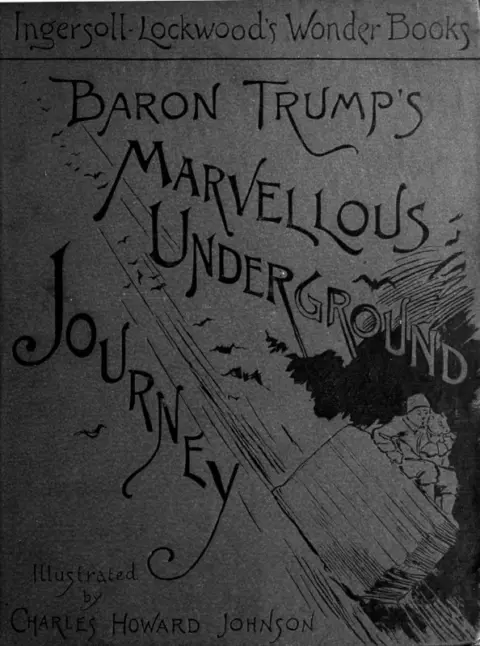
"Baron Trump's Marvellous Underground Journey" by Ingersoll Lockwood is a children's novel written in the late 19th century. This imaginative tale follows the adventures of a young baron named Wilhelm Heinrich Sebastian von Troomp, also known as Baron Trump, alongside his loyal dog, Bulger. Together, they embark on a fantastical journey in search of the mysterious portals to a 'World within a World,' guided by ancient manuscripts and their sense of curiosity. The opening of the story introduces us to Baron Trump and his concerns for his less-than-happy companion, Bulger, who is weary of the familiar surroundings of Castle Trump. After discovering a musty manuscript by Don Fum, which suggests the existence of an underground world, the baron feels compelled to leave home for adventure. His departure is filled with heartfelt farewells from his parents and preparations for what promises to be a thrilling expedition. As Baron Trump and Bulger journey northward through Russia, they face various challenges and characters, including a treacherous teamster named Ivan, hinting at the dangers and marvels that await them in their quest to discover the unknown.
Introduction adapted from the source catalogue; source summaries may be automatically generated.
Free to read · English · 69,999 words · No account needed
MAKE TIME FOR A GOOD BOOK
On by default. Untick to stop anonymous reading totals. Each page counts after 10 seconds in view. How this works.
Anonymous counting is on unless you have switched it off.
He received me very cordially, although I interrupted him at his studies, for, as I entered his apartment, he was in the act of reading four different books at the same time: two were lying on the floor, and he was perusing their raised characters with the soles of his feet, and two others were set up on a frame in front of him and he was deciphering them with the tips of his fingers.
But when informed who I was he stopped work at once and taking up his tablets, asked me a number of questions concerning the upper world, of which he had, however, no very exalted opinion.
“You people,” said he, “if I understand correctly the ancient writings of those of our nation who still preserved certain traditions of the upper world, are endowed with several senses which are utterly lacking in us, I am happy to say, for if I understand correctly ye have in the first place a sense which ye call hearing, a most troublesome sense, for by means of it ye are being constantly disturbed and annoyed by vibrations of the air coming from afar. Now, they can be of no possible good to you. Ye might as well have a sense that would inform you what was going on in the moon. Therefore, my conclusion is, that the sense of hearing only serves to distract and weaken the brain.
“Another sense that ye are possessed of,” continued Barrel Brow, “ye call the sense of sight—a power even more useless and distracting than hearing, for the reason that it enables you to know things which it is utterly bootless to know, such as what your next door neighbors may be doing, how the mountains are acting on the other side of your rivers, how your sky, as ye call it, might feel if you could touch it with your fingers, which ye can’t do, however; how soon rain will fall, which is a useless piece of knowledge if ye have roofs to cover you, as I suppose ye have; but the most ridiculous use which ye make of this sense of sight is the manufacture of what ye call pictures, by means of which ye seem to take the greatest pleasure in deceiving this very sense of which ye are so very proud. If I understand correctly these pictures, if felt of, are quite as smooth as that panel there, but so cunningly do ye draw the lines and lay in the colors, whatever they may be, that ye really succeed in deceiving yourselves and stand for hours in front of one of these bits of trickery when ye might, if ye chose, feast your eyes, as ye call it, upon the very thing which the trickster has imitated. Now, as life is much shorter in the upper world than in ours, it seems very strange to me that ye should wish to waste it in this foolish manner. Then, there is another thing, little baron,” continued the learned Barrel Brow, “which I wish to mention. It is this: The people of the upper world pride themselves very much upon what they term the power of speech, which, if I understand correctly, is a faculty they have of expressing their thoughts to each other by violently expelling the air from their lungs, and that this air, rushing into the ventilators of the brain, which ye call ears, produces a sensation of sound as ye term it, and in this way one of thy people standing at one end of the town might make his wishes known to another standing at the other end. Now, thou wilt pardon my thinking so, little baron, but this seems to me to be not a whit above the brute creature, which, opening its vast jaws, thus sets the air in motion in calling its young or breathing defiance at an enemy. And if I understand correctly, little baron, so proud are thy people of this power of speech that they insist upon making use of it at all times and upon all occasions, and, strange to say, these ‘talkers’ can always find plenty of people to open their ears to these vibrations of the air, although the effect is so wearying to the brain that in the end they invariably fall asleep. But if I understand correctly, the women are even fonder of displaying their skill in thus puffing out the air from their lungs than the men are; but, that not satisfied with this superior power of puffing out the words, they actually have recourse to a potent herb which they steep in boiling water and drink as hot as possible on account of its effect in loosening the tongue and allowing the talker to do more puffing than she could otherwise.
Your reading position is saved on this browser. Take it to another device with a library code. Reading pages adapt to text, rather than matching a printed edition.
Ingersoll Lockwood
Ingersoll Lockwood
Frank R. Stockton & Edgar Fawcett & Franklin Fyles & Anna Katharine Green & Henry Harland & Ingersoll Lockwood & Joaquin Miller & Kirk Munroe & Brainard Gardner Smith & Maurice Thompson & A. C. (Andrew Carpenter) Wheeler
BEHIND THE BOOK
This eBook is for the use of anyone anywhere in the United States and most other parts of the world at no cost and with almost no restrictions whatsoever. You may copy it, give it away or re-use it under the terms of the Project Gutenberg License included with this eBook or online at www.gutenberg.org. If you are not located in the United States, you will have to check the laws of the country where you are located before using this eBook. Read the source licence.
The original source file, including credits and licence, is retained by this library. Request an original-format copy at no charge. Please include the book title and Project Gutenberg identifier #57426.
KEEP YOUR CURIOSITY GOING
Wilfrid Scawen Blunt
Wilfrid Scawen Blunt

E. W. (Edgar Watson) Howe
Coulson Kernahan

Maurice Baring
Frances Wright