
Letters to a Friend, Written to Mrs. Ezra S. Carr, 1866-1879
John Muir
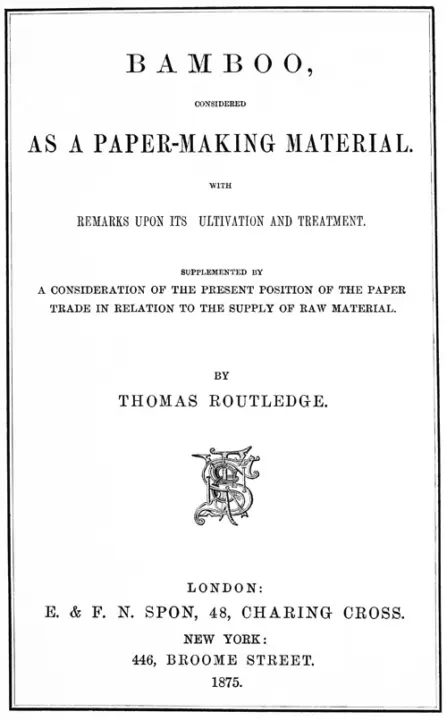
THE CLASSIC COLLECTION · 1875
"Bamboo, Considered as a Paper-making Material" by Thomas Routledge is a scientific publication written in the late 19th century. The book examines the potential of bamboo as a sustainable and economically viable raw material for the paper-making industry, emphasizing its cultivation and processing methods. Routledge argues that bamboo can meet the growing demands for paper due to its rapid growth, high yield, and low cost compared to traditional fibers. In this detailed treatise, Routledge discusses the characteristics of bamboo, including its growth patterns and the chemistry involved in converting it into paper stock. He stresses the importance of harvesting bamboo at an early stage to utilize its fibrous properties before it becomes too woody. Additionally, the book outlines a systematic approach to processing bamboo into paper stock, advocating for a production model that leverages its abundant availability in suitable climates. By juxtaposing bamboo with other fibrous plants like esparto, the author presents a compelling case for its adoption in the paper industry, predicting a significant shift toward this environmentally friendly and efficient source of material.
Introduction adapted from the source catalogue; source summaries may be automatically generated.
Free to read · English · 8,832 words · No account needed
MAKE TIME FOR A GOOD BOOK
On by default. Untick to stop anonymous reading totals. Each page counts after 10 seconds in view. How this works.
Anonymous counting is on unless you have switched it off.
Whatever "Material" the Paper-maker employs, be it Rags (of any denomination) or any other "Fibre," or "Fibrous," substance, after Boiling, he disintegrates, or comminutes it into "Half-Stuff," before, or while bleaching. This process, carried a stage farther, converts the "Half-Stuff" into "Pulp." Herein, not less than in the proper selection of his "Raw Material," lies the skill of the Paper-maker, as, however good his "Material" may be, in its Raw or normal condition, it may be very easily spoilt in either of the processes of Boiling,--Bleaching,--or Pulping.
For example, when Bread is once toasted, thereby becoming brown (and the purer and whiter the greater the change), whereby its chemical and mechanical character has become altered, no power can reconvert it into its original condition; in like manner, however good a "Raw Fibrous Material" may be, if that "Material" be either over-boiled, or over-pulped, no power will restore its normal character.
Moreover, a "Fibrous" substance once reduced to the condition of "Pulp," it is difficult, if not impossible, even for a Microscopist, to distinguish accurately the character or quality of the original "Fibre,"--its strength,--or whether it has been properly or improperly treated, and reduced to that condition--until, perhaps too late, when he has bleached it, and converted it, or attempted to convert it, into a sheet of Paper.
With a Fibrous "Paper-Stock," however, these objections do not apply, or certainly not to the same degree, as the Paper-maker could readily examine and judge of the character and strength of the "Fibre" whether it was clean and free from imperfections or adulterations--in fact, could see what he was buying, or proposing to buy, which he could not do with "Half-Stuff" or "Pulp."
So far as the Producer is concerned, his outlay for the primary "Plant" and the mechanical appliances, the cost of the subsequent treatment, the drying, packing, and economical carriage and freight from a Foreign country, would in all respects be less for "Paper-Stock" than for "Half-Stuff" or "Pulp."
Speaking from the experience of some years, during which I have conducted the manufacture and sale of many thousand tons of "Half-Stuff" prepared from "ESPARTO" and other "Raw Fibres," I feel satisfied that in introducing a New Semi-prepared Material, from a Foreign country, the preference would be given by the practical Paper-maker to a "Fibrous Paper-Stock."
[A] The Journal of the Society of Arts, 28th Nov., 1856, was printed on paper made from Esparto, at Eynsham Mills, near Oxford, then in my occupation.
Transcriber's Notes:
Passages in italics are indicated by underscore.
Fractions are displayed as follows: 1/2 correlates with 1 half, 1-1/2 correlates with 1 and a half....
Your reading position is saved on this browser. Take it to another device with a library code. Reading pages adapt to text, rather than matching a printed edition.
BEHIND THE BOOK
This eBook is for the use of anyone anywhere in the United States and most other parts of the world at no cost and with almost no restrictions whatsoever. You may copy it, give it away or re-use it under the terms of the Project Gutenberg License included with this eBook or online at www.gutenberg.org. If you are not located in the United States, you will have to check the laws of the country where you are located before using this eBook. Read the source licence.
The original source file, including credits and licence, is retained by this library. Request an original-format copy at no charge. Please include the book title and Project Gutenberg identifier #54090.
KEEP YOUR CURIOSITY GOING
John Muir

Asa Gray
Asa Gray

Florence Nightingale
Elizabeth Robins Pennell
Denison Olmsted