
Letters to a Friend, Written to Mrs. Ezra S. Carr, 1866-1879
John Muir
THE CLASSIC COLLECTION · 1875
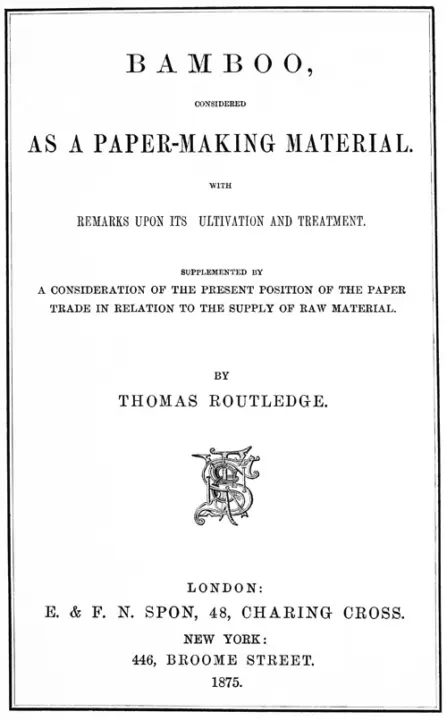
"Bamboo, Considered as a Paper-making Material" by Thomas Routledge is a scientific publication written in the late 19th century. The book examines the potential of bamboo as a sustainable and economically viable raw material for the paper-making industry, emphasizing its cultivation and processing methods. Routledge argues that bamboo can meet the growing demands for paper due to its rapid growth, high yield, and low cost compared to traditional fibers. In this detailed treatise, Routledge discusses the characteristics of bamboo, including its growth patterns and the chemistry involved in converting it into paper stock. He stresses the importance of harvesting bamboo at an early stage to utilize its fibrous properties before it becomes too woody. Additionally, the book outlines a systematic approach to processing bamboo into paper stock, advocating for a production model that leverages its abundant availability in suitable climates. By juxtaposing bamboo with other fibrous plants like esparto, the author presents a compelling case for its adoption in the paper industry, predicting a significant shift toward this environmentally friendly and efficient source of material.
Introduction adapted from the source catalogue; source summaries may be automatically generated.
Free to read · English · 8,832 words · No account needed
MAKE TIME FOR A GOOD BOOK
On by default. Untick to stop anonymous reading totals. Each page counts after 10 seconds in view. How this works.
Anonymous counting is on unless you have switched it off.
The "BAMBOO," being an endogenous plant, (that is to say, growing from inside) composed mainly of fibrous tissue, combined with the ordinary sappy and other extractive matter common to all vegetable growth, the stems do not require the elaborate preparatory manipulation which is necessary to separate the fibrous, from the extraneous and woody matter, which in exogenous plants (i. e. growing from, or on the outside) must be removed, as it is only the true fibre which is useable for Textile Manufactures.
Such plants known to commerce as "FLAX," "HEMP," "JUTE," "RHEA," &c. &c., after having become mature, and being dried, have to undergo a process of retting, or steeping, followed by scutching and heckling, in order to separate the ultimate fibres from the woody stem and bark to which, while in their normal condition, they are attached.
The cost therefore, of producing merchantable fibre from this class of plants is very considerable, and the produce or yield of fibre, to the plant cultivated, very small, that of "FLAX" being computed at from 5 to 6 cwt., "HEMP" 7 cwt., and "JUTE" 5 to 6 cwt. per acre, "COTTON" being much less; "BAMBOO," as I will presently show, producing tons as compared with cwts. of the foregoing, and, be it noted, with far less cost for cultivation, and the subsequent preparation of the fibre.
The stems of the "BAMBOO," cut young, as I propose to use them, contain from 60 to 75 per cent. of moisture; it will be obvious, therefore, that to ensure a regular and continuous supply, under economical conditions, to a central factory for the manufacture of "Paper-Stock," plantations would have to be formed contiguous thereto, as practised with "SUGAR CANE," or in a similar manner to Osier beds, in England.
I have mentioned the latter, as in order to stimulate a rapid, aqueous, and sappy growth, as also to provide for the dry seasons common to hot countries, a system of irrigation would be necessary, such a system indeed being at present practised with the SUGAR CANE, in Egypt, Spain, and elsewhere.
With plantations of "Sugar Cane," to which plant the "BAMBOO" somewhat assimilates in character and growth, it is necessary, in order to ripen the canes and develop saccharine, to allow free ventilation to the growing plant, and thus the ground is not fully occupied; this would not be the case with "BAMBOO," which should be planted and grown closely together to favour the stems shooting upwards, as practised with "HEMP" and "FLAX," where fine staple of fibre is desired.
Your reading position is saved on this browser. Take it to another device with a library code. Reading pages adapt to text, rather than matching a printed edition.
BEHIND THE BOOK
This eBook is for the use of anyone anywhere in the United States and most other parts of the world at no cost and with almost no restrictions whatsoever. You may copy it, give it away or re-use it under the terms of the Project Gutenberg License included with this eBook or online at www.gutenberg.org. If you are not located in the United States, you will have to check the laws of the country where you are located before using this eBook. Read the source licence.
The original source file, including credits and licence, is retained by this library. Request an original-format copy at no charge. Please include the book title and Project Gutenberg identifier #54090.
KEEP YOUR CURIOSITY GOING
John Muir

Asa Gray
Asa Gray

Florence Nightingale
Elizabeth Robins Pennell
Denison Olmsted