THE CLASSIC COLLECTION✦Nigeria and its tin fieldsCLASSIC FREE BOOKS
Nigeria and its tin fields
Albert Frederick Calvert
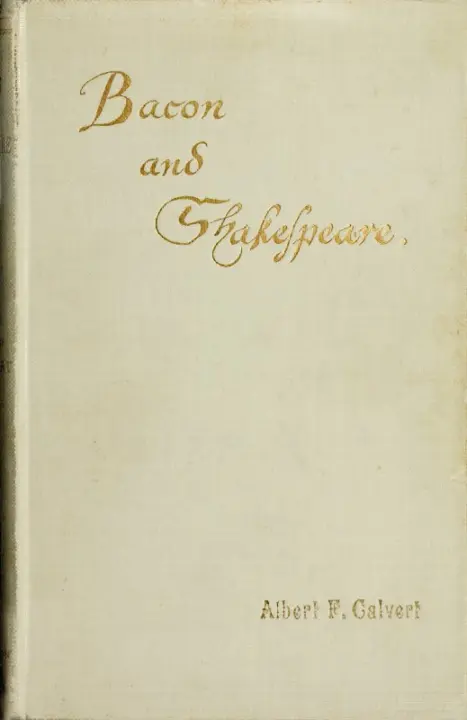
THE CLASSIC COLLECTION · 1902
"Bacon and Shakespeare" by Albert Frederick Calvert is a historical account written in the early 20th century. The work explores the controversial debate surrounding the authorship of William Shakespeare's plays and whether they were actually written by Francis Bacon. The book aims to challenge the claims made by supporters of Baconian theories and to reaffirm Shakespeare's position as the true author of the plays. The opening of the book sets the stage for a detailed examination of the Bacon-Shakespeare authorship controversy. Calvert expresses his skepticism about Baconianism, suggesting that it is based on misunderstandings and misrepresentations of both figures. He indicates that the book will offer evidence and arguments against the notion that Bacon wrote Shakespeare's works, portraying Bacon's character and actions as unworthy of the authorship attributed to him. Through this initial exposition, Calvert intends to equip readers with a clearer understanding of the nuances involved in this literary debate, emphasizing the distinct qualities that characterize both Bacon and Shakespeare.
Introduction adapted from the source catalogue; source summaries may be automatically generated.
Free to read · English · 37,416 words · No account needed
MAKE TIME FOR A GOOD BOOK
On by default. Untick to stop anonymous reading totals. Each page counts after 10 seconds in view. How this works.
Anonymous counting is on unless you have switched it off.
It is interesting in this connection to briefly sum up the concensus of expert opinion that the leading scholars and students of Elizabethan literature hold on the subject. Mr. Sidney Lee, whose Life of William Shakespeare has been called “the most useful, the most judicious, and the most authoritative of all existing biographies of the poet,” regards the theory as “fantastic.” The substance of Mr. Lee’s conclusions is that “the abundance of the contemporary evidence attesting Shakespeare’s responsibility for the works published under his name, gives the Baconian theory no rational right to a hearing; while such authentic examples of Bacon’s effort to write verse as survive prove, beyond all possibility of contradiction, that great as he was as a prose writer and a philosopher, he was incapable of penning any of the poetry assigned to Shakespeare. Defective knowledge and illogical, or casuistical, argument alone render any other conclusion possible.”
Dr. N. H. Hudson, in his Shakespeare: His Life, Art, and Character, has on the Baconian theory four things to say:--1. Bacon’s requital of the Earl’s bounty (the Earl of Essex) was such a piece of ingratitude as I can hardly conceive the author of King Lear to have been guilty of. 2. The author of Shakespeare’s plays, whatever he may have been, certainly was not a scholar. He had certainly something far better than learning, but he had not that. 3. Shakespeare never philosophises. Bacon never does anything else. 4. Bacon’s mind, great as it was, might have been cut out of Shakespeare’s without being missed.
But if, in the absence of anything bearing an even remote resemblance to proof, we find ourselves compelled to make a synopsis of expert opinion on the subject, we shall find no man’s conclusions more deserving of respect and acceptance than those of the late James Spedding. Without intending to cast any reflection upon the critics and others who have plunged with ebullient enthusiasm into this controversy, it may not be out of place to point out that Spedding is head and shoulders above all disputants in knowledge, and second to none in critical ability. His knowledge of Shakespeare was intimate and profound, and he knew his Bacon more thoroughly than it has been the lot of any other man of letters to be known by his fellow man. He gave up his position in the Colonial Office, and declined the position of Under-Secretary of State, with £2,000 a year, in order to devote his whole time to the study of the life and works of Lord Bacon--a task which occupied him for nearly thirty years. Sir Henry Taylor, in a letter to a friend in 1861, wrote as follows:--“I have been reading Spedding’s Life and Letters of Lord Bacon with profound interest and admiration--admiration not of the perfect style and penetrating judgment only, but also of the extraordinary labours bestowed upon the works by a lazy man; the labour of some twenty years, I believe, spent in rummaging among old records in all places they were to be found, and collating different copies of manuscripts written in the handwriting of the 16th century, and noting the minutest variations of one from another--an inexpressibly tedious kind of drudgery, and, what was, perhaps, still worse, searching far and wide, waiting, watching, peering, prying through long years for records which no industry could recover. I doubt whether there be any other example in literary history of so large an intellect as Spedding’s devoting itself, with so much self-sacrifice, to the illustration of one which was larger still, and doing so out of reverence, not so much for that largest intellect, as for the truth concerning it.” Sir Henry Taylor, in this passage, not only does justice to the diligence and genius of the author, but recognises the spirit in which the work was undertaken. Spedding spent thirty years in quest of the truth concerning this remarkable man, and having discovered it, he was prepared to maintain his conclusions with all the power of his knowledge and commanding intelligence. These qualities he exercised with paralysing effect against Lord Macaulay’s Essay on Bacon. It has been claimed by one champion of Shakespeare’s cause that Macaulay’s “well-known depth of research, comprehensive grasp of facts and details, and his calm method of presenting honest conclusions, renders him pre-eminent as a safe authority.” The exact opposite is, of course, the case, but the possession of these very qualities are revealed by Spedding in his Evenings with a Reviewer, to the utter spoliation of a great number of Macaulay’s cherished calculations and conclusions. “No more conscientious, no more sagacious critic,” according to G. S. Venables, “has employed in a not unworthy task the labour of his life,” and the same writer has also declared that “the historical and biographical conclusions which he (Spedding) established depend on an exhaustive accumulation of evidence arranged and interpreted by the clearest of intellects, with an honesty which is rarely known in controversial discussion.” Spedding is, in brief, universally acknowledged to be not only the greatest authority on Bacon, but also of the times in which he lived. His acquaintance with Elizabethan literature, its history, and its manuscripts was unique--he was, it may be said without fear of contradiction, a master of his period. “His knowledge of Shakespeare,” says Venables, in the prefatory notice to Evenings with a Reviewer, “was extensive and profound, and his laborious and subtle criticism derived additional value from his love of the stage.” The opinion of such an authority on such a subject as the authorship of plays attributed to Shakespeare is, in default of proof to the contrary, of the highest possible value--to a close student of Spedding it must appear incontrovertible.
Your reading position is saved on this browser. Take it to another device with a library code. Reading pages adapt to text, rather than matching a printed edition.
Albert Frederick Calvert
Albert Frederick Calvert
Albert Frederick Calvert
Albert Frederick Calvert
BEHIND THE BOOK
This eBook is for the use of anyone anywhere in the United States and most other parts of the world at no cost and with almost no restrictions whatsoever. You may copy it, give it away or re-use it under the terms of the Project Gutenberg License included with this eBook or online at www.gutenberg.org. If you are not located in the United States, you will have to check the laws of the country where you are located before using this eBook. Read the source licence.
The original source file, including credits and licence, is retained by this library. Request an original-format copy at no charge. Please include the book title and Project Gutenberg identifier #49516.
KEEP YOUR CURIOSITY GOING
Cécile Tormay

Moritz Busch
John L. Ransom
Frances Wright
Cécile Tormay

Mabel Potter Daggett