THE CLASSIC COLLECTION✦Nigeria and its tin fieldsCLASSIC FREE BOOKS
Nigeria and its tin fields
Albert Frederick Calvert
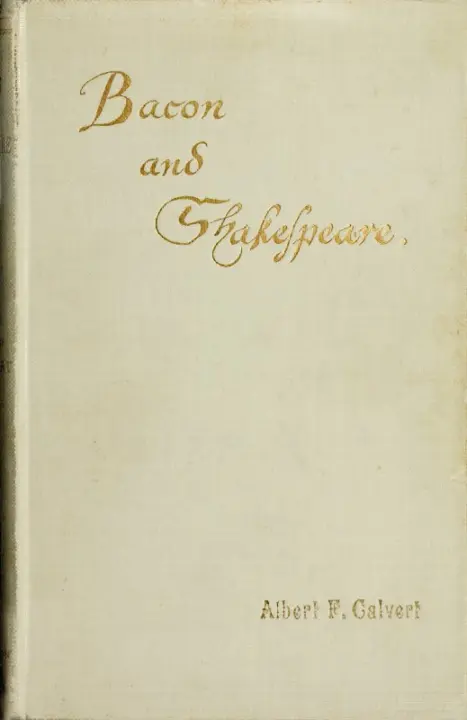
THE CLASSIC COLLECTION · 1902
"Bacon and Shakespeare" by Albert Frederick Calvert is a historical account written in the early 20th century. The work explores the controversial debate surrounding the authorship of William Shakespeare's plays and whether they were actually written by Francis Bacon. The book aims to challenge the claims made by supporters of Baconian theories and to reaffirm Shakespeare's position as the true author of the plays. The opening of the book sets the stage for a detailed examination of the Bacon-Shakespeare authorship controversy. Calvert expresses his skepticism about Baconianism, suggesting that it is based on misunderstandings and misrepresentations of both figures. He indicates that the book will offer evidence and arguments against the notion that Bacon wrote Shakespeare's works, portraying Bacon's character and actions as unworthy of the authorship attributed to him. Through this initial exposition, Calvert intends to equip readers with a clearer understanding of the nuances involved in this literary debate, emphasizing the distinct qualities that characterize both Bacon and Shakespeare.
Introduction adapted from the source catalogue; source summaries may be automatically generated.
Free to read · English · 37,416 words · No account needed
MAKE TIME FOR A GOOD BOOK
On by default. Untick to stop anonymous reading totals. Each page counts after 10 seconds in view. How this works.
Anonymous counting is on unless you have switched it off.
“So help you mercy, that how strange
Or odd soe’er I bear myself--
As I, perchance, hereafter shall think meet
To put an antic disposition on--
That you, at such times seeing me, never shall,
With arms encumber’d thus, or this head shake,
Or by pronouncing of some doubtful phrase,
As ‘Well, well, we know;’--or ‘We could, and if we would;’
Or ‘If we list to speak;’--or, ‘There be, an if they might:’--
Or such ambiguous giving out, to note
That you know aught of me;--This not to do,
So grace and mercy at your most need help you,
Swear.”
No one can question the fitness and perfect appropriateness of the foregoing passage in Hamlet, but it is doubtful if anybody, other than Dr. Owen, will recognise their cogency when they are addressed by Bacon to his unknown decipherer.
Bacon declares that Bottom’s recital of his dream, which commences,
“The eye of man hath not heard,
The ear of man hath not seen,”
is
“Simply and plainly, the ingenious means of writing
Without creating suspicion;”
and he goes on to explain that the decipherer can, by changing
“The words from one end to another, make it read aright.”
Bacon heartens his timorous decipherer with the words, “Be thou not, therefore, afraid of greatness”--the greatness that he will attain as the reward of his decipherations. “Some,” he assures the unknown, in the memorable words, “have greatness thrust upon them,” and he further reminds him that
“There is a tide in the affairs of man,
Which taken at the flood,
Leads on to glorious fortune.”
“Nature and fortune joined to make you great,” Bacon tells his decipherer, from the text of King John, and one can almost imagine Dr. Owen blushing with conscious pride, as he translated this borrowed gem. He implores the modest unknown to free his (Bacon’s) name from the disgraceful part he had in the death of the Earl of Essex, and cries--
“Oh, if I could
I would make a willow cabin at your gate,
And call upon your soul within the house....
You should not rest
Between the elements of earth and air,
But you should pity me----”
Words full of passion and beautiful imagery when spoken by Viola, on behalf of Orsino, to the haughty and unresponsive Lady Olivia, but sheer drivel when taken as Bacon’s exhortation to the discover of his wrongs.
Your reading position is saved on this browser. Take it to another device with a library code. Reading pages adapt to text, rather than matching a printed edition.
Albert Frederick Calvert
Albert Frederick Calvert
Albert Frederick Calvert
Albert Frederick Calvert
BEHIND THE BOOK
This eBook is for the use of anyone anywhere in the United States and most other parts of the world at no cost and with almost no restrictions whatsoever. You may copy it, give it away or re-use it under the terms of the Project Gutenberg License included with this eBook or online at www.gutenberg.org. If you are not located in the United States, you will have to check the laws of the country where you are located before using this eBook. Read the source licence.
The original source file, including credits and licence, is retained by this library. Request an original-format copy at no charge. Please include the book title and Project Gutenberg identifier #49516.
KEEP YOUR CURIOSITY GOING
Cécile Tormay

Moritz Busch
John L. Ransom
Frances Wright
Cécile Tormay

Mabel Potter Daggett