THE CLASSIC COLLECTION✦Nigeria and its tin fieldsCLASSIC FREE BOOKS
Nigeria and its tin fields
Albert Frederick Calvert
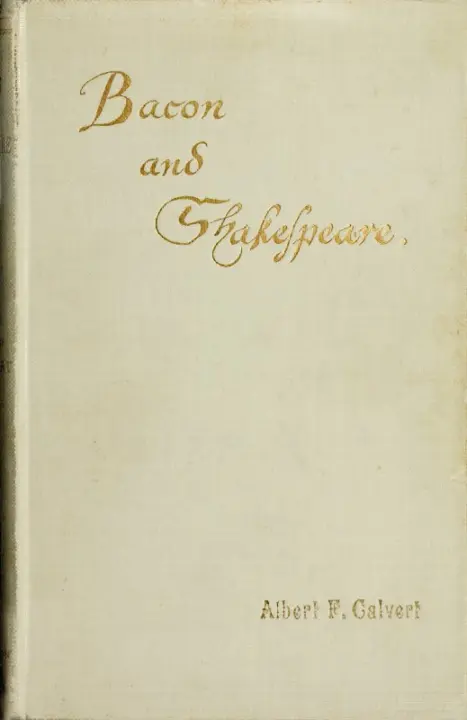
THE CLASSIC COLLECTION · 1902
"Bacon and Shakespeare" by Albert Frederick Calvert is a historical account written in the early 20th century. The work explores the controversial debate surrounding the authorship of William Shakespeare's plays and whether they were actually written by Francis Bacon. The book aims to challenge the claims made by supporters of Baconian theories and to reaffirm Shakespeare's position as the true author of the plays. The opening of the book sets the stage for a detailed examination of the Bacon-Shakespeare authorship controversy. Calvert expresses his skepticism about Baconianism, suggesting that it is based on misunderstandings and misrepresentations of both figures. He indicates that the book will offer evidence and arguments against the notion that Bacon wrote Shakespeare's works, portraying Bacon's character and actions as unworthy of the authorship attributed to him. Through this initial exposition, Calvert intends to equip readers with a clearer understanding of the nuances involved in this literary debate, emphasizing the distinct qualities that characterize both Bacon and Shakespeare.
Introduction adapted from the source catalogue; source summaries may be automatically generated.
Free to read · English · 37,416 words · No account needed
MAKE TIME FOR A GOOD BOOK
On by default. Untick to stop anonymous reading totals. Each page counts after 10 seconds in view. How this works.
Anonymous counting is on unless you have switched it off.
“As I have often said ... you have poems and prose workes on divers theames in all such various stiles, as are put before th’ world as Greene’s, as Shakespeare’s, Burto’s, as Peele’s, Spenser’s, as Marlowe’s, as Jonso’ dramas ... for I varied my stile to suit different men, since no two shew th’ same taste and like imagination....”
“Any play publisht as Marlowe’s, came from th’ same source as all which you will now work out....”
“Greene, Spense’, Peele, Shakespeare, Burton, and Marley, as you may somewhere see it, or, as it is usually given, Marlowe, have thus farre been my masques....”
“A few workes also beare th’ name o’ my friend, Ben Jonson--these are Sejanus and th’ Masques, used to conceale the Iliads chiefly and to make use o’ my newe cipher....”
“I masqued manie grave secrets in my poems which I have publisht, now as Peele’s or Spenser’s, now as my owne, then againe in th’ name of authours, so cald, who plac’d workes of mixt sort before a reading world, prose and poetry. To Robt. Greene did I entruste most of that work....”
Bacon has limited our speculations upon the extent of his literary work by definitely mentioning the works which he wrote in a cipher discovered by Dr. Owen:
“We will enumerate them by their whole titles From the beginning to the end: William Shakespeare, Robert Greene, George Peele, and Christopher Marlowe’s Stage plays; The Faerie Queen, Shepherd’s Calendar, And all the works of Edmund Spenser; The Anatomy of Melancholy of Robert Burton, The History of Henry VII., The Natural History, The Interpretation of Nature, The Great Instauration, Advancement of Learning, The De Augmentis Scientiarum, Our Essays, and all the other works of our own.”
Even when we note that the Advancement and De Augmentis are the English and Latin versions of the same work--a fact that Dr. Owen appears to have overlooked--Mr. Theobald must acknowledge that this represents a very fair literary output, but it does not form the full list of his works. The names of his cipher or interiour works, are enumerated by Mrs. Gallup:
“There are five histories as followes: The Life o’ Elizabeth, The Life of Essex, The White Rose o’ Britaine, The Life and Death of Edward Third, The Life of Henry th’ Seventh; five tragedies: Mary Queene o’ Scots, Robert th’ Earl o’ Essex (my late brother), Robert th’ Earle o’ Leicester (my late father), Death o’ Marlowe, Ann Bullen; three comedies: Seven Wise Men o’ th’ West, Solomon th’ Second, The Mouse-Trap.”
Bacon and “Divine Aide.”
Your reading position is saved on this browser. Take it to another device with a library code. Reading pages adapt to text, rather than matching a printed edition.
Albert Frederick Calvert
Albert Frederick Calvert
Albert Frederick Calvert
Albert Frederick Calvert
BEHIND THE BOOK
This eBook is for the use of anyone anywhere in the United States and most other parts of the world at no cost and with almost no restrictions whatsoever. You may copy it, give it away or re-use it under the terms of the Project Gutenberg License included with this eBook or online at www.gutenberg.org. If you are not located in the United States, you will have to check the laws of the country where you are located before using this eBook. Read the source licence.
The original source file, including credits and licence, is retained by this library. Request an original-format copy at no charge. Please include the book title and Project Gutenberg identifier #49516.
KEEP YOUR CURIOSITY GOING
Cécile Tormay

Moritz Busch
John L. Ransom
Frances Wright
Cécile Tormay

Mabel Potter Daggett