THE CLASSIC COLLECTION✦The history of the condition of women in various ages and nationsCLASSIC FREE BOOKS
The history of the condition of women in various ages and nations
Lydia Maria Child
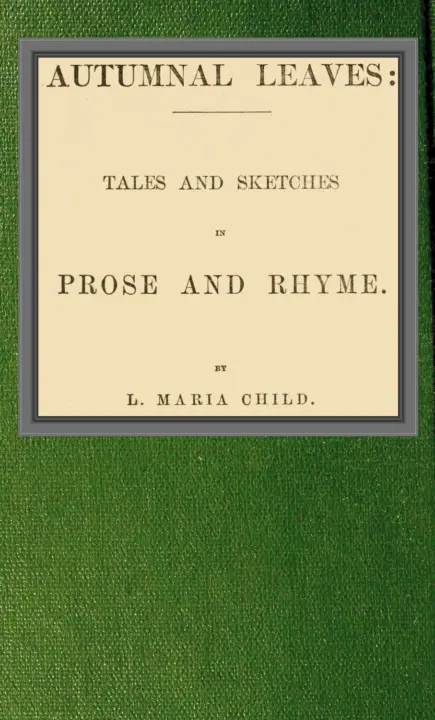
THE CLASSIC COLLECTION · 1857
"Autumnal Leaves: Tales and Sketches in Prose and Rhyme" by Lydia Maria Child is a collection of literary sketches and stories written in the mid-19th century. The work intertwines poetry and prose, offering a variety of narratives that explore themes of love, beauty, nature, and social distinction. At the heart of these sketches are characters like Edward Vernon and Sibella Flower, who navigate the complexities of class, aspiration, and romantic ideals within their societal constraints. The opening of this collection introduces us to a scene where social class and beauty intersect, showcasing the characters of Edward Vernon and Sibella Flower. Edward, an aristocratic young man, is captivated by Sibella, a beautiful nursery maid, causing tension within his family, particularly with his status-conscious sister, Julia. Sibella, meanwhile, struggles with her own feelings, aware of the societal barriers that separate her from Edward. As their admiration for one another grows, the narrative hints at the challenges they will face due to their differing social standings, setting a tone of bittersweet romanticism that permeates the collection.
Introduction adapted from the source catalogue; source summaries may be automatically generated.
Free to read · English · 84,925 words · No account needed
MAKE TIME FOR A GOOD BOOK
On by default. Untick to stop anonymous reading totals. Each page counts after 10 seconds in view. How this works.
Anonymous counting is on unless you have switched it off.
“The interior workmanship is not yet examined,” rejoined his amiable competitor. “There is not a better mechanician in all Switzerland, than Pierre Berthoud.”
“Ah, but you know how to invest equally good workmanship with grace and beauty,” replied the more heavily moulded Genevan.
“Study the Graces, my boy; make yourself familiar with models of beauty,” said old Antoine Breguet, laying a friendly hand upon the young man’s shoulder.
“I should but imitate, and he creates,” answered Pierre, despondingly; “and worst of all, my good master, I hate myself because I envy him.”
“But you have many and noble gifts, Pierre,” said Rosabella, gently. “You know how delightfully very different instruments combine in harmony. Grandfather says your workmanship will be far more durable than Florien’s. Perhaps you may both be his partners.”
“But which of us will be thine?” thought Pierre. He smothered a deep sigh, and only answered, “I thank you, Rosabella.”
Well aware that these envious feelings were unworthy of a noble soul, he contended with them bravely, and treated Florien even more cordially than usual. “I will follow our good master’s advice,” said he; “I will try to clothe my good machinery in forms of beauty. Let us both make a watch for Rosabella, and present it to her on her next birth-day. You will rival me, no doubt; for the Graces threw their garlands on you when you were born.” “Bravo!” shouted Florien, laughing and clapping his hands. “The poetry is kindling up in your soul. I always told you that you would be a poet, if you could only express what was in you.”
“And your soul expresses itself so easily, so fluently!” said
Pierre, with a sigh.
“Because my springs lie so near the surface, and yours have depths to come from,” replied his good-natured companion.
“The worst of it is, the cord is apt to break before I can draw up my weighty treasures,” rejoined Pierre, with a smile. “There is no help for it. There will always be the same difference between us, that there is in our names. I am a rock, and you are a flower. I might be hewed and chiselled into harmonious proportions; but you grow into beauty.”
“Then be a rock, and a magnificent one,” replied his friend, “and let the flower grow at your feet.”
“That sounds modestly and well,” answered Pierre; “but I wish to be a flower, because----”
“Because what?” inquired Florien, though he half guessed the secret, from his embarrassed manner.
“Because I think Rosabella likes flowers better than rocks,” replied Pierre, with uncommon quickness, as if the words gave him pain.
Your reading position is saved on this browser. Take it to another device with a library code. Reading pages adapt to text, rather than matching a printed edition.
Lydia Maria Child
Lydia Maria Child
Lydia Maria Child
Lydia Maria Child
BEHIND THE BOOK
This eBook is for the use of anyone anywhere in the United States and most other parts of the world at no cost and with almost no restrictions whatsoever. You may copy it, give it away or re-use it under the terms of the Project Gutenberg License included with this eBook or online at www.gutenberg.org. If you are not located in the United States, you will have to check the laws of the country where you are located before using this eBook. Read the source licence.
The original source file, including credits and licence, is retained by this library. Request an original-format copy at no charge. Please include the book title and Project Gutenberg identifier #67832.
KEEP YOUR CURIOSITY GOING

David Patterson (Spirit) Hatch

David Patterson (Spirit) Hatch

David Patterson (Spirit) Hatch
Coulson Kernahan

Ralph Waldo Emerson

Maurice Baring