THE CLASSIC COLLECTION✦The history of the condition of women in various ages and nationsCLASSIC FREE BOOKS
The history of the condition of women in various ages and nations
Lydia Maria Child
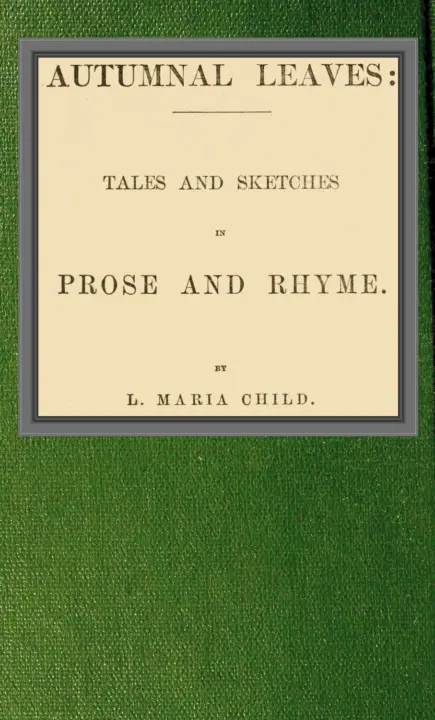
THE CLASSIC COLLECTION · 1857
"Autumnal Leaves: Tales and Sketches in Prose and Rhyme" by Lydia Maria Child is a collection of literary sketches and stories written in the mid-19th century. The work intertwines poetry and prose, offering a variety of narratives that explore themes of love, beauty, nature, and social distinction. At the heart of these sketches are characters like Edward Vernon and Sibella Flower, who navigate the complexities of class, aspiration, and romantic ideals within their societal constraints. The opening of this collection introduces us to a scene where social class and beauty intersect, showcasing the characters of Edward Vernon and Sibella Flower. Edward, an aristocratic young man, is captivated by Sibella, a beautiful nursery maid, causing tension within his family, particularly with his status-conscious sister, Julia. Sibella, meanwhile, struggles with her own feelings, aware of the societal barriers that separate her from Edward. As their admiration for one another grows, the narrative hints at the challenges they will face due to their differing social standings, setting a tone of bittersweet romanticism that permeates the collection.
Introduction adapted from the source catalogue; source summaries may be automatically generated.
Free to read · English · 84,925 words · No account needed
MAKE TIME FOR A GOOD BOOK
On by default. Untick to stop anonymous reading totals. Each page counts after 10 seconds in view. How this works.
Anonymous counting is on unless you have switched it off.
“So you know this person?” inquired his sister.
He replied, “I have merely spoken to her on the occasion of returning a ball, that one of the children tossed over into our grounds. But casually as I have seen her, her countenance and manners impress me with the respect that you feel for high birth.”
“It’s a pity you were not born in the back-woods of America,” retorted his sister, pettishly.
“I sometimes think so myself,” he quietly replied. “But let us gather some of these wild flowers, Julia, instead of disputing about conventional distinctions, concerning which you and I can never agree.”
His sister coldly accepted the flowers he offered. Her temper was clouded by the incident of the morning. It vexed her that Edward had never said, or implied, so much concerning her style of beauty; and she could not forgive the tendencies of mind which spoiled him for the part she wished him to perform in the world, as a means of increasing his own importance, and thereby advancing her interests. She had the misfortune to belong to an English family extensively connected with the rich and aristocratic, without being themselves largely endowed with wealth. Cousin Alfred, the son of her father’s older brother, was heir to a title; and consequently she measured every thing by his standard. The income of the family was more than sufficient for comfort and gentility; but the unfortunate tendency to assume the habits of others as their standard rendered what might have been a source of enjoyment a cause of discontent.
Their life was a constant struggle to keep up appearances beyond their means. All natural thoughts and feelings were kept in perpetual harness; drilled to walk blindfolded the prescribed round of conventional forms, like a horse in a bark-mill; with this exception, that their routine spoiled the free paces of the horse, without grinding any bark. Edward’s liberal soul had early rebelled against this system. He had experienced a vague consciousness of walking in fetters ever since he was reproved for bringing home a favourite school-mate to pass the vacation with him, when he was twelve years old. He could not then be made to understand why a manly, intelligent, large-hearted boy, who was a tradesman’s son, was less noble than young Lord Smallsoul, cousin Alfred’s school-friend; and within the last few weeks, circumstances had excited his thoughts to unusual activity concerning natural and artificial distinctions. As he walked in the garden, book in hand, he never failed to see the beautiful nursery-maid, if she were anywhere within sight; and she always perceived him. In her eyes, he was like a bright, far-off star; while he was refreshed by a vision of her, as he was by the beauty of an opening flower. Distinction of rank was such a fixed fact in the society around them, that the star and the flower dreamed of union as much as they did. But Cupid, who is the earliest republican on record, willed that things should not remain in that state. A bunch of fragrant violets were offered with a smile and received with a blush; and in the blush and the smile an arrow lay concealed. Then volumes of poems were loaned with passages marked; and every word of those passages were stereotyped on the heart of the reader. For a long time, he was ignorant of her name; but hearing the children call her Sibella, he inquired her other name, and they told him it was Flower. He thought it an exceedingly poetic and appropriate name; as most young men of twenty would have thought, under similar circumstances. He noticed the sequestered lanes where she best loved to rove, when sent out with the children for exercise; and those lanes became his own favourite places of resort. Wild flowers furnished a graceful and harmless topic of conversation; yet Love made even those simple things his messengers. Patrician Edward offered the rustic Sibella an Eglantine, saying, “This has a peculiar charm for me, above all flowers. It is so fragrant and delicately tinted; so gracefully untrained, and so modest in its pretensions. It always seems to me like a beautiful young maiden, without artificial culture, but naturally refined and poetic. The first time I saw you, I thought of a flowering Eglantine; and I have never since looked at the shrub, without being reminded of you.” She listened, half abashed and half delighted. She never saw the flower again without thinking of him.
Your reading position is saved on this browser. Take it to another device with a library code. Reading pages adapt to text, rather than matching a printed edition.
Lydia Maria Child
Lydia Maria Child
Lydia Maria Child
Lydia Maria Child
BEHIND THE BOOK
This eBook is for the use of anyone anywhere in the United States and most other parts of the world at no cost and with almost no restrictions whatsoever. You may copy it, give it away or re-use it under the terms of the Project Gutenberg License included with this eBook or online at www.gutenberg.org. If you are not located in the United States, you will have to check the laws of the country where you are located before using this eBook. Read the source licence.
The original source file, including credits and licence, is retained by this library. Request an original-format copy at no charge. Please include the book title and Project Gutenberg identifier #67832.
KEEP YOUR CURIOSITY GOING

David Patterson (Spirit) Hatch

David Patterson (Spirit) Hatch

David Patterson (Spirit) Hatch
Coulson Kernahan

Ralph Waldo Emerson

Maurice Baring