THE CLASSIC COLLECTION✦The history of the condition of women in various ages and nationsCLASSIC FREE BOOKS
The history of the condition of women in various ages and nations
Lydia Maria Child
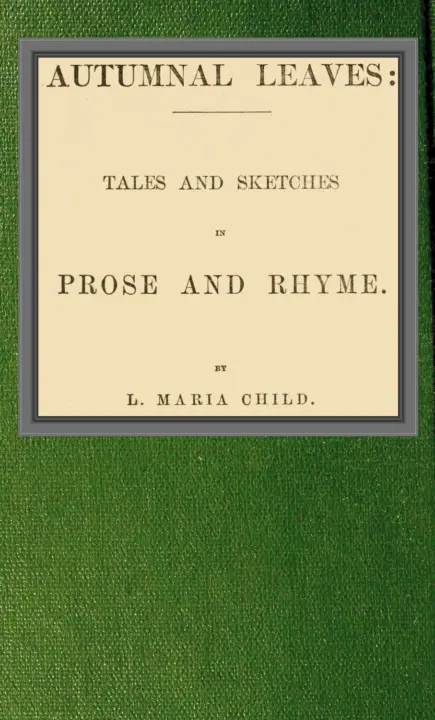
THE CLASSIC COLLECTION · 1857
"Autumnal Leaves: Tales and Sketches in Prose and Rhyme" by Lydia Maria Child is a collection of literary sketches and stories written in the mid-19th century. The work intertwines poetry and prose, offering a variety of narratives that explore themes of love, beauty, nature, and social distinction. At the heart of these sketches are characters like Edward Vernon and Sibella Flower, who navigate the complexities of class, aspiration, and romantic ideals within their societal constraints. The opening of this collection introduces us to a scene where social class and beauty intersect, showcasing the characters of Edward Vernon and Sibella Flower. Edward, an aristocratic young man, is captivated by Sibella, a beautiful nursery maid, causing tension within his family, particularly with his status-conscious sister, Julia. Sibella, meanwhile, struggles with her own feelings, aware of the societal barriers that separate her from Edward. As their admiration for one another grows, the narrative hints at the challenges they will face due to their differing social standings, setting a tone of bittersweet romanticism that permeates the collection.
Introduction adapted from the source catalogue; source summaries may be automatically generated.
Free to read · English · 84,925 words · No account needed
MAKE TIME FOR A GOOD BOOK
On by default. Untick to stop anonymous reading totals. Each page counts after 10 seconds in view. How this works.
Anonymous counting is on unless you have switched it off.
In the midst of discouragements and dangers, the brave band of settlers went on with their work. Better stores were erected, and, one after another, the temporary cabins gave place to comfortable stone houses.
An Emigrant Aid Society had been formed in the North, whose object it was to assist in the erection of mills, school-houses, and other buildings, for the public benefit. Their motive was partly financial, inasmuch as all such improvements rapidly increased the value of property in Kansas; and they were well aware that the outward prosperity, as well as the moral strength of a state depended greatly upon encouraging emigrants to go from communities where they had been accustomed to free institutions, educational privileges, orderly habits, and salutary laws. Their motives in extending a helping hand to these infant colonies, were both morally good and worldly wise. There was no partiality in their management of affairs. Emigrants from the Southern states shared their benefits equally with those from the North. Settlers were pouring in from all sections of the country; but chiefly from the North and West, because the hardy inhabitants of those states are always ready for enterprise and toil. Many of them had large families of children, and the small half-furnished tavern, called the Cincinnati House, was quite insufficient to afford them shelter while cabins were prepared for them. In the course of their first summer, John Bradford and his band of pilgrims had the satisfaction of seeing a noble stone hotel, of three stories, rise in Massachusetts street, making the place beautiful with its glazed windows, and doors of polished black walnut.
Unfortunately, the only route to Kansas, by rail-road or steamboat, passed through Missouri. Baggage-wagons were continually plundered, and letters broken open and destroyed, by the Border Ruffians. Supplies of provisions, purchased by the settlers, or sent to them by their friends, went to enrich their enemies. Money enclosed in letters met with the same fate. Still the settlers of Kansas pursued a pacific course toward their persecutors. They came from communities where laws were reliable for protection, and, following their old habits, they appealed to the laws; desirous, at all hazards, not to involve the country in civil war. This conscientious patriotism was not appreciated. The banditti on the borders laughed it to scorn; while the slaveholding gentlemen and statesmen, who used them as puppets, to do the disgraceful work they were ashamed to do openly themselves, smiled at the Yankees’ reverence for the Union, and successfully played their old game of practicing on conscientious love of country, in order to tighten the serpent coil of slavery more securely about the neck of freedom. Missourians had voted their own creatures into most of the offices of Kansas. Some of them pitched a tent in that Territory for a while, while others did not even assume the appearance of residing there. From such officers of justice the citizens of Kansas could find no redress for the robberies and wrongs continually inflicted on them, by the band of ruffians commissioned to drive them out of the Territory, by any means that would do it most effectually. Our wrongs from the British government were slight, compared with theirs. Still these Western Colonies refrained from revolution. They sent agents to Washington, with well-attested evidence of their outrageous wrongs. They received fair words, and no relief. Every day it became more evident that the President of the United States was in league with the power that was crushing free Kansas. The Missourians, emboldened by their knowledge of this fact, played their bad game more and more openly. They paid men a dollar a day, with plenty of whiskey, and free passage across the ferries, to go into Kansas and vote down the rights of the citizens. More and more, the conviction grew upon the people of Kansas that they could not trust the government of the United States, and consequently had only their own energies to rely upon. They published a paper called the Herald of Freedom, in which they maintained the right of all American citizens to choose their own magistrates, and make their own laws. They rejected the legislators imposed upon them by the rabble of Missouri, at the point of the bayonet. They declared that a large majority of the settlers were desirous to have Kansas a Free State, and that they would maintain their right to be heard. To this paper, John Bradford and William Bruce were constant contributors, and Kate’s brother, Thomas, was diligent in setting the types. Of course, the family became odious to those who were bent on driving freedom out of Kansas.
Your reading position is saved on this browser. Take it to another device with a library code. Reading pages adapt to text, rather than matching a printed edition.
Lydia Maria Child
Lydia Maria Child
Lydia Maria Child
Lydia Maria Child
BEHIND THE BOOK
This eBook is for the use of anyone anywhere in the United States and most other parts of the world at no cost and with almost no restrictions whatsoever. You may copy it, give it away or re-use it under the terms of the Project Gutenberg License included with this eBook or online at www.gutenberg.org. If you are not located in the United States, you will have to check the laws of the country where you are located before using this eBook. Read the source licence.
The original source file, including credits and licence, is retained by this library. Request an original-format copy at no charge. Please include the book title and Project Gutenberg identifier #67832.
KEEP YOUR CURIOSITY GOING

David Patterson (Spirit) Hatch

David Patterson (Spirit) Hatch

David Patterson (Spirit) Hatch
Coulson Kernahan

Ralph Waldo Emerson

Maurice Baring