THE CLASSIC COLLECTION✦The history of the condition of women in various ages and nationsCLASSIC FREE BOOKS
The history of the condition of women in various ages and nations
Lydia Maria Child
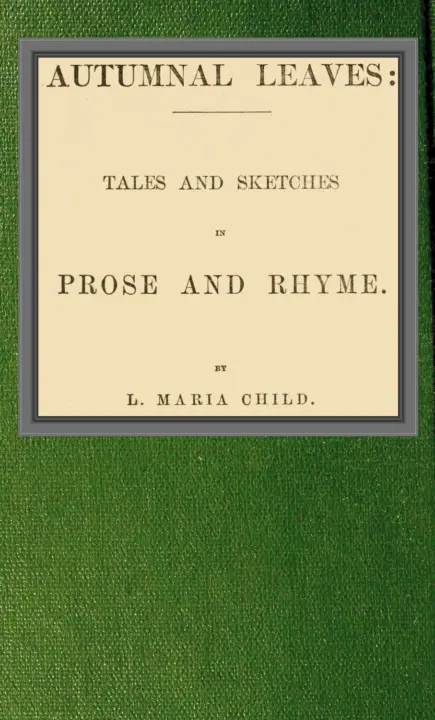
THE CLASSIC COLLECTION · 1857
"Autumnal Leaves: Tales and Sketches in Prose and Rhyme" by Lydia Maria Child is a collection of literary sketches and stories written in the mid-19th century. The work intertwines poetry and prose, offering a variety of narratives that explore themes of love, beauty, nature, and social distinction. At the heart of these sketches are characters like Edward Vernon and Sibella Flower, who navigate the complexities of class, aspiration, and romantic ideals within their societal constraints. The opening of this collection introduces us to a scene where social class and beauty intersect, showcasing the characters of Edward Vernon and Sibella Flower. Edward, an aristocratic young man, is captivated by Sibella, a beautiful nursery maid, causing tension within his family, particularly with his status-conscious sister, Julia. Sibella, meanwhile, struggles with her own feelings, aware of the societal barriers that separate her from Edward. As their admiration for one another grows, the narrative hints at the challenges they will face due to their differing social standings, setting a tone of bittersweet romanticism that permeates the collection.
Introduction adapted from the source catalogue; source summaries may be automatically generated.
Free to read · English · 84,925 words · No account needed
MAKE TIME FOR A GOOD BOOK
On by default. Untick to stop anonymous reading totals. Each page counts after 10 seconds in view. How this works.
Anonymous counting is on unless you have switched it off.
Undoubtedly, he was a vexation to an earth-born woman--that mild, dreamy, saintly man! The distance between them inevitably grew wider and wider; and the process was hastened by changes in the condition of Hermotimus. Though he had become more healthy in youth, than he was in infancy, there had never been a complete union between his soul and body. The inner and outer circles of his being, instead of clasping into each other, touched only at one point, and so remained nearly strangers. At the time of his marriage, he was believed to have outgrown the feebleness of his childhood, and to have lost the power of prophecy. But two years afterward, he fell asleep one day in the same grotto of Apollo to which his mother had been accustomed to carry offerings. He came out pale and chill, and was that night seized with a singular kind of fits, which continued to attack him more and more frequently. The old gossip was renewed. The neighbours said his father, the divine Apollo, had kissed him in his sleep, and he would never be like other men. Praxinoë nursed him carefully, for she had a kindly heart. But when the fits were on him, he inspired a degree of awe amounting almost to terror; for his looks and words impressed her with a strong conviction that he was some sort of a Spirit, and not a mortal man. At times, he told her the most secret thoughts of her heart, and repeated word for word what had been said to her, when he was out of hearing. He frequently described magnificent cities, gorgeous birds, and beautiful flowers, she had never seen or heard of. But what made her shudder more than all else, was the familiar intercourse he described with relatives and friends long since dead. If she were alone with him, during these strange visitations, he never answered when she spoke, or gave any indication that he was aware of her presence. But there was one person, to whose questions he always replied. In the neighbouring city of Clazomenæ lived a Pythagorean philosopher, named Prytanes. He heard rumours of the singular childhood of Hermotimus, and of the extraordinary fits that had come upon him in manhood; and he was desirous to ascertain how far these accounts had been exaggerated. When he made his first visit to him who was called The Sleeping Prophet, he found him lying upon a couch motionless and senseless. He took hold of his hand, and found it cold and rigid; but a change went over the countenance, like the light which drives shadows across the fields; and Hermotimus said, “I am glad you have come again; for, above all things, I have enjoyed our pleasant walks together in the groves, talking of the wings of the soul.” This seemed marvellous to Prytanes; for never, to his knowledge, had he spoken with Hermotimus. But when he asked questions concerning their conversations, the sleeper revealed to him many thoughts, which he remembered to have passed through his own mind, at various times, and which had seemed to him, at the moment, as if they did not originate in himself, but had come to him from some unknown source; thoughts which he in fact believed to have been imparted by supernal beings. When Prytanes returned to Clazomenæ, he gave an account of this wonderful experience, in public discourses to his disciples; and the fame of Hermotimus spread more and more widely. Priests and philosophers came to listen to his conversations with Prytanes; and while some went away incredulous, others were deeply impressed with awe. From far and near, people brought the diseased to him, begging him to prescribe a cure; and the rumour went round that sometimes, when he merely passed his hands over them, their pains departed. In these days, he would have been called a clairvoyant; but what we style animal-magnetism had then never been mentioned; though its phenomena were occasionally manifested, as they always have been, wherever the spiritual and physical circle of man’s compound existence is partially disjoined. Scientific causes were then little investigated. Health, beauty, eloquence, poetry, and all other things, were supposed to be direct and special gifts from some god. No wonder then that many believed Hermotimus to be really the son of Apollo, receiving the gift of healing and of prophecy from immediate and continual intercourse with his divine father.
Your reading position is saved on this browser. Take it to another device with a library code. Reading pages adapt to text, rather than matching a printed edition.
Lydia Maria Child
Lydia Maria Child
Lydia Maria Child
Lydia Maria Child
BEHIND THE BOOK
This eBook is for the use of anyone anywhere in the United States and most other parts of the world at no cost and with almost no restrictions whatsoever. You may copy it, give it away or re-use it under the terms of the Project Gutenberg License included with this eBook or online at www.gutenberg.org. If you are not located in the United States, you will have to check the laws of the country where you are located before using this eBook. Read the source licence.
The original source file, including credits and licence, is retained by this library. Request an original-format copy at no charge. Please include the book title and Project Gutenberg identifier #67832.
KEEP YOUR CURIOSITY GOING

David Patterson (Spirit) Hatch

David Patterson (Spirit) Hatch

David Patterson (Spirit) Hatch
Coulson Kernahan

Ralph Waldo Emerson

Maurice Baring