THE CLASSIC COLLECTION✦The history of the condition of women in various ages and nationsCLASSIC FREE BOOKS
The history of the condition of women in various ages and nations
Lydia Maria Child
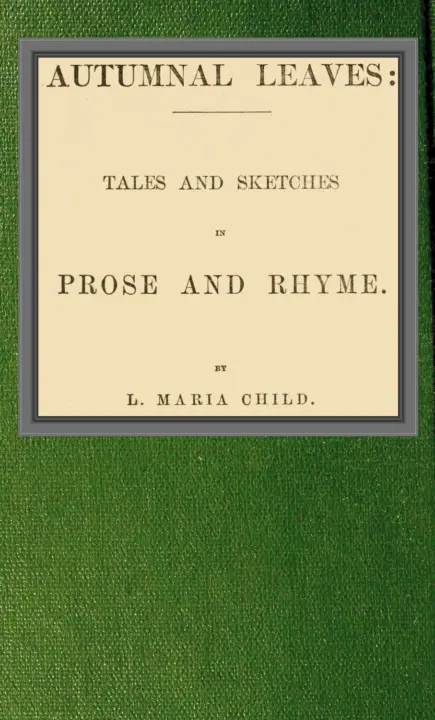
THE CLASSIC COLLECTION · 1857
"Autumnal Leaves: Tales and Sketches in Prose and Rhyme" by Lydia Maria Child is a collection of literary sketches and stories written in the mid-19th century. The work intertwines poetry and prose, offering a variety of narratives that explore themes of love, beauty, nature, and social distinction. At the heart of these sketches are characters like Edward Vernon and Sibella Flower, who navigate the complexities of class, aspiration, and romantic ideals within their societal constraints. The opening of this collection introduces us to a scene where social class and beauty intersect, showcasing the characters of Edward Vernon and Sibella Flower. Edward, an aristocratic young man, is captivated by Sibella, a beautiful nursery maid, causing tension within his family, particularly with his status-conscious sister, Julia. Sibella, meanwhile, struggles with her own feelings, aware of the societal barriers that separate her from Edward. As their admiration for one another grows, the narrative hints at the challenges they will face due to their differing social standings, setting a tone of bittersweet romanticism that permeates the collection.
Introduction adapted from the source catalogue; source summaries may be automatically generated.
Free to read · English · 84,925 words · No account needed
MAKE TIME FOR A GOOD BOOK
On by default. Untick to stop anonymous reading totals. Each page counts after 10 seconds in view. How this works.
Anonymous counting is on unless you have switched it off.
She was under the necessity of returning to Chicago the next day, to attend to her school. In another department of the school, was a teacher from New England, a farmer’s son, who had worked with his hands in the summer, and studied diligently in the winter, till he had become a scholar of more than common attainments. He taught school during the week, and occasionally preached on Sunday, not because he was too indolent to perform manual labour, or because he considered it ungenteel. He was attracted toward books by a genuine thirst for knowledge; and he devoted himself to moral and intellectual teaching, for the simple reason that God had formed him for it. He loved the occupation, and was therefore eminently successful in it. This young man had for some time been in love with Sibella Flower, without obtaining any signs of encouragement from her. But there is much truth in the old adage about the facility of catching a heart at the rebound. He never wrote poetry, or spoke eloquently about the beauties of scenery; for his busy intellect employed itself chiefly with history, science, and ethics. But though he was unlike Edward Vernon, he was gentle, good, and wise; and, after her morning-dream had vanished utterly, Sibella became aware that his society furnished pleasant companionship for heart and mind. Their intimacy gradually increased, and they finally married. Being desirous to purchase land and build a house, they continued to earn money by teaching. The desired home, with its various belongings, seemed likely to be soon completed, without great expense; for William Wood had all the capabilities of a genuine Yankee. He could hew logs and plane them, make rustic tables, benches, and arbours, and mend his own shoes and saddles, during the intervals of preparing lectures on chemistry and astronomy. In this imperfect existence, there is perhaps no combination of circumstances more favourable to happiness, than the taste to plan a beautiful home, practical skill to embody the graceful ideas, and the necessity of doing it with one’s own hands. Those who have homes prepared for them by hired architects, gardeners, and upholsterers, cannot begin to imagine the pleasure of making a nest for one’s self. William was always planning bridges, arbours, and fences, and Sibella never saw a beautiful wild shrub, or vine, without marking it to be removed to the vicinity of their cabin. She told him all about her early love-dream, and said she should always cherish a grateful remembrance of it, because it had proved such a powerful agent to wake up the dormant energies of her soul. “I am a Wood-Flower now, dear William,” said she, playfully; “and, after all, that is no great change for an Eglantine.” He smiled, and said he wished he was as poetic as she was. He was poetic in his deeds. His young wife often found a bunch of fragrant wild-flowers on her pillow, when she woke, or in her plate, when they seated themselves at the breakfast-table. He made an arbour for her to rest in, when they rode out on horseback to visit their future homestead. It was shaded with wild vines, and an Eglantine bush was placed near the entrance, filling the whole arbour with the sweet breath of its foliage. The first time Sibella saw it, she looked at him archly, and said, “So you are not jealous of that foolish dream, dear William? Well, it is customary to plant flowers on graves; and this shall be sacred to the memory of a dream. Ah, what a bright little cluster of Pansies you have planted here!” “That is what you call them in Old England,” said he; “but in New England we name them Ladies’ Delights, though some call them Forget-me-nots. Your romantic Edward preferred the Eglantine; but this is an especial favourite with your practical William. I like it because it will grow in all soils, bloom at all seasons, and hold up its head bravely in all weathers. If I were like you, I should say it was the efflorescence of Yankee character.” She clapped her hands, and exclaimed, “Bravo! William. You are growing poetic. I will name your little favourite the Yankee’s Flower; and that will be myself, you see; for I am the Yankee’s Flower.” She looked into his honest eyes affectionately, and added, “There is one Yankee character who is a Lady’s Delight.”
Your reading position is saved on this browser. Take it to another device with a library code. Reading pages adapt to text, rather than matching a printed edition.
Lydia Maria Child
Lydia Maria Child
Lydia Maria Child
Lydia Maria Child
BEHIND THE BOOK
This eBook is for the use of anyone anywhere in the United States and most other parts of the world at no cost and with almost no restrictions whatsoever. You may copy it, give it away or re-use it under the terms of the Project Gutenberg License included with this eBook or online at www.gutenberg.org. If you are not located in the United States, you will have to check the laws of the country where you are located before using this eBook. Read the source licence.
The original source file, including credits and licence, is retained by this library. Request an original-format copy at no charge. Please include the book title and Project Gutenberg identifier #67832.
KEEP YOUR CURIOSITY GOING

David Patterson (Spirit) Hatch

David Patterson (Spirit) Hatch

David Patterson (Spirit) Hatch
Coulson Kernahan

Ralph Waldo Emerson

Maurice Baring