THE CLASSIC COLLECTION✦The history of the condition of women in various ages and nationsCLASSIC FREE BOOKS
The history of the condition of women in various ages and nations
Lydia Maria Child
THE CLASSIC COLLECTION · 1857
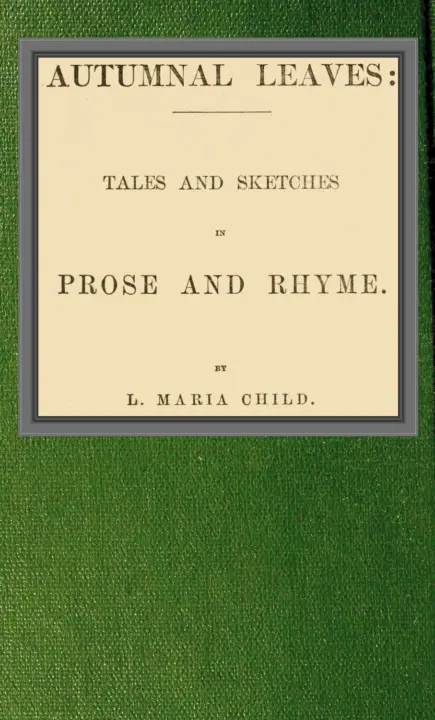
"Autumnal Leaves: Tales and Sketches in Prose and Rhyme" by Lydia Maria Child is a collection of literary sketches and stories written in the mid-19th century. The work intertwines poetry and prose, offering a variety of narratives that explore themes of love, beauty, nature, and social distinction. At the heart of these sketches are characters like Edward Vernon and Sibella Flower, who navigate the complexities of class, aspiration, and romantic ideals within their societal constraints. The opening of this collection introduces us to a scene where social class and beauty intersect, showcasing the characters of Edward Vernon and Sibella Flower. Edward, an aristocratic young man, is captivated by Sibella, a beautiful nursery maid, causing tension within his family, particularly with his status-conscious sister, Julia. Sibella, meanwhile, struggles with her own feelings, aware of the societal barriers that separate her from Edward. As their admiration for one another grows, the narrative hints at the challenges they will face due to their differing social standings, setting a tone of bittersweet romanticism that permeates the collection.
Introduction adapted from the source catalogue; source summaries may be automatically generated.
Free to read · English · 84,925 words · No account needed
MAKE TIME FOR A GOOD BOOK
On by default. Untick to stop anonymous reading totals. Each page counts after 10 seconds in view. How this works.
Anonymous counting is on unless you have switched it off.
A bamboo hut, raised two feet from the ground, and consisting of two apartments, without windows, was their bridal home. It was all they needed in a climate where, more than half the year, all household occupations could be most conveniently performed out of doors. There was a broad verandah in front, sheltered from rain and sun by the projecting roof. In front was a grove of orange and lemon trees, and in the rear was a group of plantains, whose immensely long broad leaves and yellow spikes of nodding flowers cast refreshing shadows.
A grass mat, of Jan’s own weaving, and pillows filled with a kind of silky down from a wild plant, answered for a bed. Gourd shells, a few earthern dishes, and a wooden waiter from which they ate their meals, seated on the floor, constituted their simple furniture. The rooms, which received light from the open door, were used only for eating and sleeping. The verandah was the place where all their sedentary occupations were pursued. There, Zaida might be seen busy at her spinning-wheel and loom; there, Jan wove mats and baskets for his master’s household; and there stood his gambang, a musical instrument, with wooden bars of graduated lengths, which he struck with a mallet, to accompany the simple Javanese melodies that he and Zaida were accustomed to sing together.
Years passed over their heads without any more serious variations than slight dissensions with the other slaves, occasional illness, and the frequent birth of children. Some of them resembled the father, others the mother; and some had their eyes obliquely set, like the island ancestry from whom they descended. Some were bright, some dull, some merry and some pensive; but Madame Van der Veen pronounced them all very good children; and they certainly were trained to be devotedly attentive to her. During their first years, it cost nothing to clothe them, for they ran about naked; and it required almost as little expense to furnish them with food, where rice was so easily cultivated, and plantains, cocoas and oranges grew wild. The warmth of the climate, the lavish bounty of the soil, the improvident habits which every human being must necessarily form, who acquires no property by economy, and the extreme indulgence with which he had always been treated by his gentle-hearted mistress, all conspired to render Jan forgetful of the precarious tenure by which he held the external blessings of his mere animal existence. Sometimes, when he went to Grésik, he passed by a slave-auction, and the sight always gave him a pang; for it brought up a picture of Zaida and her children standing there amid the indecent jests and rude handling of a crowd of men. Sometimes he witnessed despotic and cruel treatment of slaves, and still more frequently he heard of such instances. Then came recollections of the lashes and shrieks, that used to interrupt his music and merriment in the days of courtship; and always they brought with them the question, “What if Zaida and our daughters should ever be sold to such people as that cruel Dutchman and his jealous wife?” While any instances were fresh in his mind, he listened attentively to whatever was said about slavery by his master and the English family. From them he learned how the English, during their brief possession of Java, had interdicted slave traffic with the neighbouring islands; had passed laws forbidding slaves to be sold, except with their own consent; and had allowed them to hold, as their own, any property they were able to acquire. Mr. Van der Veen tried to excuse the Dutch for renewing their slave-trade, by urging that it was a necessity imposed upon them, because there was no other method of procuring servants. The Englishman denied any such necessity. He maintained that the natives of Java were intelligent, teachable and honest, and very willing to render services for money. He highly commended the native princes for never permitting any of their own people to be slaves. He told of one of those princes, who had inherited fifty slaves; but when the British Government declared that all should become free, unless publicly registered by their masters, within a specified time, he said, “Then I will not register my slaves. They shall be free. I have kept them hitherto, because it was the custom, and because the Dutch liked to be attended by slaves when they visited the palace. But as that is not the case with the British, they shall cease to be slaves; for I have long felt shame, and my blood has run cold, when I have reflected on what I once saw at Batavia and Semarang, where human beings were exposed at public sale, placed on a table, and examined like sheep and oxen.” The Englishman declared that he lost no opportunity of talking with all classes of people on the subject, and of circulating publications, translated into Dutch, and sent to him from England for that purpose; and he expressed a strong belief that the Dutch would soon abolish slavery. In these conversations, nothing interested Jan so much as his master’s statement, that, according to existing laws, slaves might purchase themselves. He resolved to save all the small coins he might receive; and visions flitted through his brain, of mats and baskets to be made, when his daily tasks were completed. But when he received this information, he already had a brood of children; he despaired of ever being able to collect money enough to buy them; and his anxious thoughts were far more on their account, than on his own. He always solaced himself with the thought that his mistress would not allow them to be sold while she lived, and that she would certainly make provision for them before she died.
Your reading position is saved on this browser. Take it to another device with a library code. Reading pages adapt to text, rather than matching a printed edition.
Lydia Maria Child
Lydia Maria Child
Lydia Maria Child
Lydia Maria Child
BEHIND THE BOOK
This eBook is for the use of anyone anywhere in the United States and most other parts of the world at no cost and with almost no restrictions whatsoever. You may copy it, give it away or re-use it under the terms of the Project Gutenberg License included with this eBook or online at www.gutenberg.org. If you are not located in the United States, you will have to check the laws of the country where you are located before using this eBook. Read the source licence.
The original source file, including credits and licence, is retained by this library. Request an original-format copy at no charge. Please include the book title and Project Gutenberg identifier #67832.
KEEP YOUR CURIOSITY GOING

David Patterson (Spirit) Hatch

David Patterson (Spirit) Hatch

David Patterson (Spirit) Hatch
Coulson Kernahan

Ralph Waldo Emerson

Maurice Baring