THE CLASSIC COLLECTION✦The history of the condition of women in various ages and nationsCLASSIC FREE BOOKS
The history of the condition of women in various ages and nations
Lydia Maria Child
THE CLASSIC COLLECTION · 1857
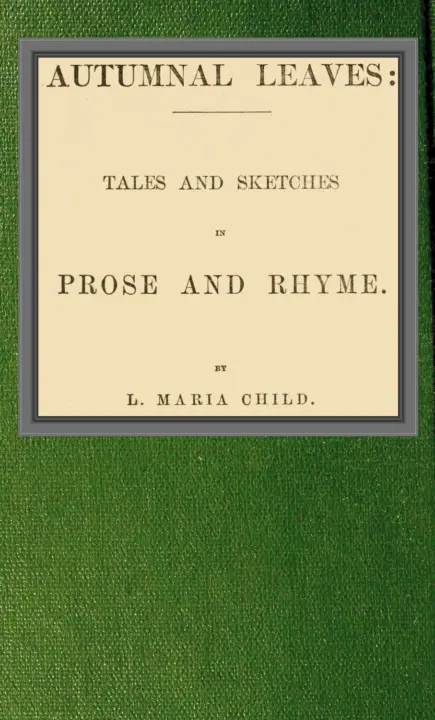
"Autumnal Leaves: Tales and Sketches in Prose and Rhyme" by Lydia Maria Child is a collection of literary sketches and stories written in the mid-19th century. The work intertwines poetry and prose, offering a variety of narratives that explore themes of love, beauty, nature, and social distinction. At the heart of these sketches are characters like Edward Vernon and Sibella Flower, who navigate the complexities of class, aspiration, and romantic ideals within their societal constraints. The opening of this collection introduces us to a scene where social class and beauty intersect, showcasing the characters of Edward Vernon and Sibella Flower. Edward, an aristocratic young man, is captivated by Sibella, a beautiful nursery maid, causing tension within his family, particularly with his status-conscious sister, Julia. Sibella, meanwhile, struggles with her own feelings, aware of the societal barriers that separate her from Edward. As their admiration for one another grows, the narrative hints at the challenges they will face due to their differing social standings, setting a tone of bittersweet romanticism that permeates the collection.
Introduction adapted from the source catalogue; source summaries may be automatically generated.
Free to read · English · 84,925 words · No account needed
MAKE TIME FOR A GOOD BOOK
On by default. Untick to stop anonymous reading totals. Each page counts after 10 seconds in view. How this works.
Anonymous counting is on unless you have switched it off.
He was but three years old when his mistress married Lambert Van der Veen, and removed with him to a country-seat near the neighbouring city of Grésik. Little Jan did not thoroughly like that gentleman, because he was often sent out of the parlour when he came; and Maria was so engrossed with her lover, that she sometimes forgot to nod and smile when “little brownie” peeped into the room. He was very exclusive in his affections. He wanted to have those he loved all to himself. Therefore, though the young man spoke kindly to him, and often gave him sugar-plums, a shadow always passed over his expressive face, when, running eagerly at the sound of the piano, he looked into the parlour and saw his rival there.
But after Maria was married, he became, if possible, more of a petted plaything than ever; for her husband was engaged in commercial pursuits, which often took him far from home, and their house, being two miles from the city, was more quiet than her father’s place of residence had been. She occupied many of her lonely hours in teaching Jan various infantile accomplishments, and especially in developing his remarkable powers of imitation. The birds greatly attracted his attention; and in a few months he could mock them so perfectly, that they mistook his voice for their own. He soon did the same with the buzz and whirr of every insect, and laughed to hear how all the little creatures answered him. Nature had made him almost as sensitive to colours, as to sounds; and whenever his mistress went into the garden, he would run after her to beg for a flower. She liked the sound of his little padding feet, and often smiled to watch his pliant motions and graceful form, clothed only with a large party-coloured bamboo hat, and a girdle of broad fringe about his loins. When the master was at home, he was obliged to find his entertainment more among the slaves. They generally liked to sing or whistle to him, and would laugh merrily at his eager attempts to imitate. But some, who had children of their own, envied the high favour he enjoyed, and consequently bore no good will toward him. They did not dare to strike him, but they devised many ways of making him uncomfortable. Decidedly, he liked the parlour better than the slaves’ quarters. He preferred it in the first place, because he was more attended to there; and in the next place, because he could hear so many pleasant sounds, and see so many pretty things. He liked the cool straw carpet, and the pale green walls. The big china jars were an object of perpetual delight. He was never weary of putting his little fingers on the brilliant flowers and butterflies, with which they were plentifully adorned. But what excited his wonder more than any thing else, was a folding screen of oriental workmanship, which separated the parlour from the dining-room; for there were gilded pagodas, Chinese mandarins with peacock’s feathers in their caps, and two birds-of-paradise, as large as life; a great deal larger, in fact, than the mandarins or the pagodas. Then it was so pleasant to peep out into the garden, through the vine-embowered lattice-work of the verandah; to see the blooming roses, and the small fountain’s silvery veil; to inhale the fragrance of the orange blossoms, and listen to the cool trickling of the tiny water drops. All this was in reality his; for he knew not that he was a little slave; and it is the privilege of unconscious childhood to own whatsoever it delights in. In this point of view, it all belonged to little Jan more truly than it did to Mr. Van der Veen. No wonder he sighed when the master returned, since it condemned him, for a time, to a degree of exile from his paradise. Perhaps there was some slight jealousy on the other side, also; for though the gentleman was always kind to his wife’s favourite, he sometimes hinted at the danger of spoiling him, and the intercourse between them was never very familiar. At first, little Jan was afraid to approach the parlour at all, when he was at home. But on one occasion, when his stay was unusually prolonged, his patience became exhausted waiting for his departure. He began by peeping in slyly through the folding screen. Seeing himself observed, he ran away; but soon came again and peeped, and receiving a smile from his mistress, he came in timidly, and offering his master a geranium blossom, said, “May little Jan stay?” Maria immediately said, “Oh yes, let him stay: he is so happy here.” But there was no occasion to plead his cause; for there was no resisting his pretty looks and his graceful offering. Mr. Van der Veen patted his head, and he crept under the table to listen to the piano. After that, he never avoided his master, though he still continued to come in timidly, and if not encouraged by a smile, would run off to bring a flower as an admission-fee.
Your reading position is saved on this browser. Take it to another device with a library code. Reading pages adapt to text, rather than matching a printed edition.
Lydia Maria Child
Lydia Maria Child
Lydia Maria Child
Lydia Maria Child
BEHIND THE BOOK
This eBook is for the use of anyone anywhere in the United States and most other parts of the world at no cost and with almost no restrictions whatsoever. You may copy it, give it away or re-use it under the terms of the Project Gutenberg License included with this eBook or online at www.gutenberg.org. If you are not located in the United States, you will have to check the laws of the country where you are located before using this eBook. Read the source licence.
The original source file, including credits and licence, is retained by this library. Request an original-format copy at no charge. Please include the book title and Project Gutenberg identifier #67832.
KEEP YOUR CURIOSITY GOING

David Patterson (Spirit) Hatch

David Patterson (Spirit) Hatch

David Patterson (Spirit) Hatch
Coulson Kernahan

Ralph Waldo Emerson

Maurice Baring