THE CLASSIC COLLECTION✦An outlaw’s diary: the CommuneCLASSIC FREE BOOKS
An outlaw’s diary: the Commune
Cécile Tormay
THE CLASSIC COLLECTION · 1893
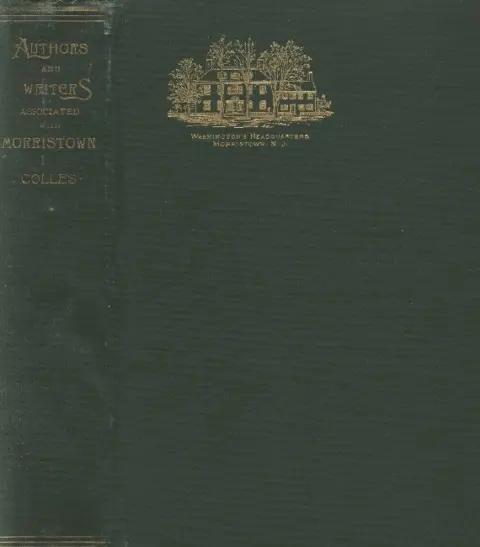
"Authors and Writers Associated with Morristown" by Julia Keese Colles is a historical account written in the late 19th century. This work provides an in-depth exploration of the literary figures and notable personalities connected to the town of Morristown, New Jersey, and includes a chapter dedicated to its historical significance. The content focuses on individuals who contributed to the cultural and artistic landscape of Morristown, thereby showcasing the town's rich heritage. The opening of the book introduces the author’s dedication and the context of the publication's origins, highlighting its roots in a well-received lecture. It emphasizes the significance of preserving the names of authors linked to Morristown, noting that the list of such figures has expanded significantly since the book's conception. It also previews the forthcoming sections that will explore various contributing writers, poets, and their works, providing insights into the historical and cultural backdrop of Morristown, particularly during key periods such as the American Revolution.
Introduction adapted from the source catalogue; source summaries may be automatically generated.
Free to read · English · 83,218 words · No account needed
MAKE TIME FOR A GOOD BOOK
On by default. Untick to stop anonymous reading totals. Each page counts after 10 seconds in view. How this works.
Anonymous counting is on unless you have switched it off.
Now, that this "poor dog" of a husband was an ogre is abundantly proved by the fact that Mother Hubbard provided for him bones.
Yes! bones! my friends; but--they--were--human--bones!
Deep research has convinced me of this fact. I find that in those days ogres did not catch and kill their own meat, as is commonly supposed. They were but human, my friends, and, like the rest of humanity, preferred rather to purchase labor than perform it. They, therefore, employed their own individual butchers; but, with rare wisdom, they chose some carnivorous animal to supply their table.
In proof of this, we come, Secondly, to the word cupboard, as mentioned
in the text,--
"Old Mother Hubbard went to the cupboard,
To get her poor dog a bone."
This word cupboard is in our present version misspelt, owing to some fault in copying from the original, and thus is rendered c-u-p-b-o-a-r-d; but the word properly should be spelt c-u-b-b-e-d. This is a compound word, derived from cub--a young bear--and bed, or deposit, as we speak of the bed of a river.
This was a bone deposit--a place where the ogre's food was deposited by
the cub.
A young cub was a less expensive butcher than a bear, as nowadays labor is cheaper from the young aspirant than from the assured professional. Therefore they were the usual employees.
But this ogre, though evidently in the habit of employing a cub in this department, had now become dissatisfied and procured the more satisfactory service of an old bear; for, if you will carefully examine the text, you will see that the meaning is obvious, for, as though to insure all its readers from misunderstanding, you will see that it is distinctly stated that--
"The cub-bed was bear."
Now we come Thirdly to the word "none."
"And so the poor dog got none."
This word in the original stands for two things--first, n-o-n-e, meaning nothing, which was the heretical sense deducted by my opponent, and the other and correct sense being n-u-n--a woman with black veil, generally of tender years; and Mother Hubbard, who intended to supply her lord's table with one small bone, found that instead the bear had secured the bones of a whole nun!
Fourthly and lastly, it is clear from the words "poor dog," that the ogre was poor, but not Mother Hubbard.
No, my hearers, evidently she was rich, evidently she held the purse-strings, and the ogre had stealthily supplied his table with a luxury, and his house with a steward, for which he individually was incapable of providing the means.
Your reading position is saved on this browser. Take it to another device with a library code. Reading pages adapt to text, rather than matching a printed edition.
BEHIND THE BOOK
This eBook is for the use of anyone anywhere in the United States and most other parts of the world at no cost and with almost no restrictions whatsoever. You may copy it, give it away or re-use it under the terms of the Project Gutenberg License included with this eBook or online at www.gutenberg.org. If you are not located in the United States, you will have to check the laws of the country where you are located before using this eBook. Read the source licence.
The original source file, including credits and licence, is retained by this library. Request an original-format copy at no charge. Please include the book title and Project Gutenberg identifier #37834.
KEEP YOUR CURIOSITY GOING
Cécile Tormay

Moritz Busch
John L. Ransom
Frances Wright
Cécile Tormay

Mabel Potter Daggett