
Letters to a Friend, Written to Mrs. Ezra S. Carr, 1866-1879
John Muir
THE CLASSIC COLLECTION · 1914
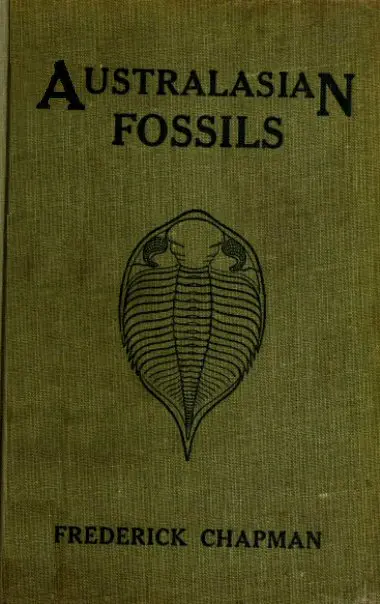
"Australasian Fossils: A Students' Manual of Palaeontology" by Frederick Chapman is a scientific publication written in the early 20th century. This manual aims to fill the gap in literature on fossils discovered in the Southern Hemisphere, specifically in Australasia, offering students an accessible overview of palaeontology. The book discusses a variety of topics, including fossil classification, geological epochs, and methods for finding and preserving fossils, catering to the needs of natural history and palaeontology students. The opening portion of the manual introduces its context and purpose, emphasizing the scarcity of resources concerning region-specific fossils in existing geological literature. It articulates the importance of studying fossils for understanding Earth's history, evolution, and the distribution of ancient life forms. Chapman underscores the manual’s intent to provide a foundational framework for students, alongside practical advice for fossil collectors, encouraging exploration and a deeper appreciation for the field of palaeontology.
Introduction adapted from the source catalogue; source summaries may be automatically generated.
Free to read · English · 61,198 words · No account needed
MAKE TIME FOR A GOOD BOOK
On by default. Untick to stop anonymous reading totals. Each page counts after 10 seconds in view. How this works.
Anonymous counting is on unless you have switched it off.
The Lower Devonian red jaspers of Bingera and Barraba in New South Wales have afforded some casts of Radiolaria, resembling Carposphaera and Cenosphaera.
The large number of fifty-three species have been found in the radiolarian rocks of Middle Devonian age at Tamworth in New South Wales (Fig. 66). These have been referred to twenty-nine genera comprising amongst others, Cenosphaera, Xiphosphaera, Staurolonche, Heliosphaera, Acanthosphaera and Spongodiscus.
=Cretaceous Radiolaria.--=
Although certain silicified rocks in the Jurassic in Europe have furnished a large series of Radiolaria, the Australian marine limestones of this age have not yielded any of their remains up to the present. They have been found, however, in the Lower Cretaceous of Queensland, and in the (?)Upper Cretaceous of Port Darwin, N. Australia. The Radiolaria from the latter locality belong to the sub-orders Prunoidea, Discoidea and Cyrtoidea (Fig. 66). The rock which contains these minute fossils is stated to be eaten by the natives for medicinal purposes. As its composition is almost pure silica, its efficacy in such cases must be more imaginary than real.
=Cainozoic Radiolaria.--=
Cainozoic rocks of Pliocene age, composed entirely of Radiolaria, occur at Barbados in the West Indies. No Cainozoic Radiolaria, however, have been found either in Australia or New Zealand up to the present time.
Nubecularia stephensi, Howchin. Carbopermian: Tasmania and New South
Wales.
Frondicularia woodwardi, Howchin. Carbopermian: W. Australia and New
South Wales.
Geinitzina triangularis, Chapm. & Howchin. Carbopermian: New South
Wales.
Pulvinulina insignis, Chapman. Trias (Wianamatta Series): New South
Wales.
Marginulina solida, Terquem. Jurassic: W. Australia.
Flabellina dilatata, Wisniowski. Jurassic: W. Australia.
Vaginulina striata, d'Orbigny. Lower Cretaceous: Queensland.
Truncatulina lobatula, W. and J. sp. Lower Cretaceous: Queensland.
Miliolina vulgaris, d'Orb. sp. Cainozoic: Victoria and S. Australia.
Textularia gibbosa, d'Orb. Cainozoic: Victoria and S. Australia.
Nodosaria affinis, d'Orb. Cainozoic: Victoria and S. Australia.
Polymorphina elegantissima, Parker and Jones. Cainozoic: Victoria, Tasmania, and S. Australia.
Truncatulina ungeriana, d'Orb. sp. Cainozoic: Victoria, King Island,
and S. Australia.
Amphistegina lessonii, d'Orb. Cainozoic: Victoria and S. Australia.
Lepidocyclina martini, Schlumberger. Cainozoic (Balcombian and
Janjukian): Victoria.
L. tournoueri, Lemoine and Douvillé. Cainozoic (Junjukian):
Victoria.
Cycloclypeus pustulosus, Chapman. Cainozoic (Janjukian): Victoria.
Fabularia howchini, Schlumberger. Cainozoic (Kalimnan): Victoria.
Hauerina intermedia, Howchin. Cainozoic (Kalimnan): Victoria.
Rotalia beccarii, Linné sp. Pleistocene: Victoria and S. Australia.
Polystomella striatopunctata, Fichtel and Moll sp. Pleistocene: Victoria and S. Australia.
(?) Carposphaera sp. Lower Cambrian: South Australia.
(?) Cenellipsis sp. Lower Cambrian: South Australia.
Cenosphaera affinis, Hinde. Devonian: New South Wales.
Staurolonche davidi, Hinde. Devonian: New South Wales.
Amphibrachium truncatum, Hinde. Upper Cretaceous: Northern Territory.
Dictyomitra triangularis, Hinde. Upper Cretaceous: Northern
Territory.
Your reading position is saved on this browser. Take it to another device with a library code. Reading pages adapt to text, rather than matching a printed edition.
BEHIND THE BOOK
This eBook is for the use of anyone anywhere in the United States and most other parts of the world at no cost and with almost no restrictions whatsoever. You may copy it, give it away or re-use it under the terms of the Project Gutenberg License included with this eBook or online at www.gutenberg.org. If you are not located in the United States, you will have to check the laws of the country where you are located before using this eBook. Read the source licence.
The original source file, including credits and licence, is retained by this library. Request an original-format copy at no charge. Please include the book title and Project Gutenberg identifier #59074.
KEEP YOUR CURIOSITY GOING
John Muir

Asa Gray
Asa Gray

Florence Nightingale
Elizabeth Robins Pennell
Denison Olmsted