
Letters to a Friend, Written to Mrs. Ezra S. Carr, 1866-1879
John Muir
THE CLASSIC COLLECTION · 1914
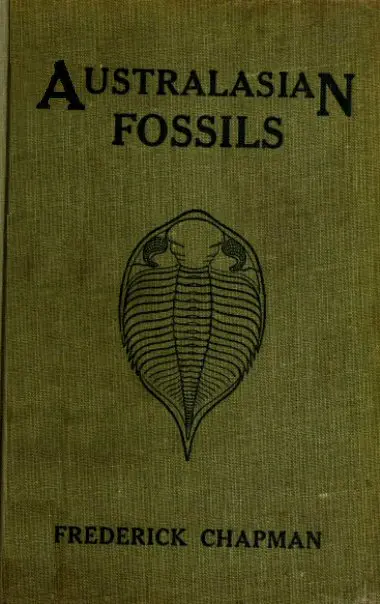
"Australasian Fossils: A Students' Manual of Palaeontology" by Frederick Chapman is a scientific publication written in the early 20th century. This manual aims to fill the gap in literature on fossils discovered in the Southern Hemisphere, specifically in Australasia, offering students an accessible overview of palaeontology. The book discusses a variety of topics, including fossil classification, geological epochs, and methods for finding and preserving fossils, catering to the needs of natural history and palaeontology students. The opening portion of the manual introduces its context and purpose, emphasizing the scarcity of resources concerning region-specific fossils in existing geological literature. It articulates the importance of studying fossils for understanding Earth's history, evolution, and the distribution of ancient life forms. Chapman underscores the manual’s intent to provide a foundational framework for students, alongside practical advice for fossil collectors, encouraging exploration and a deeper appreciation for the field of palaeontology.
Introduction adapted from the source catalogue; source summaries may be automatically generated.
Free to read · English · 61,198 words · No account needed
MAKE TIME FOR A GOOD BOOK
On by default. Untick to stop anonymous reading totals. Each page counts after 10 seconds in view. How this works.
Anonymous counting is on unless you have switched it off.
In Australia, as at Pokolbin, New South Wales, in the Mersey River district, Tasmania, and in the Irwin River district, Western Australia, the Permian rocks, or "Permo-carboniferous" as they are generally called, often contain beds of impure limestone crowded with the chalky white tests of Nubecularia: other interesting genera occur at the first named locality as Pelosina, Hyperammina, Haplophragmium, Placopsilina, Lituola, Thurammina, Ammodiscus, Stacheia, Monogenerina, Valvulina, Bulimina, (?)Pleurostomella, Lagena, Nodosaria, Frondicularia, Geinitzina, Lunucammina, Marginulina, Vaginulina, Anomalina and Truncatulina. The sandy matrix of certain Glossopteris leaf-beds in the Collie Coal measures in W. Australia have yielded some dwarfed examples belonging to the genera Bulimina, Endothyra, Valvulina, Truncatulina and Pulvinulina; whilst in the Irwin River district similar beds contain Nodosaria and Frondicularia (Fig. 63).
=Triassic Foraminifera.--=
The Triassic and Rhaetic clays of Europe occasionally show traces of foraminiferal shells, probably of estuarine habitat, as do the Wianamatta beds of New South Wales, which also belong to the Triassic epoch. The Australian representatives are placed in the genera Nubecularia, Haplophragmium, Endothyra, Discorbina, Truncatulina, and Pulvinulina. These shells are diminutive even for foraminifera, and their starved condition indicates uncongenial environment.
=Jurassic Foraminifera.--=
The Jurassic limestones of Western Australia, at Geraldton, contain many species of Foraminifera, principally belonging to the spirally coiled and slipper-shaped Cristellariae. Other genera present are Haplophragmium, Textularia, Bulimina, Flabellina, Marginulina, Vaginulina, Polymorphina, Discorbina, and Truncatulina.
=Cretaceous Foraminifera.--=
In the Lower Cretaceous rocks known as the Rolling Downs Formation in Queensland, shells of the Foraminifera are found in some abundance at Wollumbilla. They are represented chiefly by Cristellaria and Polymorphina.
=Cainozoic Foraminifera.--=
The Cainozoic strata in all parts of the world are very rich in Foraminifera, and the genera, and even many species are similar to those now found living. Certain types, however, had a restricted range, and are therefore useful as indicators of age. Such are the Nummulites and the Orbitoides of the Eocene and the Oligocene of Europe, India and the West Indies; and the Lepidocyclinae of the Miocene of Europe, India, Japan and Australia (Fig. 64).
The genus Lepidocyclina is typically represented in the Batesford beds near Geelong, Victoria by L. tournoueri, a fossil of the Burdigalian stage (Middle Miocene) in Europe, as well as by L. marginata. A limestone with large, well-preserved tests of the same genus, and belonging to a slightly lower horizon in the Miocene has lately been discovered in Papua.
Your reading position is saved on this browser. Take it to another device with a library code. Reading pages adapt to text, rather than matching a printed edition.
BEHIND THE BOOK
This eBook is for the use of anyone anywhere in the United States and most other parts of the world at no cost and with almost no restrictions whatsoever. You may copy it, give it away or re-use it under the terms of the Project Gutenberg License included with this eBook or online at www.gutenberg.org. If you are not located in the United States, you will have to check the laws of the country where you are located before using this eBook. Read the source licence.
The original source file, including credits and licence, is retained by this library. Request an original-format copy at no charge. Please include the book title and Project Gutenberg identifier #59074.
KEEP YOUR CURIOSITY GOING
John Muir

Asa Gray
Asa Gray

Florence Nightingale
Elizabeth Robins Pennell
Denison Olmsted