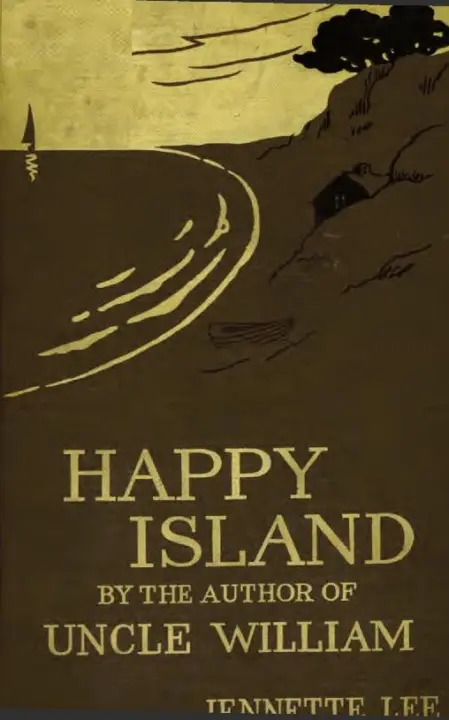
Happy Island: A New “Uncle William” Story
Jennette Lee
THE CLASSIC COLLECTION · 1915
"Aunt Jane" by Jennette Lee is a novel written in the early 20th century. The story centers around Aunt Jane Holbrook, a nurturing and sensible matron at the Berkeley House of Mercy, a hospital where her expertise and caring nature are respected by both patients and staff. As she tends to patients, Aunt Jane demonstrates a remarkable blend of warmth, practical wisdom, and humor, creating an atmosphere of comfort and healing. The opening portion of the book introduces Aunt Jane in her role at the hospital, showcasing her interactions with patients and medical staff. A scene unfolds in which a young man, a patient in the men's ward, curiously inquires about Aunt Jane's thoughts, only to find her contemplating mundane tasks like adjusting a mattress. This mix of the ordinary with the profound establishes her dual nature as a caretaker—she manages daily hospital duties while exuding a sense of peace and comfort to those around her. The narrative hints at Aunt Jane's deep connections with the patients, revealing her capacity to uplift their spirits, which becomes a recurring theme of the novel. As the story progresses, it becomes evident that Aunt Jane's presence is vital not only to the physical well-being of her patients but also to their emotional healing.
Introduction adapted from the source catalogue; source summaries may be automatically generated.
Free to read · English · 52,486 words · No account needed
MAKE TIME FOR A GOOD BOOK
On by default. Untick to stop anonymous reading totals. Each page counts after 10 seconds in view. How this works.
Anonymous counting is on unless you have switched it off.
"Well--I don't know that she upset him," said Aunt Jane. "Something did! You can find out, I guess." Her gaze was approvingly mild.
He relaxed a little.
"You want I should come with you?" she asked.
"No," hastily, "I'll send for you--if I need anything. Miss Canfield's
around, I suppose."
"Yes, she's there, I guess. She's there most of the time," said Aunt Jane. Her face was non-committal.
But he glanced at it sharply. Then he went down to Suite A.
Herman Medfield, still sitting in his window, with the blue quilted gown wrapped about his legs, wore an unhappy expression.
Dr. Carmon scanned it. He set down the black bag and drew up a chair.
"What seems to be the matter?" he asked. He seated himself firmly in the chair and looked at his patient through keen glasses. All the little fine unconscious fibres that diagnosed a case for Dr. Carmon were alert and reaching out for signs; but the doctor himself looked as impassive as a stone jug, sitting in his chair, a hand on either knee--surveying Herman Medfield.
"What is the matter?" he said.
"I don't know." Medfield's tone was indifferent. "I feel worse--general
distress--heaviness."
"Any pain?" The doctor's hand burrowing in his pocket had brought out
the stethoscope.
He adjusted it to his ears and hitched his chair a little nearer. Medfield made an obliging movement forward.
"Stay where you are," said the doctor gruffly. He leaned forward and
placed the little metal disks on the blue quilted gown and bent his
head.
The two men were silent. Medfield with his head against the back of the chair and his eyes closed was wondering guiltily what the two little flexible tubes were revealing to the listening ears.
And Dr. Carmon, behind an impenetrable scowling mask, was wondering what the devil had gone wrong with Herman Medfield. And he listened--not so much with his ears, as with those little inner senses that never deceived him if he trusted them.
He slipped off the stethoscope and sat up. "Did you say you had pain?"
he asked.
"A little." The tone was weary.
Dr. Carmon looked at him sharply. "Whereabouts?"
Medfield turned his head restively. "Everywhere," he said. "Up my back and shoulders--the right one--and in my head."
"Your head aches, does it?" That was the outside question; and inside, all the little therapeutic fibres in Dr. Carmon's stubby figure were saying to him: "His head is as good as yours is, this minute! What's the matter with him? Buck up--and find out!"
He put his hand on the patient's wrist. "What would you like for
dinner?" he asked.
"I couldn't eat anything," said Medfield passively.
Your reading position is saved on this browser. Take it to another device with a library code. Reading pages adapt to text, rather than matching a printed edition.
BEHIND THE BOOK
This eBook is for the use of anyone anywhere in the United States and most other parts of the world at no cost and with almost no restrictions whatsoever. You may copy it, give it away or re-use it under the terms of the Project Gutenberg License included with this eBook or online at www.gutenberg.org. If you are not located in the United States, you will have to check the laws of the country where you are located before using this eBook. Read the source licence.
The original source file, including credits and licence, is retained by this library. Request an original-format copy at no charge. Please include the book title and Project Gutenberg identifier #43380.
KEEP YOUR CURIOSITY GOING
Coulson Kernahan

Maurice Baring
Frances Wright
Cécile Tormay

Frederic Jesup Stimson

W. H. P. (William Henry Pope) Jarvis