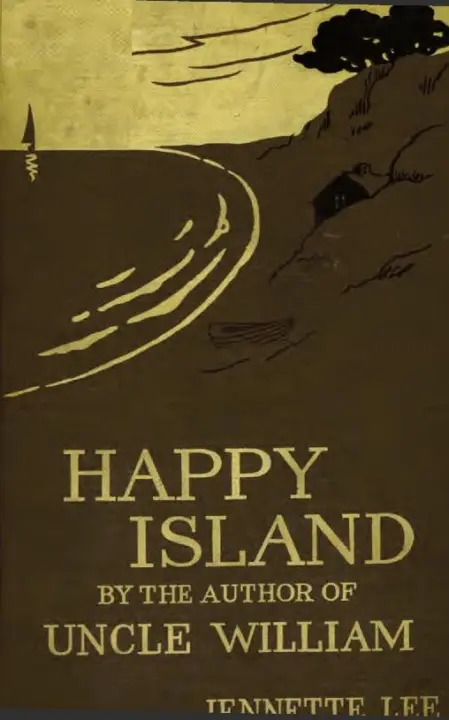
Happy Island: A New “Uncle William” Story
Jennette Lee
THE CLASSIC COLLECTION · 1915
"Aunt Jane" by Jennette Lee is a novel written in the early 20th century. The story centers around Aunt Jane Holbrook, a nurturing and sensible matron at the Berkeley House of Mercy, a hospital where her expertise and caring nature are respected by both patients and staff. As she tends to patients, Aunt Jane demonstrates a remarkable blend of warmth, practical wisdom, and humor, creating an atmosphere of comfort and healing. The opening portion of the book introduces Aunt Jane in her role at the hospital, showcasing her interactions with patients and medical staff. A scene unfolds in which a young man, a patient in the men's ward, curiously inquires about Aunt Jane's thoughts, only to find her contemplating mundane tasks like adjusting a mattress. This mix of the ordinary with the profound establishes her dual nature as a caretaker—she manages daily hospital duties while exuding a sense of peace and comfort to those around her. The narrative hints at Aunt Jane's deep connections with the patients, revealing her capacity to uplift their spirits, which becomes a recurring theme of the novel. As the story progresses, it becomes evident that Aunt Jane's presence is vital not only to the physical well-being of her patients but also to their emotional healing.
Introduction adapted from the source catalogue; source summaries may be automatically generated.
Free to read · English · 52,486 words · No account needed
MAKE TIME FOR A GOOD BOOK
On by default. Untick to stop anonymous reading totals. Each page counts after 10 seconds in view. How this works.
Anonymous counting is on unless you have switched it off.
"It came ten days ago--the thirtieth, wasn't it--just as I was starting for Norway. I'm pretty glad it didn't miss me!"--They sat quiet a minute. Then the boy looked at him. "You're looking fine, sir!"
"I'm all right! Doing splendidly!"
He felt suddenly that he could let his pains go. The house across the town was not so empty, after all. He had a sudden vision of Julian running up the long stairs--two at a time--and he looked at him happily.
The boy leaned forward. His eye fell on the black-edged card; he looked at it and smiled and half reached out a hand, incredulous.
"How is--" He hesitated. He had always been afraid of his father. But the man on the pillows was, somehow, a different sort of father; he leaned forward with a swift twinkle at the card.
"How is the--widow?" he asked.
"Very well, I suppose," said Medfield. "It is some time since I saw her." He spoke a little formally. But his heart leaped at the touch of comradeship.
"How about this?" said Julian. He touched the black-edged card.
Herman Medfield's face flushed--almost guiltily. "Flowers," he said.
"I say!" The boy whistled softly. Then he laughed. "I say!" He put down the card and looked at it.
"Three boxes!" acknowledged Medfield.
The boy held out his hand. "Would you mind shaking hands, sir?"
Herman Medfield took the hand, laughing a little, and his eyes filled with quiet pride and happiness. "I am glad you've come home, Julian."
"Looks to me about time!" said the youth. He glanced again at the card
and chuckled.
Then he stood up.
It was Miss Canfield for the tray.
She came around to the other side of the bed; and Herman Medfield looked up at her--and glanced from her to his boy.
"This is my son, Julian, Miss Canfield." He was watching the two faces that confronted each other across the bed.
The young man's had lighted with a little look of admiration.
He held out his hand across the bed. "It's a long-distance introduction,
isn't it?"
The girl took the hand quietly. "How do you do, Mr. Herman," she said
pleasantly.
"I'm glad to meet you," said Julian out of a puzzled look; and the two
hands fell apart.
Herman Medfield flashed a twinkle at her. "His name is not Herman," he remarked dryly. "Nor mine," he added after a minute. "'Herman' is for the hospital-- Aunt Jane invented it."
"I see." The girl held it. "I wondered a little----"
"Don't let anybody else wonder," said Medfield. "I want to get rid of
myself--for a while."
The young man smiled whimsically. "Where do I come in, sir?"
Your reading position is saved on this browser. Take it to another device with a library code. Reading pages adapt to text, rather than matching a printed edition.
BEHIND THE BOOK
This eBook is for the use of anyone anywhere in the United States and most other parts of the world at no cost and with almost no restrictions whatsoever. You may copy it, give it away or re-use it under the terms of the Project Gutenberg License included with this eBook or online at www.gutenberg.org. If you are not located in the United States, you will have to check the laws of the country where you are located before using this eBook. Read the source licence.
The original source file, including credits and licence, is retained by this library. Request an original-format copy at no charge. Please include the book title and Project Gutenberg identifier #43380.
KEEP YOUR CURIOSITY GOING
Coulson Kernahan

Maurice Baring
Frances Wright
Cécile Tormay

Frederic Jesup Stimson

W. H. P. (William Henry Pope) Jarvis