
The Writing of News A Handbook with Chapters on Newspaper Correspondence and Copy Reading
Charles G. (Charles Griffith) Ross
THE CLASSIC COLLECTION · 1905
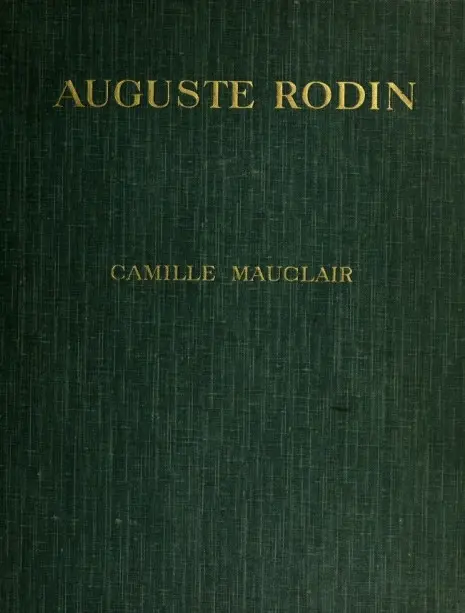
"Auguste Rodin: The Man - His Ideas - His Works" by Camille Mauclair is a biographical account and critical study of the renowned French sculptor, written in the early 20th century. This work explores Rodin's artistic journey, exploring his innovative techniques and philosophies surrounding sculpture, while detailing his impact on the art world. The book offers insights into Rodin's life, his notable works, and the technical principles that underpin his artistic vision, making it a significant read for art enthusiasts and students alike. The opening of the volume introduces readers to Auguste Rodin's formative years, detailing his early struggles, dedication, and eventual rise to prominence. Born into a modest family in Paris, Rodin pursued his passion for art through rigorous self-study and informal apprenticeships, facing numerous rejections early in his career. Mauclair emphasizes Rodin’s intense work ethic, his pivotal experiences in Brussels, and his early successes that began to gain him recognition, such as "The Man with the Broken Nose" and "The Age of Brass." This introduction sets the stage for a deeper exploration into Rodin's methods, influences, and the critical reception of his works throughout the book.
Introduction adapted from the source catalogue; source summaries may be automatically generated.
Free to read · English · 31,655 words · No account needed
MAKE TIME FOR A GOOD BOOK
On by default. Untick to stop anonymous reading totals. Each page counts after 10 seconds in view. How this works.
Anonymous counting is on unless you have switched it off.
From these fragments of conversation the reader will conceive how Rodin's generalising spirit leads him from the realism of his daily work to the synthesis of a sort of ideo-realistic metaphysical system. He has the sense (belonging only to genius) of the continuity of the universe, and he certainly had it at a time when, unlettered as he was, he would not have known how to explain it specifically to himself. He constantly formulates this metaphysical system, as I have seen it formulated by Stéphane Mallarmé, who could never see anything without instantly bringing together two ideas or images that no one would ever have thought of connecting. Spontaneous analogy is the mark of genius and the secret of all real poetry. This is why I consider Rodin as a very great poet--not in the sense that he dislikes, but on the contrary, by giving to the word "poet" its deep etymological significance according to the Greek, that of "making, creating, vivifying." We may understand, too, in how great a degree an intellectuality of this kind offers a living challenge to the ideas of the "École." The man who thinks thus is necessarily isolated and has struggled all his life, never making a concession and saying nobly, "The artist, like the woman, has an honour to preserve." I will further quote from Rodin the following reflection[6]: "Where you follow nature, you get everything. When I have a beautiful woman's body for a model the drawings that I make from it give me images of insects, birds, and fishes. That seems improbable, and I had no suspicion of it myself. Formerly I used to be seeking shapes for vases, either to use them at Sèvres, where I used to work, or elsewhere.... I never succeeding in finding a beauty of proportions and lines such as I had the feeling of, because I only founded my attempts upon imagination. Since that time I have drawn women's bodies, and one of these bodies gave me, in the synthesis of it, a magnificent shape for a vase, with true and harmonious lines. The point is not to create. Creation and improvisation are useless words. Genius only comes to the man who understands with his eye and his brain. Everything is in the things about us. Manufacture and ornamental art want reforming according to these ideas. I should have liked to see that. Everything-is contained in nature. There is an harmonious, continual, uninterrupted movement. A woman, a mountain, a horse, in conception they are all the same thing, they are made on the same principles. Young artists compose instead of following their models and understanding that therein lies infinity." Here Rodin directly touches a scientific truth--the relative monotony of Nature's productive forms. Nature does everything with very few forms: the variations are so infinite that there are no two leaves alike, but the nerves of a leaf, the lines of a vein, an artery, a bird's wing, a fishbone, a nerve-cell, are identical; multiplicity derives from identity and returns to it, so that everything is reduced to a fundamental geometry which perhaps is but the effect of a single cellular generation. In this respect the laws of art and of science are the same, even as among all the arts there is a synthesis of common laws, an identity where we seem to behold a difference. Recent work in science, by establishing the existence of states of radiation (Crookes, Röntgen, Hertz) is busy undermining our old conception of matter, showing us the identity of it with the immaterial, and thereby abolishing our preconceptions about the idea and the fact, music and sculpture, considered as different manifestations. I remember that I one day kept Rodin's curiosity excited for a long time by explaining the details of this theory to him; he was not acquainted with it, and listened to me as to a writer in love with general ideas. But it was clear that in his mere province as a sculptor he knew far better and had penetrated far more deeply into this enthralling problem of identity. His is a luminous mind, of the same kind as the electric rays; it rather penetrates than surrounds what is obscure to it. On that day he was disturbed, and I was irritated by certain declamations which had been written about his "philosophy," and of which the author had assuredly not comprehended the logical consequences; and we came to the conclusion that it would be much better for Rodin's peace of mind to keep silent upon these points, for his "philosophy" could only be made comprehensible to those who could understand the method of his sculpture.
Your reading position is saved on this browser. Take it to another device with a library code. Reading pages adapt to text, rather than matching a printed edition.
BEHIND THE BOOK
This eBook is for the use of anyone anywhere in the United States and most other parts of the world at no cost and with almost no restrictions whatsoever. You may copy it, give it away or re-use it under the terms of the Project Gutenberg License included with this eBook or online at www.gutenberg.org. If you are not located in the United States, you will have to check the laws of the country where you are located before using this eBook. Read the source licence.
The original source file, including credits and licence, is retained by this library. Request an original-format copy at no charge. Please include the book title and Project Gutenberg identifier #50665.
KEEP YOUR CURIOSITY GOING
Charles G. (Charles Griffith) Ross
Hannah Webster Foster

Emily Lawless
Edwin Hamlin Carr

Charles De Lano Hine
Andrew Ure