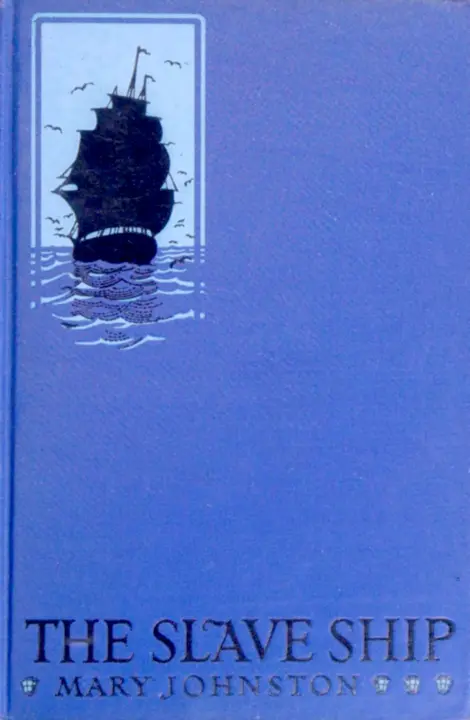
The slave ship
Mary Johnston
THE CLASSIC COLLECTION · 1901
"Audrey" by Mary Johnston is a historical novel likely written in the early 20th century. The book is set in a time marked by exploration and the settlement of America, following the lives of early colonists as they navigate the wilderness and their relationships. The central character appears to be a young girl named Audrey, who finds herself amidst a world of adventure, danger, and the complexities of human interaction, particularly highlighted by the dramatic circumstances surrounding her family. The beginning of "Audrey" introduces readers to an idyllic valley scene in the wilderness where a pioneer family lives in a cabin, described with rich, evocative imagery. The narrative shifts quickly as the tranquility is interrupted by the arrival of a well-armed group of gentlemen, led by the Governor, eager for adventure. The initial harmony of nature is contrasted with the foreboding presence of potential danger, foreshadowing tumultuous events ahead. Soon, an attack from Native Americans leads to tragedy for the family, which brings young Audrey to the forefront as she survives and faces a new perilous reality, setting the stage for her journey and the challenges she must confront in this unforgiving world.
Introduction adapted from the source catalogue; source summaries may be automatically generated.
Free to read · English · 122,227 words · No account needed
MAKE TIME FOR A GOOD BOOK
On by default. Untick to stop anonymous reading totals. Each page counts after 10 seconds in view. How this works.
Anonymous counting is on unless you have switched it off.
When Haward caught her by the hand, she trembled and drew a sobbing breath. “‘I have had a friend,’ Audrey?” he asked. “Why not ‘I have a friend’?”
“Why not?” thought Audrey. “Of course he would think, why not? Well,
then”--
“I have a friend,” she said aloud. “Have you not been to me the kindest friend, the most generous”--She faltered, but presently went on, a strange courage coming to her. She had turned slightly toward him, though she looked not at him, but upward to where the light streamed through the high window. It fell now upon her face. “It is a great thing to save life,” she said. “To save a soul alive, how much greater! To have kept one soul in the knowledge that there is goodness, mercy, tenderness, God; to have given it bread to eat where it sat among the stones, water to drink where all the streams were dry,--oh, a king might be proud of that! And that is what you have done for me.... When you sailed away, so many years ago, and left me with the minister and his wife, they were not always kind. But I knew that you thought them so, and I always said to myself, ‘If he knew, he would be sorry for me.’ At last I said, ‘He is sorry for me; there is the sea, and he cannot come, but he knows, and is sorry.’ It was make-believe,--for you thought that I was happy, did you not?--but it helped me very much. I was only a child, you know, and I was so very lonely. I could not think of mother and Molly, for when I did I saw them as--as I had seen them last. The dark scared me, until I found that I could pretend that you were holding my hand, as you used to do when night came in the valley. After a while I had only to put out my hand, and yours was there waiting for it. I hope that you can understand--I want you to know how large is my debt.... As I grew, so did the debt. When I was a girl it was larger than when I was a child. Do you know with whom I have lived all these years? There is the minister, who comes reeling home from the crossroads ordinary, who swears over the dice, who teaches cunning that he calls wisdom, laughs at man and scarce believes in God. His hand is heavy; this is his mark.” She held up her bruised wrist to the light, then let the hand drop. When she spoke of the minister, she made a gesture toward the shadows growing ever thicker and darker in the body of the house. It was as though she saw him there, and was pointing him out. “There is the minister’s wife,” she said, and the motion of her hand again accused the shadows. “Oh, their roof has sheltered me; I have eaten of their bread. But truth is truth. There is the schoolmaster with the branded hands. He taught me, you know. There is”--she was looking with wide eyes into the deepest of the shadows--“there is Hugon!” Her voice died away. Haward did not move or speak, and for a minute there was silence in the dusky playhouse. Audrey broke it with a laugh, soft, light, and clear, that came oddly upon the mood of the hour. Presently she was speaking again: “Do you think it strange that I should laugh? I laughed to think I have escaped them all. Do you know that they call me a dreamer? Once, deep in the woods, I met the witch who lives at the head of the creek. She told me that I was a dream child, and that all my life was a dream, and I must pray never to awake; but I do not think she knew, for all that she is a witch. They none of them know,--none, none! If I had not dreamed, as they call it,--if I had watched, and listened, and laid to heart, and become like them,--oh, then I should have died of your look when at last you came! But I ‘dreamed;’ and in that long dream you, though you were overseas, you showed me, little by little, that the spirit is not bond, but free,--that it can walk the waves, and climb to the sunset and the stars. And I found that the woods were fair, that the earth was fair and kind as when I was a little child. And I grew to love and long for goodness. And, day by day, I have had a life and a world where flowers bloomed, and the streams ran fresh, and there was bread indeed to eat. And it was you that showed me the road, that opened for me the gates!”
Your reading position is saved on this browser. Take it to another device with a library code. Reading pages adapt to text, rather than matching a printed edition.
Mary Johnston
Mary Johnston
Mary Johnston
Mary Johnston
BEHIND THE BOOK
This eBook is for the use of anyone anywhere in the United States and most other parts of the world at no cost and with almost no restrictions whatsoever. You may copy it, give it away or re-use it under the terms of the Project Gutenberg License included with this eBook or online at www.gutenberg.org. If you are not located in the United States, you will have to check the laws of the country where you are located before using this eBook. Read the source licence.
The original source file, including credits and licence, is retained by this library. Request an original-format copy at no charge. Please include the book title and Project Gutenberg identifier #14513.
KEEP YOUR CURIOSITY GOING
Cécile Tormay

Moritz Busch
Coulson Kernahan
John L. Ransom

Maurice Baring
Frances Wright