THE CLASSIC COLLECTION✦An outlaw’s diary: the CommuneCLASSIC FREE BOOKS
An outlaw’s diary: the Commune
Cécile Tormay
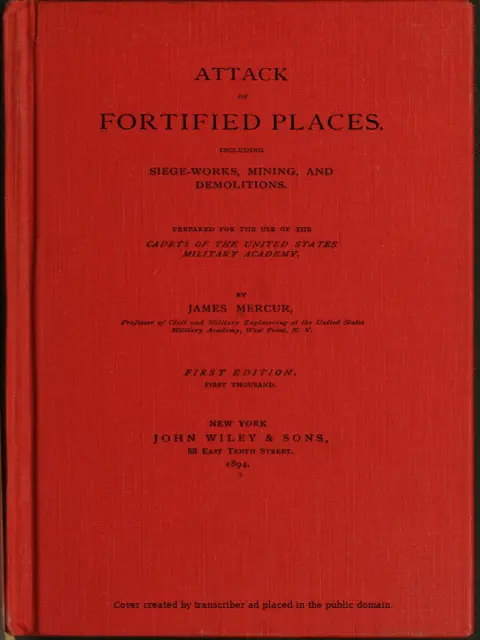
THE CLASSIC COLLECTION · 1894
"Attack of Fortified Places: Including Siege-works, Mining, and Demolitions" by James Mercur is a military engineering manual written in the late 19th century. It serves as a comprehensive guide for cadets at the United States Military Academy, detailing modern methods for attacking fortified positions, including various strategies and the construction of defenses. The focus of the book is on the technical aspects of siege warfare, as well as the appropriate application of artillery, trenches, and other fortifications. The opening of the book presents a preface that outlines its purpose: to provide an outline of best practices in military engineering for besieging fortified locations. Mercur emphasizes the need for careful planning and construction to adapt to the advancements in weaponry that have rendered older tactics obsolete. He discusses various attack methods such as blockades, surprise assaults, bombardments, and regular sieges, setting the stage for detailed examination in subsequent chapters. This portion highlights the importance of adapting strategies based on the conditions and technologies of modern warfare, making it a valuable resource for both historical study and practical military application.
Introduction adapted from the source catalogue; source summaries may be automatically generated.
Free to read · English · 53,059 words · No account needed
MAKE TIME FOR A GOOD BOOK
On by default. Untick to stop anonymous reading totals. Each page counts after 10 seconds in view. How this works.
Anonymous counting is on unless you have switched it off.
In wooden bridges they may be placed in auger-holes bored for them, and in iron bridges inside the hollow members, between eye-bars, or in other similar places.
=107. Tunnels, Canal-locks=, and similar constructions must be attacked with large charges, so placed as to temporarily or permanently disable the work, as may be considered necessary. The location of each charge should be determined and its amount computed from these considerations before the destruction is attempted.
A temporary obstruction is frequently all that is necessary or desirable for these works, and the damage done to them should be carefully regulated with a view to their subsequent repair and use.
=108. Railroads.=--Railroads are temporarily disabled by tearing up the track, making hot fires of piles of ties, placing the rails upon them so that they will heat and bend by their own weight; or, better still, twisting the rails while hot by suitably-shaped steel hooks and wooden levers of the kind devised by General Haupt (Pl. XII, Fig. 33). Rails so twisted cannot be again used until re-rolled.
=109. Rolling-stock.=--Railroad cars may be disabled by breaking one or more wheels with sledges, or may be destroyed by burning. Locomotives may be disabled temporarily by carrying away the smaller parts of the mechanism, or permanently by breaking the engine-cylinders with sledges; bursting the boilers or burning out their fire-boxes by drawing out nearly all their water, fastening down the safety-valves, and building a hot fire in the furnaces; or by making a hot fire under them so as to heat and thus bend or warp the reciprocating parts of the machinery.
=110.= In all hasty demolitions with explosives the charges should be well in excess of those computed by the ordinary rules: first, because the explosives will not be so placed as to act to the greatest advantage; and, second, because the demolition should be immediate and complete.
PAGE
Additional operations--intrenched camps, 91
Advance from first parallel, 84
Advanced positions, 104
Advantage lies with attack, 176
Ammunition, 44, 57, 101
Angle template, 137, 148
Approaches, 16
Approaches, execution of, 20-3
Approaches, tracing, 18
Approaches, over-ground, 31
Ascending galleries, 148
Armament, 100
Army of observation, 69
Artillery, first position, 75, 104
Artillery, first position opening fire, 67
Artillery, second position, 81
Artillery, second position opening fire, 83
Artillery-fire, opening, by defence, 104
Assault, 4
Assault, defence against, 7
Assault, dispositions for, 5
Assault of breach, 89
Attaching a miner, 177
Attack by mines, 169-171
Attack by sap, 91
Attack, close, 107
Attack, journal of, 97
Attack, plan of, 78
Attack, point of, 73
Attack, successive steps of, 64
Auger, earth, 138
Auxiliary frame, 144
Battery, alternative construction, 50
Battery behind crest of hill, 53
Battery, breaching, 83
Battery, construction of, 48
Battery, constructing centre passage of, 48
Battery, counter, 82
Battery, definitions, 42
Battery, electric, 163-6
Battery, enfilading, 82
Battery, exposed sunken, 46
Battery for field-guns, construction of, 43
Battery for siege-guns and howitzers, 44
Battery for siege-guns, ammunition required, 44
Your reading position is saved on this browser. Take it to another device with a library code. Reading pages adapt to text, rather than matching a printed edition.
BEHIND THE BOOK
This eBook is for the use of anyone anywhere in the United States and most other parts of the world at no cost and with almost no restrictions whatsoever. You may copy it, give it away or re-use it under the terms of the Project Gutenberg License included with this eBook or online at www.gutenberg.org. If you are not located in the United States, you will have to check the laws of the country where you are located before using this eBook. Read the source licence.
The original source file, including credits and licence, is retained by this library. Request an original-format copy at no charge. Please include the book title and Project Gutenberg identifier #59253.
KEEP YOUR CURIOSITY GOING
Cécile Tormay

Moritz Busch
John L. Ransom
Frances Wright
Cécile Tormay

Mabel Potter Daggett