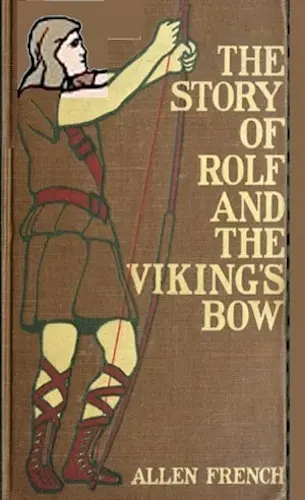
The Story of Rolf and the Viking’s Bow
Allen French
THE CLASSIC COLLECTION · 1917
"At Plattsburg" by Allen French is a novel written in the early 20th century, specifically during the time surrounding World War I. The story revolves around the experiences of Richard Godwin, a naive but earnest citizen, as he navigates military training at a camp in Plattsburgh, New York. The narrative captures his interactions with fellow recruits, including the wealthy David Ridgway Farnham, as they adapt to military life amidst their personal struggles with social class differences and the underlying currents of impending war. The beginning of "At Plattsburgh" sets the stage for Richard Godwin's journey as he arrives at the training camp. Through his letters to his mother, we see his blend of excitement and trepidation about his new life in uniform, marked by encounters with a pacifist pastor and the lively, often humorously portrayed dynamics with fellow recruits. Among them, David Farnham stands out with his upper-class background, creating tension primarily due to his sheltered nature and lack of practical skills. The opening chapters establish the camaraderie, challenges, and transformative experiences of these young men as they confront both the rigors of military training and their own identities during a pivotal time in history.
Introduction adapted from the source catalogue; source summaries may be automatically generated.
Free to read · English · 74,003 words · No account needed
MAKE TIME FOR A GOOD BOOK
On by default. Untick to stop anonymous reading totals. Each page counts after 10 seconds in view. How this works.
Anonymous counting is on unless you have switched it off.
"I'm from Harvard, class of 'sixteen," said young David. Well-grown as he is, I couldn't help thinking of him as young.
"I'm from Buffalo," said Knudsen shortly. "I run a foundry there." His blue eyes were unwavering and quite expressionless as he looked Farnham over.
"Farnham? Farnham?" said the man with the short pointed beard. The others turned and looked at him. "I remember now. You were in my section in English A, your Freshman year."
"Oh," said young David. "Professor Corder. Of course. How de do? I remember that you flunked me."
"But you got through English D after two tries," said Corder. "Such is
college life."
As none followed up the subject, I asked where they got their equipment. On their direction I went to the store-tent at the head of the street, where on the strength of my signature an obliging regular intrusted to me various listed articles, which I lugged to the tent.
This domicile is in the shape of a pyramid on a three foot wall, about sixteen feet on a side, the whole supported by a solid post held by an iron tripod. The tent contains eight beds, the corporal's always to the right of the entrance, the others in a mystic order which I will not bother you with. As yet we did not know how we were to fall in, but I set up my cot modestly among the rear rank, put under it my suit case, laid on the cot a mattress and pillow, properly cased in light duck, and garnished the whole with three blue blankets which promise comfort in this September weather. And then I dove into the blue bag.
First on the list, a sweater, o. d., like all the outfit, and very heavy.
A poncho. A rubber oblong with button-holes along three sides, and a slit, provided with a collar, less than halfway down the middle.
A shelter-half. That was the strangely shaped piece of brown duck, in pattern something like a big old-fashioned kite, with unsymmetrical button-holes and loops of rope.
Five tent-pins. Aluminum, ridged and bent.
A pack. A queerly outlined piece of canvas, provided with straps of webbing, wider or narrower, with buckles, rings, and a big pocket. Its attachments numerous and incomprehensible.
A cartridge belt. Easily recognized, with its many pockets and numberless
eyelets.
A first-aid kit. In a sealed tin box, buttoned in a pocket attached to
the belt.
A canteen in a cloth case. Not flat and circular, but solid and bulky.
A bacon tin. Hm--a small box?
A condiment can. A double ended contraption, in one end of which had once been powdered chocolate.
Your reading position is saved on this browser. Take it to another device with a library code. Reading pages adapt to text, rather than matching a printed edition.
Allen French
Allen French

Allen French
BEHIND THE BOOK
This eBook is for the use of anyone anywhere in the United States and most other parts of the world at no cost and with almost no restrictions whatsoever. You may copy it, give it away or re-use it under the terms of the Project Gutenberg License included with this eBook or online at www.gutenberg.org. If you are not located in the United States, you will have to check the laws of the country where you are located before using this eBook. Read the source licence.
The original source file, including credits and licence, is retained by this library. Request an original-format copy at no charge. Please include the book title and Project Gutenberg identifier #25825.
KEEP YOUR CURIOSITY GOING
Cécile Tormay

Moritz Busch
Coulson Kernahan
John L. Ransom

Maurice Baring
Frances Wright