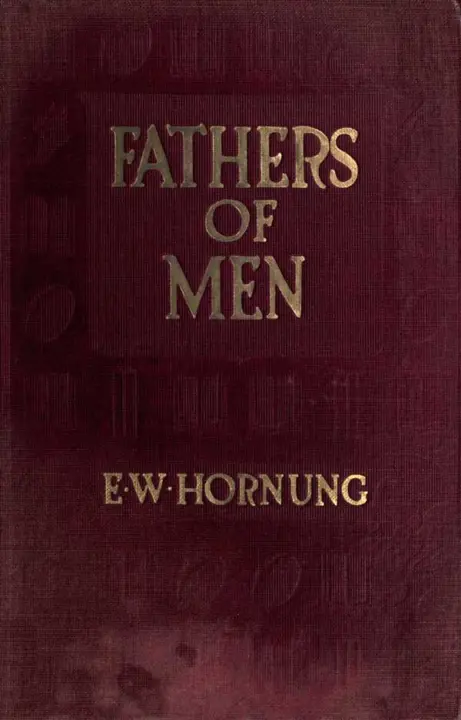
Fathers of Men
E. W. (Ernest William) Hornung
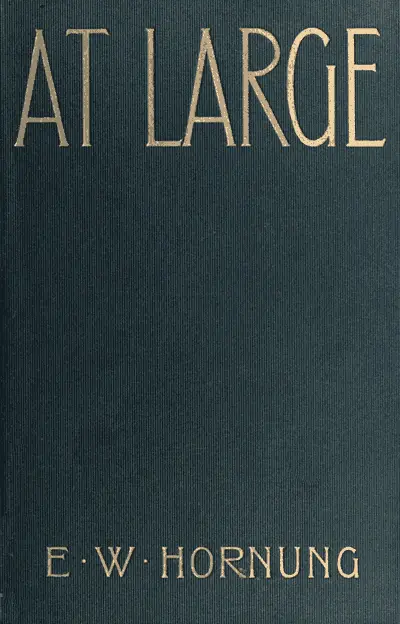
THE CLASSIC COLLECTION · 1902
"At Large" by E. W. Hornung is a novel written in the early 20th century. The story introduces the characters Edmonstone and Flint, two partners engaged in licensed hawking across the wilds of Australia. The narrative begins with their journey through the harsh Australian landscape, detailing Edmonstone's ambitions for prosperity and the tensions arising from Flint's more cynical outlook on their endeavors. The opening portion of the book sets the scene as Edmonstone and Flint travel in their wagon, highlighting their contrasting personalities—Flint is laid-back while Edmonstone is eager and anxious about their journey. As they navigate the difficult terrain, Edmonstone expresses his worry about their money and the possibility of encountering danger, especially after learning of recent robberies in the area. Their dialogue reveals Edmonstone's desperation to maintain their financial prospects, culminating in their fateful encounter with a group of masked bushrangers. The tension escalates as they find themselves bound and threatened by the outlaws, marking the beginning of their trials and perhaps foreshadowing the challenges that lie ahead in their quest for fortune.
Introduction adapted from the source catalogue; source summaries may be automatically generated.
Free to read · English · 94,069 words · No account needed
MAKE TIME FOR A GOOD BOOK
On by default. Untick to stop anonymous reading totals. Each page counts after 10 seconds in view. How this works.
Anonymous counting is on unless you have switched it off.
Dick felt the blood rushing back to his face at the words.
"Miles has gone," the Colonel pursued in a tone of annoyance; "gone this morning--a summons to Australia, he fears--a thing he had never dreamt of until last night."
"Dear me!" said Dick, with surprise that was partly genuine. For his plan had worked out better--he had been followed more strictly to the letter than he could have dared to hope; the misgivings of the last hour were turned to supreme satisfaction.
"Yes," sighed the soldier, "it was most unexpected. And I need not tell you how disappointed we all are."
Dick murmured that he was sure of it, with all the awkwardness of an honest tongue driven into hypocrisy.
"For my own part, I feel confoundedly put out about it. I shall be as dull as ditch-water for days. As for the ladies, they'll miss him horribly."
Dick's reply was monosyllabic, and its tone fell distinctly short of
sympathy.
"He was such a good fellow!"
The Colonel said this regretfully, and waited for some echo. But Dick could have said nothing without the whole truth bursting out, so he merely asked:
"When did he go?"
"About nine--as soon as he could pack up his things, in fact. Alice was not down to say good-bye to him."
Dick's eyes glittered.
"He will be back to say it, though?" he asked suspiciously.
"No, I fear not; he will probably have to start at once; at least, so his agent told him--the fellow who came down last night, and robbed us of him for half the evening. By-the-bye, we missed you too; did you go home?"
"Yes." Dick faltered a little.
"Have you and Alice been quarrelling?" asked Alice's father abruptly.
Dick answered simply that they had. Colonel Bristo silently paced the carpet. When he spoke again it was to revert to the subject of Miles.
"Yes, I am sorry enough to lose him; for we had become great friends, intimate friends, and we understood one another thoroughly, he and I. But the worst of it is, we shan't have him with us in Yorkshire. What a man for the moors! And how he would have enjoyed it! But there; it's no use talking; we're all disappointed, and there's an end of it."
The Colonel laid his hand on Dick's shoulder, and added:
"You won't disappoint us, my boy?"
"For the moors, sir?"
"Why, of course."
"I cannot go--I am very sorry"--hastily--"but----"
"Nonsense, Dick!"
"I really cannot--I cannot, indeed," with lame repetition.
"And why?" asked Colonel Bristo, mildly. "Why--when you promised us
weeks ago?"
Your reading position is saved on this browser. Take it to another device with a library code. Reading pages adapt to text, rather than matching a printed edition.
E. W. (Ernest William) Hornung
E. W. (Ernest William) Hornung
E. W. (Ernest William) Hornung
E. W. (Ernest William) Hornung
BEHIND THE BOOK
This eBook is for the use of anyone anywhere in the United States and most other parts of the world at no cost and with almost no restrictions whatsoever. You may copy it, give it away or re-use it under the terms of the Project Gutenberg License included with this eBook or online at www.gutenberg.org. If you are not located in the United States, you will have to check the laws of the country where you are located before using this eBook. Read the source licence.
The original source file, including credits and licence, is retained by this library. Request an original-format copy at no charge. Please include the book title and Project Gutenberg identifier #35684.
KEEP YOUR CURIOSITY GOING
Coulson Kernahan

Maurice Baring
Frances Wright
Cécile Tormay

Frederic Jesup Stimson

W. H. P. (William Henry Pope) Jarvis