
The Writing of News A Handbook with Chapters on Newspaper Correspondence and Copy Reading
Charles G. (Charles Griffith) Ross
THE CLASSIC COLLECTION · 1914
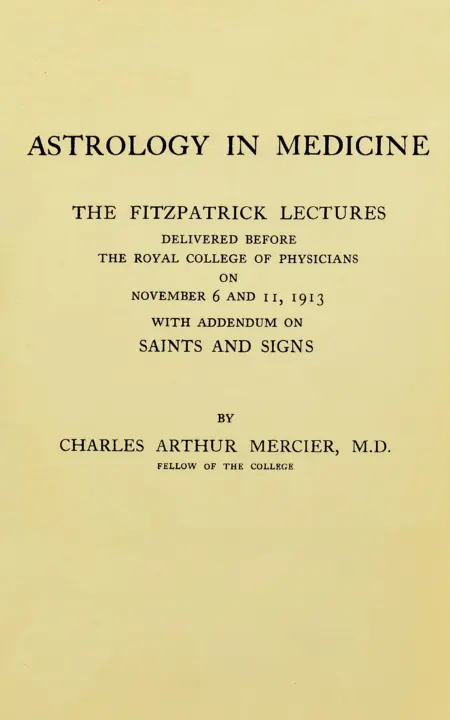
"Astrology in Medicine" by Charles Arthur Mercier is a scholarly lecture series written in the early 20th century. It explores how astrological doctrine was built and why it once seemed indispensable to physicians, laying out its technical system (signs, planets, houses, aspects, and humours) and arguing that it hindered medical progress even as it shaped practice for centuries.
The opening of the work surveys astrology’s vast historical reach and abrupt extinction, then sets out its basic machinery so readers can see how it was meant to guide doctors. Mercier explains the four elemental qualities and the zodiac arranged by triplicities, linking each sign to humours, life stages, and body parts. He introduces the seven traditional planets, their “fortunate” or “unfortunate” character, and their sweeping jurisdictions (including animals, plants, metals), then shows how a planet’s power varies by sign, house, aspect, motion, and hour. He defines the twelve Houses of Heaven and their meanings, details aspects from conjunction to opposition, and notes practical rules like planetary days and hours (tracing the Rx/Jupiter symbol atop prescriptions). To illustrate how an astrologer would reason, he interprets a nativity to predict a warlike career crowned with disaster—an example used to reveal both the system’s internal logic and its arbitrariness.
Introduction adapted from the source catalogue; source summaries may be automatically generated.
Free to read · English · 19,959 words · No account needed
MAKE TIME FOR A GOOD BOOK
On by default. Untick to stop anonymous reading totals. Each page counts after 10 seconds in view. How this works.
Anonymous counting is on unless you have switched it off.
Of plants, Saturn has jurisdiction over the oak, the mespilus, the rue, the hellebore, and generally over those of slow growth, of narcotic virtue, and of crass substance. Jupiter over the laurel, the sandal-wood, the cinnamon, the balsam and the incense tree. Mars over pepper, ginger, mustard, jalap, scammony, colocynth, euphorbium, and generally over all bitter plants and hot poisons. Sol aspects the palm, rosemary, heliotrope, crocus, and all aromatics. Venus the olive, the pine, the lily, the rose and the pea; Mercury the corylus and the millefoil; and Luna the cucumber, the gourd, pepin fruits, i.e. apples and pears, and lettuce.
The minerals of Saturn are lead and all black stones; of Jupiter, tin, the sapphire, and the amethyst; of Mars, iron, jasper, and magnesia; of Sol, gold, carbuncles, and crysolite; of Venus, copper, smaragdus, turquoise, and coral; of Mercury, quicksilver, chalcedony, and cornelian; and of Luna, silver, crystals, beryl, and the diamond.
I defer to the next lecture the consideration of those planetary aspects that have a special bearing upon medicine, but this is perhaps the proper place to make the very important distinction between the benevolent, propitious, or fortunate Planets and those that are malevolent, unpropitious, or unlucky. The fortunate, or benevolent, or propitious Planets are Jupiter, Sol, and Venus, of which the first and last are lucky in the highest degree. Saturn, Mars, and Luna are malevolent, unpropitious, and unlucky. Mercury is variable in this respect. He has scarcely any character of his own, but he reinforces the benevolence or the malevolence, as the case may be, of whatever Planet may be in conjunction with him, or may be favourably aspected by him.
It is evident, if these premises are granted, that the course and termination of every malady in every sick person depend on the relative power, with respect to other Planets, of the particular Planet or Planets that have jurisdiction in the matter. They will depend, in the first place, on the Planet that has jurisdiction over the temperament, as Saturn if he is saturnine, Jupiter if he is jovial, Mars if he is martial, and so forth. They will depend also on the Planet that presides over the humour that is peccant, as yellow bile, black bile, blood or phlegm. They will depend on the Planet that governs the part of the body that is diseased; on that which governs the disease; on that which has jurisdiction at the time of life at which the sick person is arrived; on that which presided over his nativity, and so forth. Here are at least six circumstances to be taken into account, and of course, the Planet that governs one of these circumstances may not be the same, and in fact must be different from those which govern others. So that seven Planets may all be influencing the disease and the sick person at once, and may all be pulling in different directions, some towards health and some towards death, some towards acuteness and some towards chronicity of the disease. It is evident, therefore, that his fate must depend on the relative powers of the propitious and unpropitious Planets, and that it is of the utmost importance to determine the factors on which the powers of the Planets depend, and to estimate their strength in any particular case.
Your reading position is saved on this browser. Take it to another device with a library code. Reading pages adapt to text, rather than matching a printed edition.
BEHIND THE BOOK
This eBook is for the use of anyone anywhere in the United States and most other parts of the world at no cost and with almost no restrictions whatsoever. You may copy it, give it away or re-use it under the terms of the Project Gutenberg License included with this eBook or online at www.gutenberg.org. If you are not located in the United States, you will have to check the laws of the country where you are located before using this eBook. Read the source licence.
The original source file, including credits and licence, is retained by this library. Request an original-format copy at no charge. Please include the book title and Project Gutenberg identifier #78150.
KEEP YOUR CURIOSITY GOING
Charles G. (Charles Griffith) Ross
Hannah Webster Foster

Emily Lawless
Edwin Hamlin Carr

Charles De Lano Hine
Andrew Ure