THE CLASSIC COLLECTION✦Second Sight: A Study of Natural and Induced ClairvoyanceCLASSIC FREE BOOKS
Second Sight: A Study of Natural and Induced Clairvoyance
Sepharial
THE CLASSIC COLLECTION · 1920
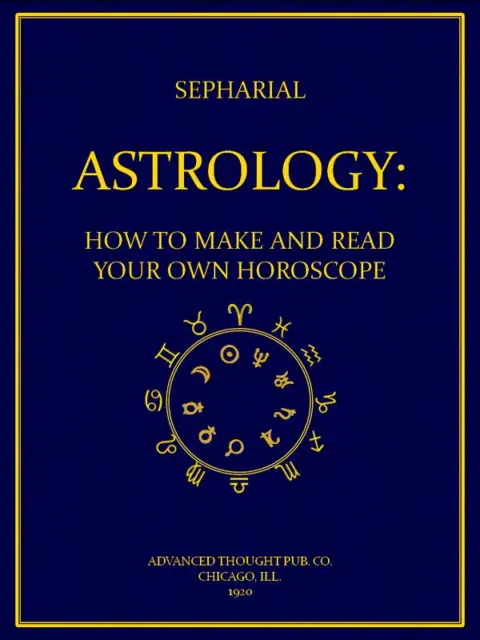
"Astrology: How to Make and Read Your Own Horoscope" by Sepharial is a practical guide on astrology written in the early 20th century. The work aims to introduce readers to the basics of creating and interpreting horoscopes, emphasizing its relevance and utility in understanding human character and life events. With a focus on Genethliacal Astrology, it serves as a foundational text for beginners eager to explore this ancient discipline. The opening of the book contains a preface by the author, conveying the growing interest and need for an accessible manual on astrology due to increased recognition of its practical applications. Sepharial emphasizes that astrology not only reveals human character but also offers insights into various aspects of life, thus directing personal ambitions positively. He refers to the timing of individuals' births and planetary alignments, suggesting that understanding these influences can aid in navigating life's challenges and opportunities. The author establishes a sense of intrigue around astrology as a revealing and scientifically grounded practice rather than mere superstition, inviting readers to delve deeper into its mysteries.
Introduction adapted from the source catalogue; source summaries may be automatically generated.
Free to read · English · 31,494 words · No account needed
MAKE TIME FOR A GOOD BOOK
On by default. Untick to stop anonymous reading totals. Each page counts after 10 seconds in view. How this works.
Anonymous counting is on unless you have switched it off.
Uranus gives an eccentric mind, waywardness, originality, inventiveness. Acting on the affairs of business, it produces sudden and unexpected developments, irregularities, rapid rise and fall, instability, unexpected turns of good and bad fortune. In the body it has relation to the nervous system, and its diseases are those of paralysis, lesion, and nervous derangement.
Saturn produces a thoughtful, sober, ponderable mind; steadfastness, patience, and endurance; disposition to routine and habit, method. In financial affairs it gives steady results commensurate with labour, success that is slow but sure, durance, hardships, privations. In the body it is related to the osseous system, and its effects are brought about by obstructions, chills, and inhibition of function.
Jupiter gives joviality, optimism, bountifulness, generosity, a rich and fruitful mind. It renders the subject fortunate in his affairs, giving success and frequently opulence. With this planet strong in the horoscope a person never “goes under.” In the body it has relation to the arterial process, and its diseases are those which arise from surfeit, congestion, and plethora.
Mars confers a sense of freedom, much ambition and executive ability, frankness, truthfulness, and scorn of consequence. It renders the mind forceful and militant, stimulates to new projects and enterprises, and in the body of man has relation to the muscular system. Its diseases are those which arise from inflammatory action in the tissues.
Venus confers poesy, good taste, fine feeling, artistic powers, gentleness, docility, dalliance, and love of pleasure. It renders the affairs pleasant and prosperous, giving profit from both artistic and rustic pursuits. Next to Jupiter it is the most benefic of the planets in its action on mankind. In the body it has relation to the venous system, and its diseases are those which arise from impurities of the blood, scorbutic and zymotic diseases, eczema, smallpox, measles, &c.
Mercury renders its subjects active, versatile, apt and business-like, disposed to much commerce, whether of the mind or the market, and eager in the pursuit of knowledge; alert, and well-informed. Its influence on affairs of life is variable, for it always translates the nature of that planet to which at birth it is in nearest aspect (Sect. I., chap. iv.). In the body it is related to the sensorium, the centres of sensation, and reflexly controls the nerves of action.
The Moon gives gracefulness of manner and suavity of speech, softness and adaptability of nature, variableness, love of change, romance, and adventure; disposed to exploration and voyaging. In the body it corresponds to the glandular system, and its diseases are those incidental to the lymphatic glands and vascular tissue.
Your reading position is saved on this browser. Take it to another device with a library code. Reading pages adapt to text, rather than matching a printed edition.
BEHIND THE BOOK
This eBook is for the use of anyone anywhere in the United States and most other parts of the world at no cost and with almost no restrictions whatsoever. You may copy it, give it away or re-use it under the terms of the Project Gutenberg License included with this eBook or online at www.gutenberg.org. If you are not located in the United States, you will have to check the laws of the country where you are located before using this eBook. Read the source licence.
The original source file, including credits and licence, is retained by this library. Request an original-format copy at no charge. Please include the book title and Project Gutenberg identifier #46963.
KEEP YOUR CURIOSITY GOING

David Patterson (Spirit) Hatch

David Patterson (Spirit) Hatch

David Patterson (Spirit) Hatch

Edwin Abbott Abbott

Richard Watson
T. G. (Theophilus Gould) Steward