THE CLASSIC COLLECTION✦An outlaw’s diary: the CommuneCLASSIC FREE BOOKS
An outlaw’s diary: the Commune
Cécile Tormay
THE CLASSIC COLLECTION · 1906
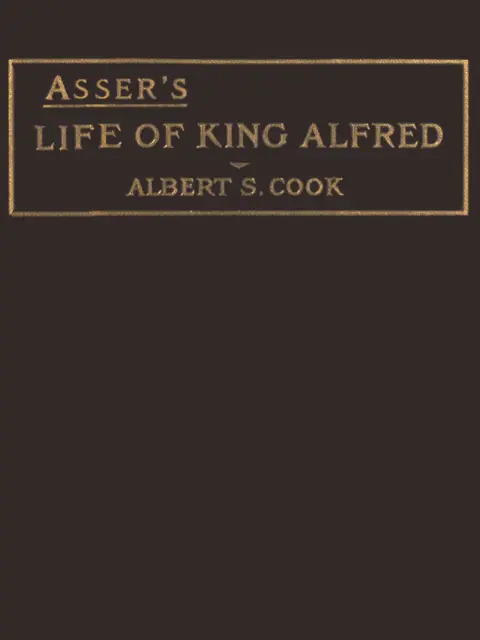
"Asser's Life of King Alfred" by John Asser is a biography written in 893. A Welsh monk recruited to Alfred the Great's scholarly court, Asser composed the only substantial contemporary account of England's legendary king. This work reveals Alfred's character, achievements, and daily life in remarkable detail—information unavailable for any other early English ruler. Though the original manuscript perished in a 1731 fire, earlier transcriptions preserved this invaluable portrait. The biography's authenticity has sparked debate, but scholars now widely accept it as genuine.
Introduction adapted from the source catalogue; source summaries may be automatically generated.
Free to read · English · 25,696 words · No account needed
MAKE TIME FOR A GOOD BOOK
On by default. Untick to stop anonymous reading totals. Each page counts after 10 seconds in view. How this works.
Anonymous counting is on unless you have switched it off.
[193] Probably from the monastery of St. Bertin, at St. Omer (Pas-de-Calais). See Appendix I, p. 71, and Appendix II, pp. 75 ff.
[194] Cf. chap. 94, and Appendix I, p. 71.
[195] Original.
[196] Perhaps Dean, near Eastbourne, in Sussex.
[197] Five miles southwest of Chepstow. ‘There was an abbey there, where a traveling ecclesiastic would be likely to stay, and it was on the great Roman road to South Wales, by which a traveler from Wessex to St. Davids would proceed’ (Stevenson).
[198] The MS. seems to be corrupt at this point, so that what I have given is a loose conjectural rendering of the Latin: ... et illa adjuvaretur per rudimenta Sancti Dequi in omni causa, tamen pro viribus.
[199] Original.
[200] Pembrokeshire and part of Carmarthenshire.
[201] ‘Rhodri Mawr (the Great), King of Gwyneth, who acquired the rule of the whole of North and Mid-Wales and Cardigan’ (Stevenson).
[202] Old name of Glamorgan and part of Monmouthshire.
[203] In Monmouthshire.
[204] Alfred.
[205] See chaps. 8 and 56.
[206] Original.
[207] Perhaps Landford in Wiltshire.
[208] In Alfred’s Preface to his translation of Boethius we are told: ‘[He made this translation as well as he could], considering the various and manifold worldly cares that oft troubled him both in mind and body.’ The similarity of phrase is striking.
[209] Both in Somersetshire; these monasteries are otherwise unknown.
[210] Largely from the Chronicle.
[211] Largely from the Chronicle.
[212] Namely, Alfred.
[213] A mistranslation from the Chronicle; it should read, ‘were not
in captivity,’ etc.
[214] Here follows Camden’s famous (forged?) interpolation about
Grimbald and Oxford.
[215] Much expanded from the Chronicle.
[216] From the Chronicle.
[217] Charles the Fat.
[218] Burgundy.
[219] Chiefly from the Chronicle.
[220] Cf. chap. 84.
[221] Original.
[222] Original.
[223] Cf. chap. 24.
[224] Author unknown.
[225] Cf. chap. 76.
[226] Original.
[227] Luke 23. 42.
[228] The following phrases, introduced at this point, seem to be corrupt: Hic aut aliter, quamvis dissimili modo, in regia potestate.
[229] November 11.
[230] Alfred calls the passages which he translated from St. Augustine’s Soliloquies by the name of ‘flowers’ or ‘blossoms’ (blōstman). See Hargrove’s edition (Yale Studies in English XIII), and his version into modern English (Yale Studies in English XXII).
[231] The application of the word to a work of St. Augustine’s gave it great currency in the Frankish Latin of the period.
[232] The Handbook seems to have been known to William of Malmesbury (d. 1143); cf. his Gesta Pontificum, pp. 333, 336.
[233] Original.
[234] Unknown.
[235] Cf. note 5, chap. 80.
[236] ... unicuique ubicumque male habet.
[237] Original.
[238] Cf. chap. 74.
[239] MS. corrupt: De cotidiana nationum.
[240] This makes no sense; yet the Latin is: quæ in Tyrreno mari usque ultimum Hiberniæ finem habitant.
[241] Cf. chap. 70.
[242] Perhaps Elias III, patriarch from about 879 to 907; the MS. reads Abel. Stevenson’s emendation is supported by the fact that certain medical recipes are related to have been sent to Alfred by the patriarch Elias (Cockayne, Leechdoms 2. 290).
Your reading position is saved on this browser. Take it to another device with a library code. Reading pages adapt to text, rather than matching a printed edition.
BEHIND THE BOOK
This eBook is for the use of anyone anywhere in the United States and most other parts of the world at no cost and with almost no restrictions whatsoever. You may copy it, give it away or re-use it under the terms of the Project Gutenberg License included with this eBook or online at www.gutenberg.org. If you are not located in the United States, you will have to check the laws of the country where you are located before using this eBook. Read the source licence.
The original source file, including credits and licence, is retained by this library. Request an original-format copy at no charge. Please include the book title and Project Gutenberg identifier #63384.
KEEP YOUR CURIOSITY GOING
Cécile Tormay

Moritz Busch
John L. Ransom
Frances Wright
Cécile Tormay

Mabel Potter Daggett