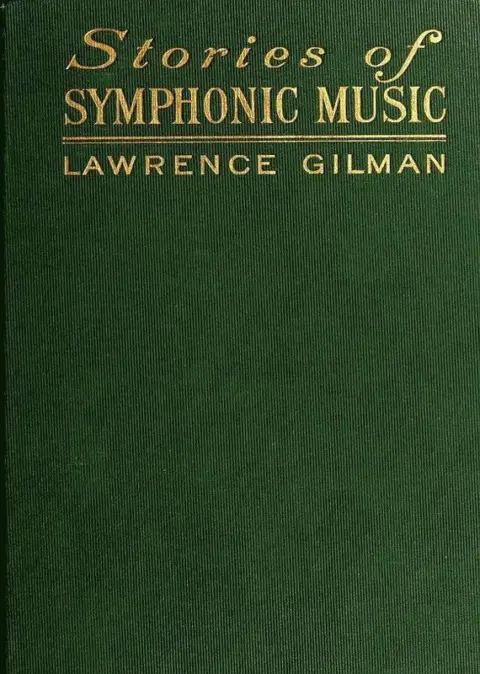
Stories of Symphonic Music A Guide to the Meaning of Important Symphonies, Overtures, and Tone-poems from Beethoven to the Present Day
Lawrence Gilman
THE CLASSIC COLLECTION · 1908
"Aspects of Modern Opera: Estimates and Inquiries" by Lawrence Gilman is a critical examination of modern operatic art, likely written in the early 20th century. The book discusses the influence of figures like Wagner, Puccini, and Strauss on contemporary opera, analyzing their contributions and the subsequent developments in the genre. It explores the evolution of operatic expression and the tensions between music and drama in modern works. The opening of the text sets the stage for an in-depth inquiry into the aftermath of Wagner's impactful legacy on opera. Gilman reflects on the general decline of creative vitality in opera after Wagner's death, suggesting that while his influence has been substantial, it has also stifled originality among his successors. He critiques the limitations of several composers, particularly in the context of their inability to break free from Wagnerian principles, ultimately leading to a discussion of the few artists—like Puccini and Strauss—who successfully navigate their own paths in the evolving landscape of opera.
Introduction adapted from the source catalogue; source summaries may be automatically generated.
Free to read · English · 19,323 words · No account needed
MAKE TIME FOR A GOOD BOOK
On by default. Untick to stop anonymous reading totals. Each page counts after 10 seconds in view. How this works.
Anonymous counting is on unless you have switched it off.
The music of "Salome," then, judging it in its entirety, is deficient as an exposition, as a translation into tone, of the drama upon which it is based; for it is inadequate in its expression of the play's central and informing emotion. One listens to this music, it must be granted, with the nerves in an excessive state of tension--it is enormously exciting; but so is, under certain conditions, a determined beating upon a drum. An assault upon the nerve-centres is a vastly different thing from an emotional persuasion; yet there are many who, in listening to "Salome," will need to be convinced of it.
It would be absurd to deny, of course, that "Salome" is in many ways a noteworthy and brilliant--and, for the curious student of musical evolution--a fascinating work. Its musicianship--the sheer technical artistry which contrived it--is stupefying in its enormous and inerrant mastery. The quality of its inspiration and its success as a musico-dramatic commentary, which have been the prime considerations in this discussion, have been measured, of course, by the most exacting standards--by the standards set in other and greater works of Strauss, in comparison with which it is lamentably inferior in vitality, sincerity, and importance. In at least one respect, however, it compels the most unreserved praise; and that is in the case of its superlative orchestration. Strauss has written here for a huge and complicated body of instruments, and he has set them an appalling task. Never in the history of music has such instrumentation found its way onto the printed page. Yet, though he requires his performers to do impossible things, they never fail to contribute to the effect of the music as a whole; for the dominant and wonderful distinction of the scoring lies precisely in the splendour of its total effect, and the almost uncanny art with which it is accomplished. One finds upon every page not only new and superlative achievements in colouring, unimagined sonorities, but a keenly poetic feeling for the timbre which will most intensify the dramatic moment. The instrumentation, from beginning to end, is a gorgeous fabric of strange and novel and obsessing colours--for in such orchestral writing as this, sound becomes colour, and colour sound: it is not a single sense which is engaged, but a subtle and indescribable complex of all the senses; one not only hears, one also imagines that one sees and feels these tones, and is even fantastically aware of their possessing exotic and curious odours, vague and singular perfumes. It is when one turns from the bewildering magnificence of its orchestral surfaces to a consideration of the actual substance of the music, the fundamental ideas which lie within the dazzling instrumental envelope, that it is possible to realise why, for many of his most determined admirers, this work marks a pathetic decline from the standard set by Strauss in his former achievements. The indisputable splendour of this music, its marvellous witchery, are incurably external. It is a gorgeous and many-hued garment, but that which it clothes and glorifies is a poor and unnurtured thing. There is little vitality, little true substance, within this dazzling instrumental envelope; and for any one who is not content with its brave exterior panoply, and who seeks a more permanent and living beauty within, the thing seems but a vast and empty husk. It is not that the music is at times cacophonous in the extreme, that its ugliness ranges from that which is merely harsh and unlovely to that which is brutally and deliberately hideous; for we have not to learn anew, in these days of post-Wagnerian emancipation, that a dramatic exigency justifies any possible musical means that will appropriately express it: to-day we cheerfully concede that, when a character in music-drama tells another character that his body is "like the body of a leper, like a plastered wall where vipers crawl ... like a whitened sepulchre, full of loathsome things," the sentiment may not be uttered in music of Mendelssohnian sweetness and placidity. It is because the music is so often vulgarly sentimental, when it should be terrible and unbridled in its passion, that it seems to some a defective performance. For sheer commonness, allied with a kind of emotionalism that is the worse for being inflated in expression, it would be hard to find, in any score of the rank of "Salome," the equal of the two themes which Strauss uses so extensively that they stand almost as the dominant motives in the score: the theme which is associated with Salome's desire to kiss the lips of John, and that other theme--it has been called that of "Ecstasy"--which begins like the cantabile subject in the first movement of Tschaikowsky's "Pathetic" Symphony, and ends--well, like Strauss at his worst.
Your reading position is saved on this browser. Take it to another device with a library code. Reading pages adapt to text, rather than matching a printed edition.
BEHIND THE BOOK
This eBook is for the use of anyone anywhere in the United States and most other parts of the world at no cost and with almost no restrictions whatsoever. You may copy it, give it away or re-use it under the terms of the Project Gutenberg License included with this eBook or online at www.gutenberg.org. If you are not located in the United States, you will have to check the laws of the country where you are located before using this eBook. Read the source licence.
The original source file, including credits and licence, is retained by this library. Request an original-format copy at no charge. Please include the book title and Project Gutenberg identifier #38268.
KEEP YOUR CURIOSITY GOING

Charles G. (Charles Griffith) Ross
Hannah Webster Foster

Emily Lawless
Edwin Hamlin Carr

Charles De Lano Hine
Andrew Ure