THE CLASSIC COLLECTION✦An outlaw’s diary: the CommuneCLASSIC FREE BOOKS
An outlaw’s diary: the Commune
Cécile Tormay
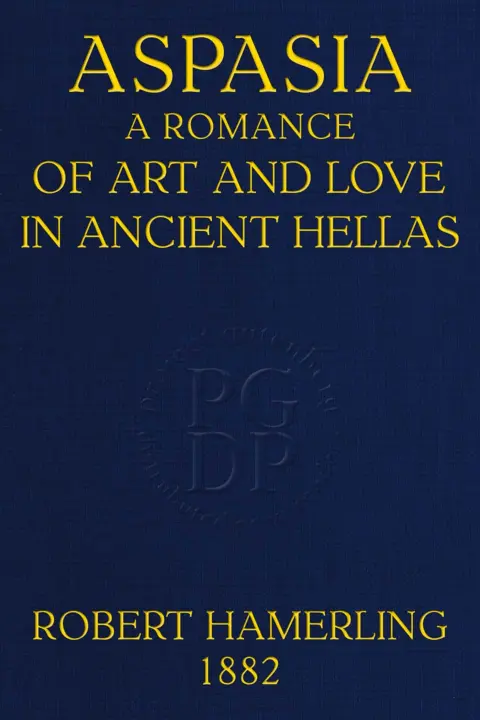
THE CLASSIC COLLECTION · 1882
“Aspasia: A Romance of Art and Love in Ancient Hellas” by Robert Hamerling is a historical novel written in the late 19th century. The book focuses on ancient Greece, blending themes of art, politics, and romance, with central figures drawn both from historical record and imaginative reconstruction. The probable main characters include Pericles, the influential Athenian statesman, and Aspasia, the intriguing Milesian woman renowned for her beauty and intellect. The novel appears to explore the intersections of personal and national destiny, with the flourishing of Greek art, the conflicts of moral and aesthetic values, and the magnetic attraction between gifted individuals as key elements. The opening of “Aspasia” sets the scene in bustling, resurgent Athens during the age of Pericles. It introduces a cast of prominent Athenians—Pericles the statesman, Phidias the sculptor, and others in their intellectual circle—against a detailed backdrop of public life, ongoing artistic achievements, and the arrival of the Delian League’s treasure. The focus sharpens on a striking, unnamed woman (later revealed as Aspasia), whose presence stirs both fascination and artistic rivalry. The narrative moves from the city’s vibrant agora to a contest between sculptors, where debates about the nature of beauty, the divine, and the political responsibilities of art unfold. The section closes by shifting to Pericles’ household, revealing tensions between public duty and private life, as well as introducing other key figures such as Pericles’ wife Telesippe and the philosopher Anaxagoras. The early chapters establish the layered interplay between historical circumstance, artistic ambition, philosophical dialogue, and the personal entanglements at the heart of Athenian society.
Introduction adapted from the source catalogue; source summaries may be automatically generated.
Free to read · English · 191,784 words · No account needed
MAKE TIME FOR A GOOD BOOK
On by default. Untick to stop anonymous reading totals. Each page counts after 10 seconds in view. How this works.
Anonymous counting is on unless you have switched it off.
did any one ever miss the woman in me, my bearing, or the voice that issued from the mournful mask?”
“No one! No one!” all exclaimed.
“And when I sorrowfully embraced the urn containing the supposed ashes of my brother,” continued the excited Polus.
“O, ye dear remains
Of my Orestes, the most loved of men—”
“The whole audience was moved, stirred, melted with sorrow!” cried Sophocles, and the others assented.
“Never was any voice heard on the stage,” continued Sophocles, “that sounded more touching, more womanly than yours.”
“I hope you don’t mean to say, that my voice has a feminine character,” replied Polus? “I think you must still remember my Ajax.”
“Wretch that I was, to let
The cursed Atridæ ’scape and shed the blood
Of harmless cattle!”
Polus’ voice seemed utterly changed in the delivery of these words. “That is the deepest, most powerful of all heroes’ voices!” cried the listeners enthusiastically.
“Well? And my Philoctetes?” continued Polus, “my cry of anguish, when the old serpent venom glowed within me—my oh! oh! oh! oh! it comes—it comes—”
Again exclamations arose: “What a voice of sorrow! What a natural expression of grief, feebleness, faintness!”
“Well!” cried Polus; “but when at the end of the tragedy I began:
“I will but pay my salutation here,
And instantly depart,
Now ye fresh fountains! each Lycœan spring
I leave you now.”
“It was a glorious moment,” assented Hipponicus; “but the finest thing I have ever seen or heard you do, was when, as Ajax, you stood on the stage repeating that wonderful soliloquy—”
“You mean,” said Polus, “when in the lonely ravine, just before the suicide, I thrust the sword point uppermost into the earth—
“There stands my sword, and fixed as it may best
Perform its office—”
“That is it!” cried Hipponicus, “and when you called Zeus, and then the Furies, and then Helios—”
“Oh, Helios,” interrupted Polus.
“And then, O Sun! who drivest the flaming car
Along the vaulted sky; when thou shalt see
My native soil, O! stop thy golden reins.
Tell the sad story to my hapless sire—”
“And when last of all,” continued Hipponicus, enthusiastically, “you remember your native soil, the paternal hearth, Salamis, the famous city of Athens, and your kindred, the Athenian nation—the hearts of twenty thousand Athenians quivered with a fiery glow! Each breast thrilled with patriotic emotion, and each individual felt that he shared the dying hero’s farewell. Hitherto they had been secretly touched and moved—now they burst into a storm of applause, bestowed on you, Sophocles, and the heroes of Salamis.”
Your reading position is saved on this browser. Take it to another device with a library code. Reading pages adapt to text, rather than matching a printed edition.
BEHIND THE BOOK
This eBook is for the use of anyone anywhere in the United States and most other parts of the world at no cost and with almost no restrictions whatsoever. You may copy it, give it away or re-use it under the terms of the Project Gutenberg License included with this eBook or online at www.gutenberg.org. If you are not located in the United States, you will have to check the laws of the country where you are located before using this eBook. Read the source licence.
The original source file, including credits and licence, is retained by this library. Request an original-format copy at no charge. Please include the book title and Project Gutenberg identifier #76058.
KEEP YOUR CURIOSITY GOING
Cécile Tormay

Moritz Busch
Coulson Kernahan
John L. Ransom

Maurice Baring
Frances Wright