THE CLASSIC COLLECTION✦Mr. Sponge’s Sporting TourCLASSIC FREE BOOKS
Mr. Sponge’s Sporting Tour
Robert Smith Surtees
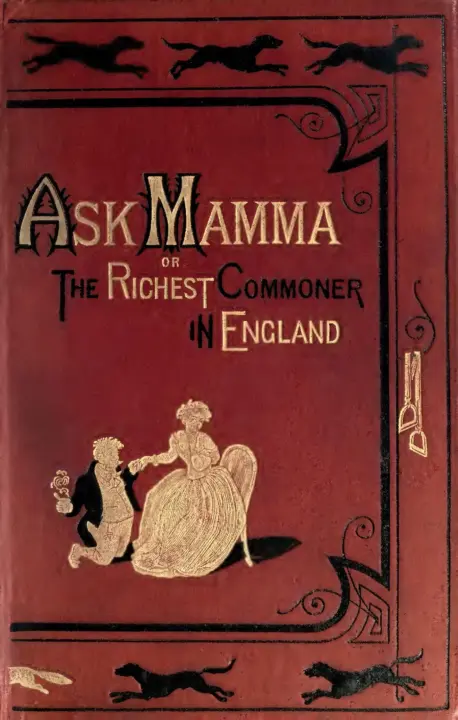
THE CLASSIC COLLECTION · 1858
"Ask Mamma; or, The Richest Commoner In England" by Robert Smith Surtees is a novel written in the mid-19th century. The story centers around Billy Pringle, who aspires to be seen as a gentleman, despite his humble origins as part of a trading family. As he navigates social situations filled with humor and satire, themes of ambition, social class, and identity emerge. The opening of the novel introduces us to Billy Pringle, fondly referred to as "Fine Billy," who is characterized by his attempts to embody gentility despite his humble background. The narrative provides a glimpse into his interactions with various members of his family, revealing their dynamics and his desire to fit into a more affluent social circle. We also meet Miss Willing, a lady's maid with aspirations of her own, who captures Billy's attention during a coach journey. Their budding acquaintance sets the stage for the humorous and often absurd twists of social class and romance that will unfold throughout the story.
Introduction adapted from the source catalogue; source summaries may be automatically generated.
Free to read · English · 179,335 words · No account needed
MAKE TIME FOR A GOOD BOOK
On by default. Untick to stop anonymous reading totals. Each page counts after 10 seconds in view. How this works.
Anonymous counting is on unless you have switched it off.
We have heard it said that the House of Commons is the most appalling and critical assembly in the world to address, but we confess we think a mixed party of ladies and gentlemen at a sit-down supper a more formidable audience.
We don’t know anything more painful than to hear a tongue-tied country gentleman floundering for words and scrambling after an idea that the quick-witted ladies have caught long before he comes within sight of his subject. Theirs is like the sudden dart of the elastic greyhound compared to the solemn towl of the old slow-moving “southern” hound after its game.
Sir Moses, however, as our readers know, was not one of the tongue-tied sort—on the contrary, he had a great flow of words and could palaver the ladies as well as the gentlemen. Indeed he was quite at home in that room where he had coaxed and wheedled subscriptions, promised wonders, and given away horses without the donees incurring any “obligation.” Accordingly at the fitting time he rose from his throne, and with one stroke of his hammer quelled the remaining conversation which had been gradually dying out in anticipation of what was coming. He then called for a bumper toast, and after alluding in felicitous terms to the happy event that so aroused the “symphonies” of old Wotherspoon, he concluded by proposing the health of her Majesty the Queen, which of course was drunk with three times three and one cheer more. The next toast, of course, was the ladies who had honoured the Ball with their presence, and certainly if ever ladies ought to be satisfied with the compliments paid them, it was on the present occasion, for Sir Moses vowed and protested that of all beauties the Hit-im and Hold-im shire beauties were the fairest, the brightest, and the best; and he said it would be a downright reflection upon the rising generation if they did not follow the Crown Prince of Prussia’s excellent example, and make that ball to be the most blissful and joyous of their recollections. This toast being heartily responded to, Sir Moses leading the cheers, Sir Harry Fuzball rose to return thanks on behalf of the ladies, any one of whom could have done it a great deal better; after which old Sir George Persiflage, having arranged his lace-tipped tie, proposed the health of Sir Moses, and spoke of him in very different terms to what Sir Moses did of Sir George at the hunt dinner, and this, answer affording Sir Moses another opportunity—the good Champagne being exhausted—he renewed his former advice, and concluded by moving an adjournment to the ball-room. Then the weight of oratory being off, the school broke loose as it were, and all parties paired off as they liked. Many were the trips at the steps as they returned by the narrow passage to the ball-room. The “Ask Mamma” Polka then appropriately struck up, but polking being rather beyond our Baronet’s powers he stood outside the ring rubbing his nose and eyeing the gay twirlers, taking counsel within himself what he should do. The state of his household had sorely perplexed him, aud he had about come to the resolution that he must either marry again or give up housekeeping and live at Hinton. Then came the question whom he should take? Now Mrs. Yammerton was a noted good manager, and in the inferential sort of way that we all sometimes deceive ourselves, he came to the conclusion that her daughters would be the same. Clara was very pretty—dom’d if she wasn’t—She would look very well at the head of his table, and just at the moment she came twirling past with Billy Pringle, the pearl loops of her pretty pink wreath dancing on her fair forehead. The Baronet was booked; “he would have her, dom’d if he wouldn’t,” and taking courage within himself as the music ceased, he claimed her hand for the next quadrille, and leading her to the top of the dance, commenced joking her about Billy, who he said would make a very pretty girl, and then commenced praising herself. He admired her and everything she had on, from the wreath to her ribbon, and was so affectionate that she felt if he wasn’t a little elevated she would very soon have an offer. Then Mammas, and Mrs. Rocket Larkspurs, and Mrs. Dotherington, and Mrs. Impelow, and many other quick-eyed ladies followed their movements, each thinking that they saw by the sparkle of Clara’s eyes, and the slight flush of her pretty face, what was going on. But they were prématuré. Sir Moses did not offer until he had mopped his brow in the promenade, when, on making the second slow round of the room, a significant glance with a slight inclination of her handsome head as she passed her Mamma announced that she was going to be Lady Mainchance!
Your reading position is saved on this browser. Take it to another device with a library code. Reading pages adapt to text, rather than matching a printed edition.
BEHIND THE BOOK
This eBook is for the use of anyone anywhere in the United States and most other parts of the world at no cost and with almost no restrictions whatsoever. You may copy it, give it away or re-use it under the terms of the Project Gutenberg License included with this eBook or online at www.gutenberg.org. If you are not located in the United States, you will have to check the laws of the country where you are located before using this eBook. Read the source licence.
The original source file, including credits and licence, is retained by this library. Request an original-format copy at no charge. Please include the book title and Project Gutenberg identifier #44822.
KEEP YOUR CURIOSITY GOING
Coulson Kernahan

Maurice Baring
Frances Wright
Cécile Tormay

Frederic Jesup Stimson

W. H. P. (William Henry Pope) Jarvis