THE CLASSIC COLLECTION✦Mr. Sponge’s Sporting TourCLASSIC FREE BOOKS
Mr. Sponge’s Sporting Tour
Robert Smith Surtees
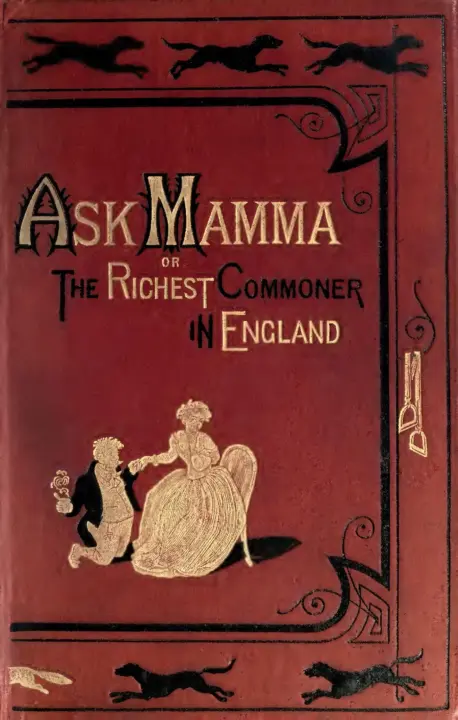
THE CLASSIC COLLECTION · 1858
"Ask Mamma; or, The Richest Commoner In England" by Robert Smith Surtees is a novel written in the mid-19th century. The story centers around Billy Pringle, who aspires to be seen as a gentleman, despite his humble origins as part of a trading family. As he navigates social situations filled with humor and satire, themes of ambition, social class, and identity emerge. The opening of the novel introduces us to Billy Pringle, fondly referred to as "Fine Billy," who is characterized by his attempts to embody gentility despite his humble background. The narrative provides a glimpse into his interactions with various members of his family, revealing their dynamics and his desire to fit into a more affluent social circle. We also meet Miss Willing, a lady's maid with aspirations of her own, who captures Billy's attention during a coach journey. Their budding acquaintance sets the stage for the humorous and often absurd twists of social class and romance that will unfold throughout the story.
Introduction adapted from the source catalogue; source summaries may be automatically generated.
Free to read · English · 179,335 words · No account needed
MAKE TIME FOR A GOOD BOOK
On by default. Untick to stop anonymous reading totals. Each page counts after 10 seconds in view. How this works.
Anonymous counting is on unless you have switched it off.
While this interesting operation was proceeding, the old dandy host produced his snuff-box, and replenishing his nose passed it on to Broadfurrow to send up the table, while he threw himself back in his chair and made a mental wager that Strong would make a mistake between the Champagne and the Sillery. The glasses being duly distributed, and the Major’s eye at length caught, our host after a prefatory throat-clearing hem thus proceeded to address him, individually, for the good of the company generally.
“Major Yammerton,” said he, “I will take the liberty of recommending a glass of Sillery to you.—The sparkling, I believe, is very good, but the still is what I particularly pride myself upon and recommend to my friends.”
“Strong!” continued he, addressing the clown, “the Sillery to Major Yammerton,” looking at Strong as much as to say, “you know it’s the bottle with the red cord round the neck.”
The Major, however, like many of us, was not sufficiently versed in the delicacies of Champagne drinking to prefer the Sillery, and to his host’s dismay called for the sparkling-stuff that Wotherspoon considered was only fit for girls at a boarding school. The rest of the party, however, were of the Major’s opinion, and all glasses were eagerly held for the sparkling fluid, while the Sillery remained untouched to the master.
It is but justice to Wotherspoon to add, that he showed himself deserving of the opportunity, for he immediately commenced taking two glasses to his guest’s one.
That one having been duly sipped and quaffed and applauded, and a becoming interval having elapsed between, Mr. Wotherspoon next rose from his chair, and looking especially wise, observed, up the table “that there was a toast he wished—he had—he had—he wished to propose, which he felt certain under any—any (pause) circumstances, would be (pause again) accepted—he meant received with approbation (applause), not only with approbation, but enthusiasm,” continued he, hitting off the word he at first intended to use, amid renewed applause, causing a slight “this is my health,” droop of the head from the Major—“But when,” continued the speaker, drawing largely on his snuff-box for inspiration, “But when in addition to the natural and intrinsic (pause) merit of the (hem) illustrious individual” (“Coming it strong,” thought the Major, who had never been called illustrious before,) “there is another and a stronger reason,” continued Wotherspoon, looking as if he wished he was in his seat again—“a reason that comes ‘ome to the ‘earts and symphonies of us all (applause). (“Ah, that’s the hounds,” thought the Major, “only I ‘spose he means sympathies.”) “I feel (pause) assured,” continued Mr. Wotherspoon, “that the toast will be received with the enthusiasm and popularity that ever attends the (pause) mention of intrinsic merit, however (pause) ‘umbly and inadequately the (pause) toast may be (pause) proposed,” (great applause, with cries of no, no,) during which the orator again appealed to his snuff-box. He knew he had a good deal more to say, but he felt he couldn’t get it out. If he had only kept his seat he thought he might have managed it. “I therefore,” said he, helping Mrs. Broadfurrow to the sparkling, and passing the bottle to her husband while he again appealed to the Sillery, “beg to propose, with great sincerity, the ‘ealth of Her most gracious Majesty The Queen! The Queen! God bless her!” exclaimed Wotherspoon, holding up a brimming bumper ere he sunk in his chair to enjoy it.
Your reading position is saved on this browser. Take it to another device with a library code. Reading pages adapt to text, rather than matching a printed edition.
BEHIND THE BOOK
This eBook is for the use of anyone anywhere in the United States and most other parts of the world at no cost and with almost no restrictions whatsoever. You may copy it, give it away or re-use it under the terms of the Project Gutenberg License included with this eBook or online at www.gutenberg.org. If you are not located in the United States, you will have to check the laws of the country where you are located before using this eBook. Read the source licence.
The original source file, including credits and licence, is retained by this library. Request an original-format copy at no charge. Please include the book title and Project Gutenberg identifier #44822.
KEEP YOUR CURIOSITY GOING
Coulson Kernahan

Maurice Baring
Frances Wright
Cécile Tormay

Frederic Jesup Stimson

W. H. P. (William Henry Pope) Jarvis